Meet Ava Grace Cummings, the 18-year-old North Carolina student who modelled STAC3 disorder, a rare hereditary muscle disease first identified in the Lumbee Tribe, in fruit flies and won $175,000 from Regeneron
Rest of World News: Ava Grace Cummings, an 18-year-old from North Carolina, wins $175,000 in the Regeneron Science Talent Search for her groundbreaking research on STAC3 disorder, a rare muscle disease in the Lumbee tribe, using fruit flies for potential new therapies.
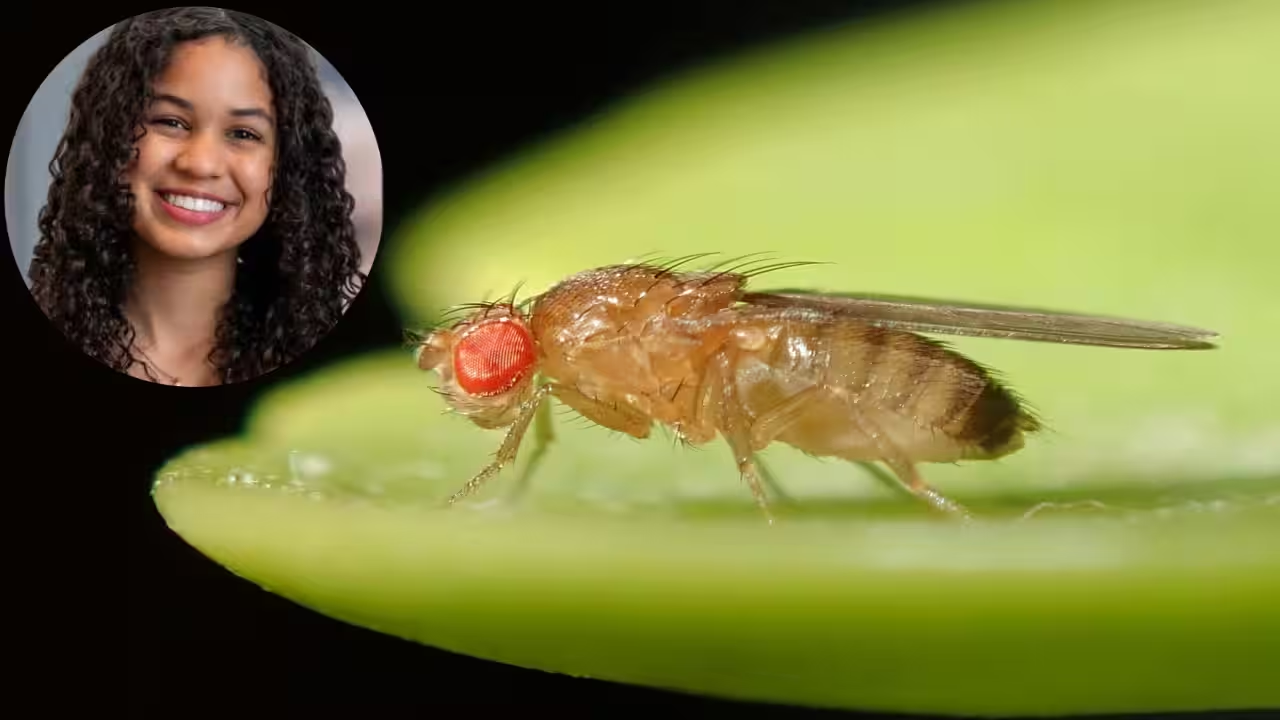
The Regeneron Science Talent Search is described by the Society for Science as the nation's oldest and most prestigious science and maths competition for high school seniors. It makes sense that most projects address issues that are somewhat unrelated to the researcher's personal life. Ava Grace Cummings made the opposite decision. The senior from Smithfield, North Carolina, who is eighteen years old, based her research on an illness she had personally witnessed in the faces of people she knew.Cummings, a member of the Lumbee and Coharie tribes, won second place and $175,000 in the 2025 competition for a study that used laboratory fruit flies to model STAC3 disorder, a rare genetic muscular condition. The flies were then used to test alternative therapies, including one based on traditional Indigenous herbal medicine.A sickness deeply ingrained in her own cultureFormerly known as Native American myopathy, STAC3 disorder is a congenital ailment that lowers muscle tone from birth and can cause joint stiffness, a cleft palate, a bent spine, and a potentially fatal reaction to some anaesthetic medications. It was initially identified in babies from the Lumbee tribe of North Carolina in the late 1980s, and it was subsequently linked to a single genetic mutation that was inherited among the group. GeneReviews estimates that STAC3 disorder affects about one in 5,000 Lumbee Native Americans. The condition has also been identified in other populations, including patients in southern Africa.For Cummings, STAC3 disorder was never an abstract condition. She told the Society for Science that seeing friends and family in the Lumbee Tribe struggle with the disease motivated her to raise awareness and look for potential treatments. There is no cure for STAC3 disorder, making the search for possible therapies an important part of her project.Turning fruit flies into a model of disease in actionTo study the rare muscle condition without human patients, Cummings turned to Drosophila. The fruit fly is widely used in genetics research because its short life cycle makes it possible to alter genes and observe changes over a relatively short period. Cummings created a strain of flies that did not express the dstac gene, the fly counterpart of the gene disrupted in STAC3 disorder. The resulting flies showed muscle-weakness traits that allowed her to model the condition in the laboratory.Armed with a workable model, she investigated two prospective therapies. One was Tirasemtiv, an experimental drug being studied for its effects on muscle contraction and neuromuscular function. The other was stinging nettle, Urtica dioica, a plant that many traditional herbal medicines employed, some of which her tribe used. She tested affected adult flies by measuring how well they climbed the walls of a test vial, while the larvae were assessed by the distance they travelled. Flies treated with nettle extract alone climbed better, while the larvae also travelled farther than untreated groups. The combination of nettle extract and Tirasemtiv produced the strongest improvement among the treatments tested.Connecting Two Medical SystemsRather than seeing Indigenous medicine and pharmaceutical research as two separate worlds, Cummings considers her study an attempt to bring the two into parity. She has said she hopes her study will bring greater attention, funding and therapeutic interest to illnesses that impact small, unique populations and are otherwise easily overlooked by the broader medical research system.During high school, she attended the North Carolina School of Science and Mathematics in Durham, where she founded and led the school's Natives Rising chapter. She also plays the piano, is a member of her school soccer team and serves as a resident life advisor. Cummings' second-place finish was also part of a notable milestone for the competition. Alongside fourth-place winner Logan Lee, a Native Hawaiian student, she was one of two Indigenous students to receive a top-10 prize in the 2025 Regeneron Science Talent Search. Native America Calling reported that it was the first time two Indigenous students had received top-10 awards in the competition's 83-year history.Catch the latest World News and Live updates. Download the TOI app.
Topics in this story
Gathered from external sources. Rights to this text belong to whoever originally published it.