In 2021, British sculptor Jason deCaires Taylor submerged six giant faces off Cannes; the degraded seabed became a free museum later linked to Posidonia seagrass restoration.
Rest of World News: Discover the unique underwater museum created by British sculptor Jason deCaires Taylor near Cannes, France. This innovative project features giant submerged faces and aims to revitalize marine life and Posidonia seagrass through art and ecological restoration.
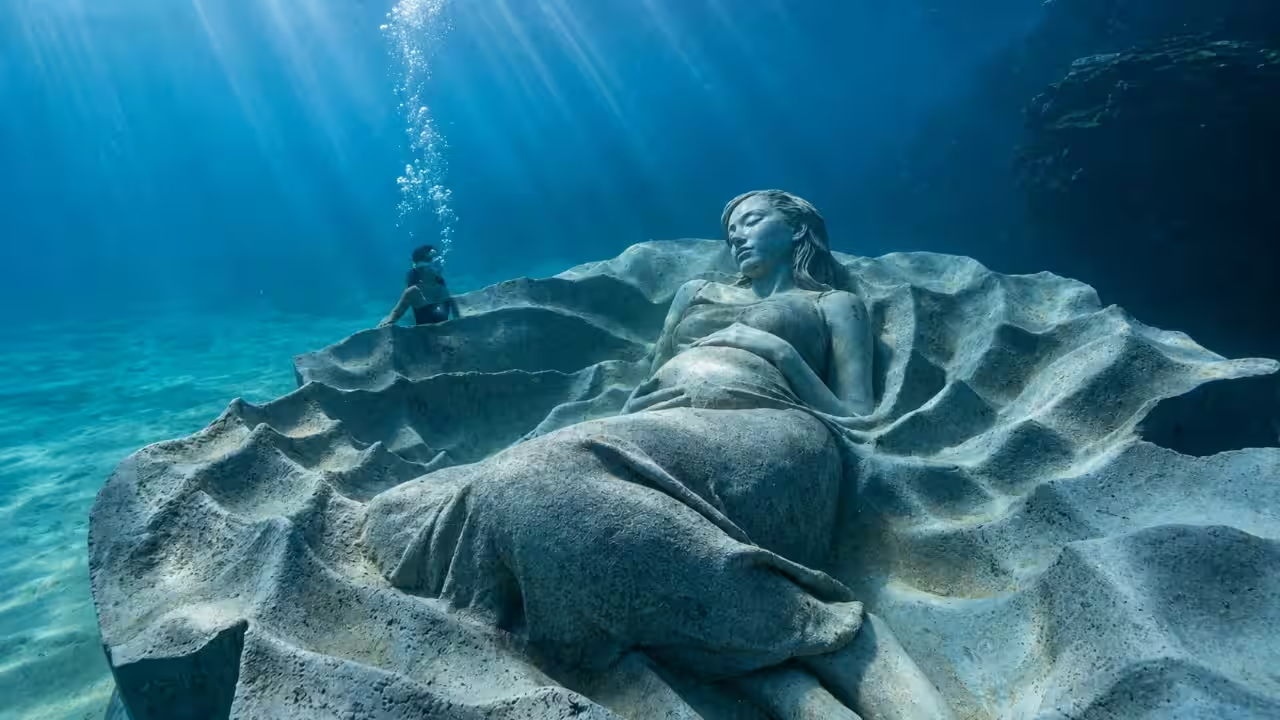
In 2021, six enormous faces appeared beneath the Mediterranean off Cannes, France, where visitors could swim over an underwater museum instead of walking through galleries. Created by British sculptor Jason deCaires Taylor, the two-metre-tall sculptures were lowered into the sea near Île Sainte-Marguerite, transforming an environmentally degraded patch of seabed into an unusual meeting point between art and marine conservation. The project was designed not only to give Cannes a new cultural attraction, but also to encourage marine life to return to the area.According to the City of Cannes, the six sculptures were submerged on January 28, 2021, near Île Sainte-Marguerite, at depths of 3 to 5 metres and between 84 and 132 metres from the shore, making them accessible to snorkellers. Each two-metre-high sculpture weighs about 10 tonnes and was made from an ecological, pH-neutral marine material designed to provide refuge for underwater life and eventually function as an artificial reef.From Cannes residents to underwater sculpturesThe artist did not create imaginary faces for the exhibition. Instead, he made moulds of faces belonging to local Cannes residents. During a temporary workshop in 2018, Taylor and his assistants made 45 casts from volunteers, from which six people were selected as models for the sculptures. The chosen participants represented a range of ages and occupations, including a fisherman, student, schoolgirl and cultural mediator, giving the installation a strong connection to the local community without suggesting that six individuals represent the entire townBut the sculptures were never intended to remain pristine artworks. From the outset, their rough surfaces and small cavities were designed to provide places where marine organisms could attach and where fish and shellfish could find shelter. The City of Cannes says the structures were created to evolve into artificial reefs, with algae, shells, corals and benthic fauna gradually colonising their surfaces and becoming part of the local ecosystem. That transformation is no longer merely a future expectation. In 2024, the city reported that all six sculptures had been fully colonised by marine biodiversity, with algae and shells covering their surfaces. The museum was therefore designed as a living installation, where biological growth is part of the artwork rather than something to be removed.Why Posidonia matters beneath the museumHowever, the environmental narrative goes beyond these six sculptures. Previously, the area was quite degraded, and the whole project was designed to attract the return of marine life and plant forms. Posidonia oceanica is the native seagrass of the Mediterranean, which plays an important role since its meadows serve as habitat for marine creatures and contribute to carbon dioxide storage.Research published in Marine Pollution Bulletin identified 25 ecosystem services associated with Posidonia oceanica meadows, including benefits linked to biodiversity, fisheries and coastal environments. The study also highlighted the continuing regression of these meadows despite their protected status, underscoring why protecting and restoring them has become an important Mediterranean conservation goal. The Cannes project has since moved beyond simply placing sculptures on the seabed. In 2024, the city announced the PRIME programme, led by the association NaturDive, to replant 3,000 square metres of Posidonia meadow over three years around the underwater museum. Cannes described the museum site as a suitable laboratory for the restoration experiment because the sculptures had already become colonised by marine biodiversity. This distinction matters as the sculptures themselves were designed to provide habitat and encourage marine life, but the later Posidonia planting is a separate restoration programme. It would therefore be inaccurate to say that the six faces alone restored the seagrass meadow. Instead, the museum has become part of a broader effort to rehabilitate a damaged coastal environment.When art becomes part of the ecosystemThe Cannes experiment reflects a growing interest in combining public art with ecological restoration. Rather than building an underwater attraction and leaving the surrounding environment untouched, the project created structures intended to be gradually absorbed into the marine landscape. Research published in Science of the Total Environment reviewed restoration efforts involving Posidonia oceanica and found that active restoration can help accelerate recovery, but also stressed that the species grows slowly and that restoration methods need to be matched to local conditions. The review called for more field experiments and a better understanding of which techniques work under different environmental circumstances. That makes Cannes’ approach particularly interesting. The museum is free to visit, the sculptures sit in shallow water, and boats are prohibited from anchoring in the protected area. The result is intended to serve two purposes at once: give people an accessible way to experience marine conservation and reduce pressure on the habitat around the artworks.These six faces thus acquire an existence which goes beyond their artistic function. They started as casts of people from Cannes, but then underwent the process of becoming giant-sized sculptures that were submerged into the seabed. Now that they have been there for some time, algae, shells and other life forms have already started to grow on them, while in the meantime another restoration project is working towards returning Posidonia to the water around them. For Cannes, the biggest change that the museum will undergo might just be that which cannot be seen from the gallery floor.Catch the latest World News and Live updates. Download the TOI app.
Topics in this story
Gathered from external sources. Rights to this text belong to whoever originally published it.