In 1951, an English couple moved with four children to roadless Three Hummock Island; they stayed until 2006 as most of its 7,400 hectares became protected
Rest of World News: Discover the remarkable journey of the Alliston family who lived on Three Hummock Island, Tasmania, for 55 years, shaping its transformation from a pastoral settlement into a protected ecological haven spanning 7,400 hectares.
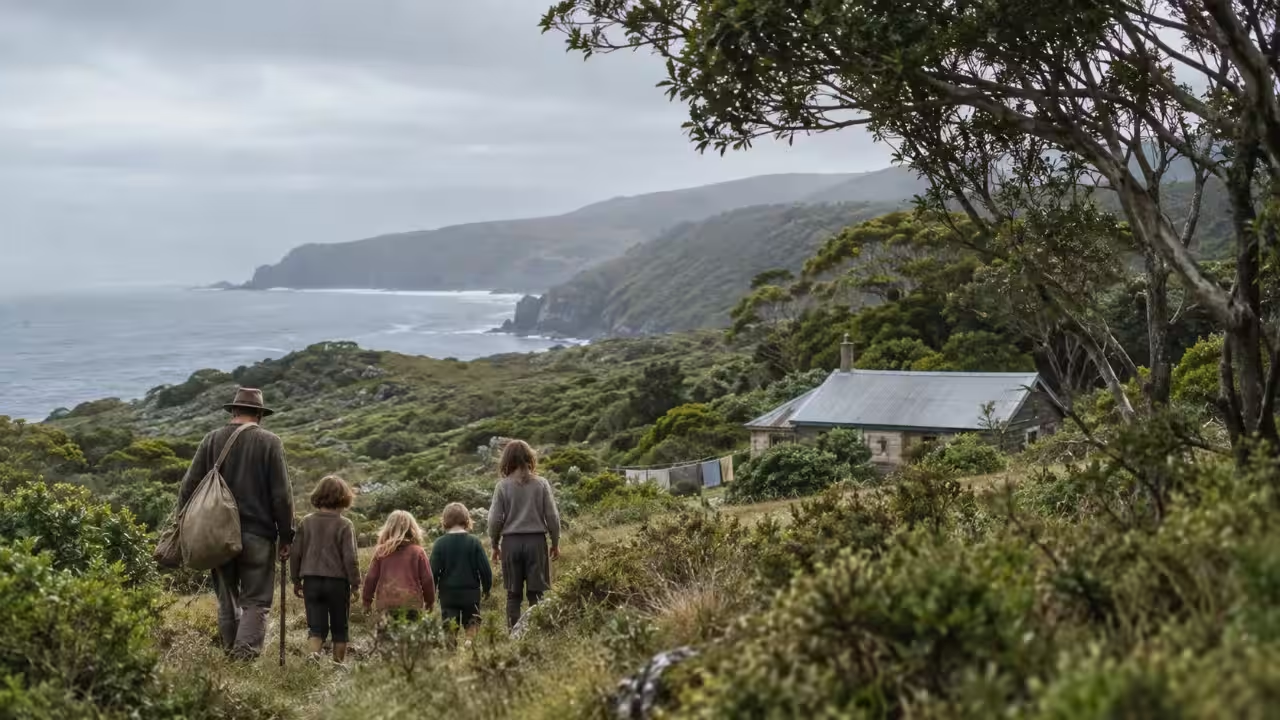
In 1951, an English couple moved with their four children to a remote island in Bass Strait, off north-west Tasmania, to build a life far from mainland routines. John and Eleanor Alliston settled on Three Hummock Island, a roadless landscape where supplies, transport and communication were difficult, and daily life depended heavily on self-reliance. They lived on the island for 55 years, while the surrounding landscape gradually shifted from a working settlement toward formal conservation.According to the history of Three Hummock Island, the island covers about 7,400 hectares and forms part of the Hunter Island Group in western Bass Strait. It takes its name from three prominent hills, the highest rising to about 237 metres. Its landscape includes beaches, lagoons, swamps, woodland and coastal scrub, providing habitat for a variety of birds and other wildlife. Most of the island was declared a nature reserve in 1978, while its protected status was strengthened when it became a State Reserve in 2001.A family life far from the mainlandThe Allistons arrived when Three Hummock Island was still associated with pastoral activity. They took over from the Nichols family, who had previously operated a farm there, and made their home at Chimney Corner. Their four children, Venetia, Robert, Warwick and Ingrid, spent part of their childhood in a place without ordinary roads or urban conveniences. Isolation was part of everyday life. Farming was physically demanding, while supplies and travel to and from the mainland depended on boats or aircraft. Weather could disrupt those connections, making careful planning and a degree of self-sufficiency essential.Eleanor Alliston later recorded the family's experiences in her books Escape to an Island and An Island Affair. Her accounts provide a rare personal perspective on raising children in such a remote environment and adapting to the practical demands of island life. The family's long connection to Three Hummock Island is documented as part of the island's history, with the Allistons spending about 55 years there after arriving in 1951. By the end of that period, the island had undergone a major change in its official status and purpose.A landscape shaped by settlementThree Hummock Island's environmental history is more complex than that of an untouched wilderness. European settlement introduced grazing, clearing and fires that changed sections of the island's vegetation. Scientific surveys have since documented the effects of those changes. According to research published in Papers and Proceedings of the Royal Society of Tasmania, a botanical survey recorded 289 vascular plant species on Three Hummock Island, including 60 introduced species. The researchers also identified six native plants regarded as rare or vulnerable. Much of the island's former Eucalyptus viminalis forest had disappeared, with grazing, fire and other human influences contributing to changes in vegetation. The findings illustrate how even a remote island can carry a long record of human influence. Its ecological character is shaped not only by wind, storms and natural succession but also by decades of farming and land management.From remote settlement to protected landscapeInstead, it placed that history within a landscape increasingly managed for its ecological value. Three Hummock Island became a State Reserve in 2001, strengthening its place within Tasmania's protected-area system. The protected landscape contains a mixture of coastal and inland habitats. Research has shown that its vegetation includes extensive areas of scrub and woodland, while its beaches and wetlands provide habitat for birds and other wildlife. The island has also been recognised as an important breeding area for species including Cape Barren geese and other seabirds.The Allistons did not simply visit a remote wilderness; they lived there through changing seasons, difficult transport and the gradual transformation of the island's official role. During their years on Three Hummock Island, its importance increasingly shifted from a remote pastoral outpost towards a protected natural landscape. Its remoteness, challenging conditions and distinctive habitats became part of the case for protecting the island. For the Allistons, however, Three Hummock Island was first a home. Their move there in 1951 created a way of life few families would have experienced, and more than half a century later, their story remained closely tied to the island's transformation from an isolated settlement into a protected landscape.Catch the latest World News and Live updates. Download the TOI app.
Topics in this story
Gathered from external sources. Rights to this text belong to whoever originally published it.