The whole street was in flames: Inside the West Midlands wildfire disaster
Harrowing 999 calls and eyewitness accounts tell the story of a day authorities say must not reoccur.
It is 13:00 BST on the hottest day of the year and five engines are speeding towards a grass fire in Birmingham.
Temperatures are creeping towards 38C and it has been yet another busy morning at West Midlands Fire Control.
But within minutes, the switchboard is jammed with panicked calls about wildfires in fields and parks that are moving dangerously close to homes.
"We had 20-plus 999 calls in a queue," recalls control room firefighter Lauren Nightingale.
"It was busy, bordering on uncomfortable – and then extreme."
Intense heatwaves and weeks without rain have left the ground tinder dry and multiple fires have started simultaneously.
"Within 10 minutes, we were experiencing conditions that were well and truly out of the norm," Nightingale, aged 29, says.
Before the day is out, she and her colleagues will deal with almost 2,000 calls, more than triple the number taken on the same day the previous year.
Holly, 14, is home alone in Stourbridge playing Roblox on her iPad. She is still in her pyjamas – it is the summer holidays – and her curtains are shut.
Her mum and sister are 140 miles away with friends in Minehead and her mum's partner is at work. Holly is chatting on her mobile to a friend when the house alarm begins to blare.
Unsure what to do, she calls her mum, who tells her to find a fob to turn it off.
But when she goes downstairs she sees her neighbours are in the street and that the sky has changed from bright blue to "orange and flickering".
"And that's when I started to get really scared," she says.
An accidental fire sparked by farming machinery has spread across fields, railway tracks, Stourbridge golf course and is now in people's gardens.
Farmers have tried to douse the flames and create fire breaks, but thick, black smoke is filling the air and closing in on homes.
Mobile phone footage shared with the BBC shows motorists stranded in the street, watching in horror.
In one, a tearful mum inside a car can be heard telling police her children are at a house in Covert Lane, near the rapidly advancing wildfire.
Holly is frozen in panic as clumps of ash rain from an apocalyptic sky.
"I was too scared to go outside because at that point you couldn't see the street. It was all just fog and smoke and ash," she says.
A three-hour drive away, her mum Anna collapses when she realises the danger her child is in.
Frantic, she sends relatives to take Holly to safety and instructs the hysterical teenager to get dressed, grab their dogs and pet tortoise and get out.
A police officer escorts them away and tells her not to look back, but she cannot help it.
Seven fire engines are dispatched to Stourbridge, where a major incident is declared as commanders realise the scale of the chaos.
Significant wildfires are also raging in parts of south Birmingham and near homes in Stoke-on-Trent, so many appliances are committed elsewhere.
When the major incident is declared, it is taking the fire service 43 minutes to attend a single call. The aim is usually five.
When he arrives on Holly's street, Bournbrook Blue Watch commander Paul Bayliss sees a scene he has never witnessed in his 24-year career.
"It was almost like a tsunami of fire and smoke coming at us."
Sebastian Chauhan, 21, has been a firefighter for a year. He says hardened colleagues fell silent as they surveyed the scene.
"Their faces just go to kind of stone and [I was] thinking, 'OK, it's really kicking off now'," he says.
Desperate residents plead with the crew to save their house first.
"[I've] never had so many people wave at me and look to me for help."
The horizon is a wall of flames and embers the size of tennis balls are falling to the ground.
"It was like it was alive, moving by itself," Chauhan says of the fire.
Poor water pressure means the crew has to siphon water from the swimming pools of several properties in this affluent part of town.
Several firefighters keel over with heat exhaustion, including watch commander Bayliss, but they have to keep going.
"I just knew I had to get up because there was no-one else coming to help at that time," he says.
Bayliss asks for 10 fire engines, only to be told there are not enough available.
For 90 minutes, his team of five and another from Ladywood in Birmingham have to fight the impossible alone until two more crews can get there.
"There was one point where we had one appliance left," call handler Nightingale says.
"We didn't have the fire engines for the crews that needed them desperately at scene. And we didn't have them for the fresh calls either."
Distressed people are shouting down the phone at operators to get help.
"They're screaming at you at this point because they don't know why you've not come to them."
Loxie Williams, 78, is driving back home in Stourbridge after a morning out with husband Robin when they see the churning smoke.
Police stop them getting any closer and, peering through a gap between houses, they see the field directly behind their garden alight.
They decamp to her daughter's house where later, on the TV news, they see their home of 26 years burning down.
"It was a total inferno," she says. "It just couldn't connect. It was such a shock. I was aghast."
Just over 20 miles away in Warstock, Birmingham, a wildfire is ripping through more homes.
Leonie Cotterill yells at her terrified children, aged seven and nine, to get out, but they try to run back inside as they are pulled away.
"[My son's] scream will never leave me," she says.
Their house of 30 years is one of six on the street destroyed, along with multiple gardens.
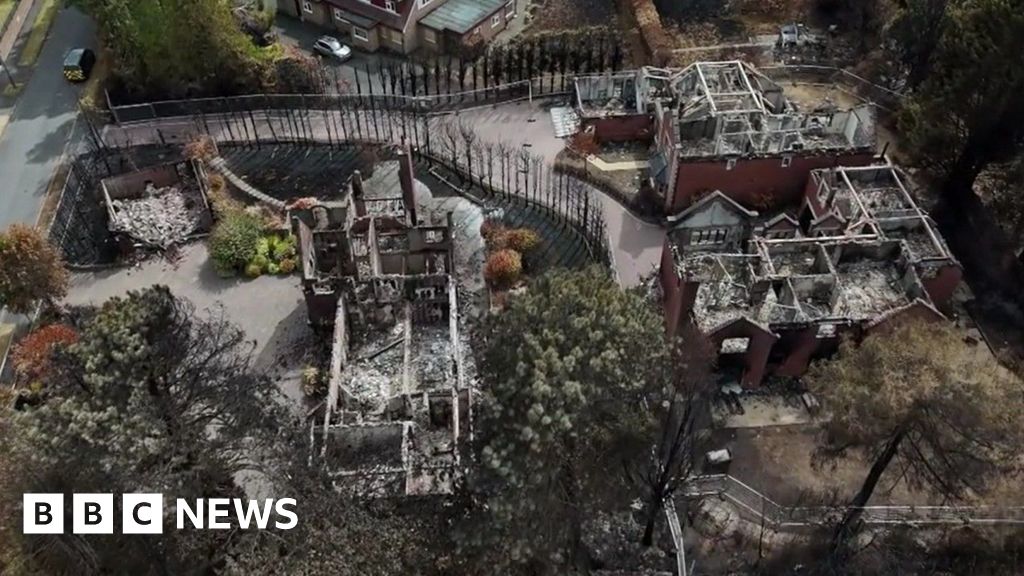
Chauhan's crew helps to save nine homes in Stourbridge, but 19 are lost across five streets and 18 are damaged.
The entire incident spans an area of about two miles and, eventually, more than 100 firefighters and 30 fire engines battle to contain it.
"If we weren't there, it could have been worse," Chauhan says.
Fires have also destroyed homes in other parts of Birmingham, Willenhall, Stoke-on-Trent and Pershore in Worcestershire, bringing the total to 38.
"It was an extraordinary day and completely unprecedented," says West Midlands chief fire officer Simon Tuhill, who was on the scene in Stourbridge.
"Standing in that road and trying to help colleagues as they made really difficult decisions, prioritise, making sure as many houses were evacuated and looking after as many residents as possible, the enormity of it hit me.
"It's been quite hard to process just how difficult it was."
Tuhill, who has since called for more specialist resources to fight wildfires, such as 4x4 vehicles and aerial firefighting capability, has welcomed Prime Minister Andy Burnham's pledge to hold a wildfire summit to discuss equipment and resources.
Burnham has promised to be "better prepared next time" and reiterated the summit will be held in the coming weeks.
"We shouldn't live through another summer like the one that we just have," Burnham says.
Dr Kerryn Little, a pyrogeography researcher at the University of Birmingham, researches how wildfires start and spread.
She says the fires came at a time when the landscape was "primed to burn" as a result of the changing climate and "any spark was going to lead to a wildfire".
"I believe that the UK is decades behind other countries in the world, it's really been quite shocking," Little says.
"I think the one good thing about this year is that people are becoming more aware, particularly at a government level, where we really need investment in wildfire preparedness."
Holly and Anna have a very lucky escape. Their house survives almost unscathed, while three neighbouring ones are gutted.
When the teenager returns home, the street appears "dystopian", she says, and she feels incredibly guilty.
"Why is our home here and theirs is all gone? It's just, it's devastating."
She says she no longer opens her curtains.
"I have a view of the whole garden from my window and it's really strange, just like seeing everything so different after 10 years of it always being the same."
When Nightingale finishes her shift and sees photos of the wreckage across Stourbridge, she feels "almost slightly responsible".
"It's definitely the worst day that any of us have experienced, 100%," she adds.
"Ultimately, we're just very grateful that the situation didn't turn out in a death and we're just very, very grateful to the crews for what they did to prevent that."
Follow BBC Birmingham on BBC Sounds , Facebook , X and Instagram .
Lives 'will be lost' unless UK does more to combat wildfires, committee chairwoman says
What can be done to reduce risk of wildfires?
Multiple fires destroy homes and cause devastation in West Midlands
What we know so far about the West Midlands fires
'Words cannot describe losing our home in Stourbridge wildfire'
Topics in this story
Gathered from external sources. Rights to this text belong to whoever originally published it.