In 2007, an Australian geologist browsing Google Earth spotted an 850-foot circle in the outback; drilling later confirmed an iron-meteorite crater
Rest of World News: In 2007, Australian geologist Arthur Hickman identified a mysterious 850-foot circle in Western Australia's outback via Google Earth, leading to the discovery of Hickman Crater, one of Australia's youngest impact craters, confirmed through extensive drilling and analysis.
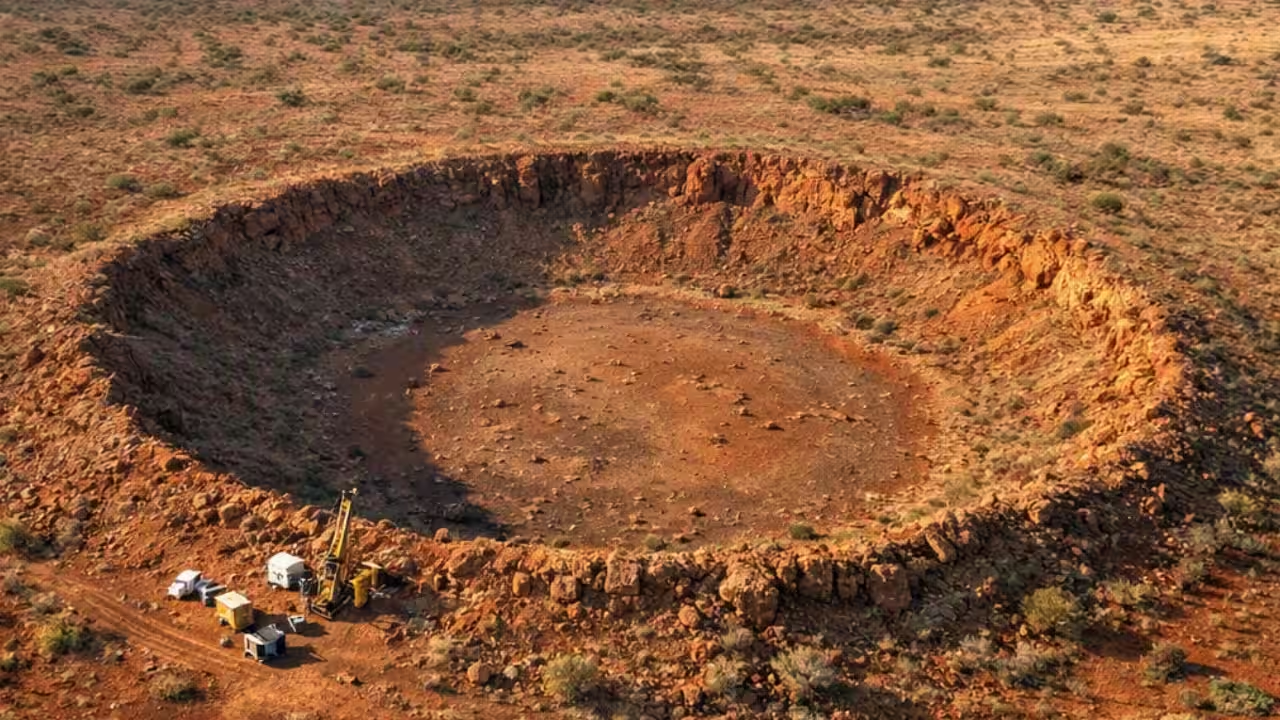
In July 2007, a geologist scrolling through satellite images of Western Australia noticed a near-perfect circle in the outback. At the time, Arthur Hickman of the Geological Survey of Western Australia did not know he was looking at an impact crater, one that was later found to be among the youngest in Australia.A 260-metre crater in the PilbaraA study from the Australian Journal of Earth Sciences found that the size of the structure was around 260 metres (around 850 feet). The structure has been described by Australian Geographic as being the latest meteorite crater structure that has been discovered in Australia. This structure has been informally named the Hickman Crater.What the 2008 paper concludedThe first detailed published analysis came in the paper Hickman Crater, Ophthalmia Range, Western Australia: evidence supporting a meteorite impact origin, published in the Australian Journal of Earth Sciences. Authors Glikson, Hickman and Vickers reported a mean crater diameter of 260 metres. The lack of fragments from young volcanics younger than the Woongarra Rhyolite was not consistent with the explosive volcanic mechanism. Instead, the authors concluded that an impact had occurred, likely from a projectile about 10 metres wide that excavated a crater roughly 80 metres deep. It was dated to the Late Pleistocene period, with an age of between 10,000 and 100,000 years, due to the damming effect of the southern margin on a nearby creek.Why GSWA drilled in 2012Field evidence was not enough to raise a certainty. According to a 2017 news release from the Department of Mines, Industry Regulation and Safety (DMIRS), the Geological Survey of Western Australia ran the 2012 drilling project with Atlas Iron, which was already working in the area, to confirm early suspicions that the structure was a meteorite impact crater. Those results are laid out in the study Collaborative scientific drilling at Hickman Crater by P. W. Haines. The study describes a circular rim about 260 metres across that rises to 30 metres above a flat floor. The depth of the hole, drilled vertically in the aforementioned floor, was 64.7 metres. According to the 2012 drill core, the upper 48.4 metres is sediment that accumulated in the crater after it formed. At depths between 55.1 and 64.7 meters, there was very fractured rhyolite, which was the original bedrock.The crucial piece of evidence was chemistry. Ratios of platinum group elements in the breccia resembled those of meteorites much more than the ratios in the average continental crust, meaning a considerable meteoritic content. High nickel concentration indicated an iron meteorite. According to Haines, iron projectiles are the most common type to form small, simple craters like this one, even though chondrites are more common among meteorite falls overall, since stony projectiles of this size usually break up in the air.Why the impact left little shock damageHaines suggests that the projectile, estimated at about 10 metres across, may have been slowed significantly by the atmosphere before impact, which could have reduced shock pressures below the level needed to form the diagnostic planar deformation features while still leaving enough energy to excavate the crater. As has been suggested by Haines, the object may have been small enough to decelerate within the Earth's atmosphere before impact. As noted above, this appears to be the first scientific drill hole in a simple crater less than one kilometre in diameter in Australia, and possibly elsewhere.Catch the latest World News and Live updates. Download the TOI app.
Topics in this story
Gathered from external sources. Rights to this text belong to whoever originally published it.