After retiring and moving to Phoenix in the early 1950s, Grover Thompson spent 22 years building a rock garden filled with hundreds of figures, miniature buildings, windmills and fountains
Explore the fascinating journey of Grover Thompson, who transformed his retirement into a vibrant rock garden filled with hundreds of whimsical figures, miniature buildings, and fountains in Phoenix. Discover the history and preservation efforts of this folk art site.
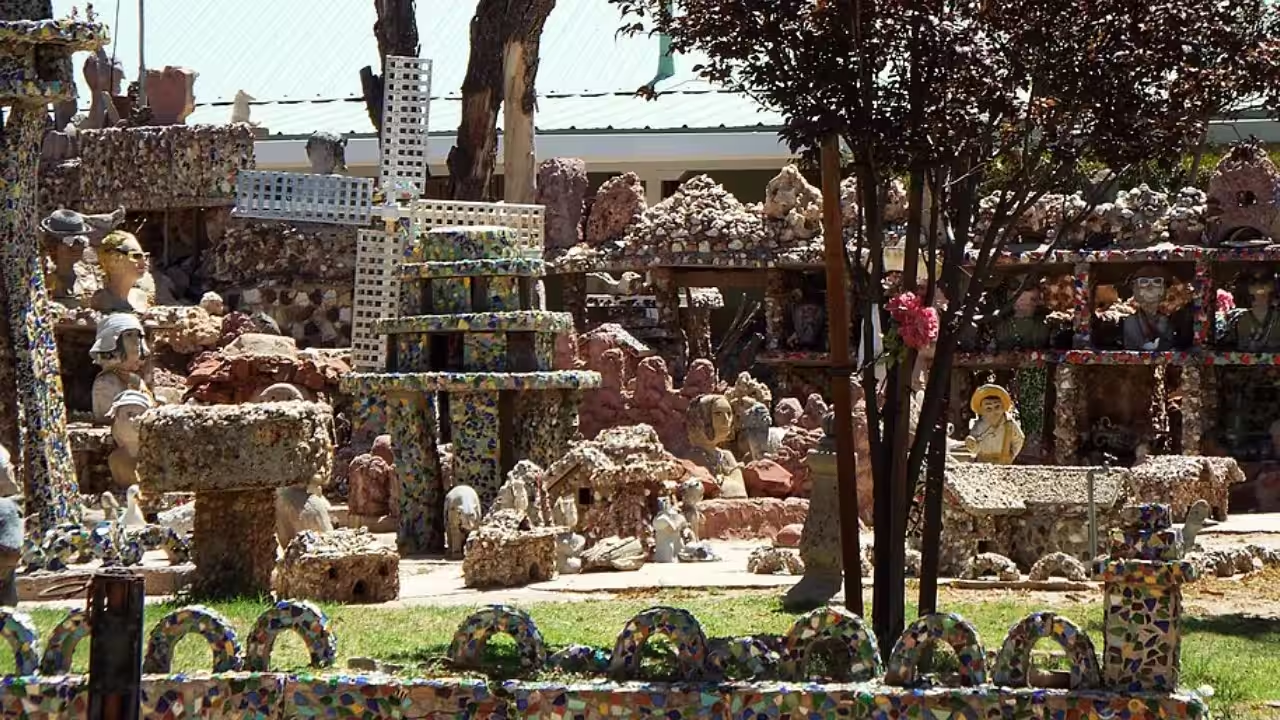
Sunnyslope is a mountainside neighborhood in north Phoenix. On one residential street, the front yard of a private home is filled with windmills topped with colorful mosaics, small concrete figures and rock fountains. Phoenix New Times notes that much of it can be seen from the street. The garden is the work of Grover Cleveland Thompson, a retired heavy-equipment operator who built it over two decades. It is a private property and not a public park, yet it has a long record of visitors, advocates and local attention.Thompson’s retirement to Sunnyslope in 1952 The SPACES Archives entry Sunnyslope Rock Garden, written by Jo Farb Hernández, says Thompson retired and moved to the neighborhood in 1952. He began a massive environment of rocks and concrete, ornamented with natural and man-made found objects and worked on it for 22 years. The entry says he was inspired by Petersen Rock Garden in Bend, Oregon, near where he used to live. The Minnesota Museum of the Mississippi page Sunnyslope Rock Garden, Phoenix, Arizona places the move around 1953, when Thompson and his second wife, Nancy, bought a patch of undeveloped land in Sunnyslope. Sources therefore differ by a year on his arrival.Fiestaware shards and Halloween-mask faces as inexpensive materialsThe above-mentioned SPACES entry states that most of the characters are painted in bright colors since Thompson used pieces of Fiestaware for their cheap decoration. The entry further claims that many of the faces were created using the old Halloween masks as molds. The Phoenix New Times confirms the information about the masks, stating that he poured concrete into the Halloween masks from the 1950s and lists pottery, broken bottles, glass pieces, clay and rocks among the materials used. According to ABC15, Julia Taggart of the Sunnyslope Historical Society claims that the neighbors used to leave pottery and china outside his mailbox and he would use them in his garden the next day.Seven fountains and seven windmills reported by Phoenix New TimesOver 22 years, Thompson constructed seven fountains, seven windmills and a model of the Seattle Space Needle, Phoenix New Times reports. At its peak, SPACES says, the garden contained several hundred figures, miniature buildings, windmills and fountains, while Roadside America gives a more modest tally of over 50 mosaic-clad structures, including Dutch windmills, a ziggurat, a wishing well and a miniature cliffside pueblo. Sources also disagree on the height of the Space Needle replica, which Roadside America puts at nine feet and a 2002 Phoenix New Times feature at 12 feet. Even so, all sources agree about the nature of the garden, a crowded miniature landscape of buildings and cultural icons.Work stopped in 1974 as Thompson’s health failedPhoenix New Times explains that the expansion stopped in 1974 due to Thompson's failing health. He died in the late 1970s, with the museum site giving the fall of 1977 and SPACES giving 1978. The museum site adds that the garden would probably have been forgotten after his death but for a stroke of luck that led to its sale.Marion Blake’s purchase in 1979 According to SPACES, the house was purchased in 1979 by Marion Blake, who is a native of New York. The museum states that Blake obtained the house and garden from Cloydene, Thompson’s daughter, on the condition that she keep it safe and she went on to care for it for more than four decades. She made sure that cracks in the cement were fixed and that the delicate sculptures were preserved during storms.The City of Phoenix staff report Phoenix City Staff Report Z-94-24-3, dated September 6, 2024, requests Historic Preservation overlay zoning for the Thompson Rock Garden. The report states that the property was first identified in the 1979 Phoenix Historic Building Survey and that the Historic Preservation Commission began the designation process on June 17, 2024. It also describes the garden as one of only two folk art sites in Phoenix, the other being the Louis Lee Rock Garden.The commission adopted its recommendation at its September 16, 2024 meeting, as its results notice shows and Phoenix approved the overlay zoning in December 2024, which the museum page says made the garden a designated historic site. ABC15 reports that more than 300 people supported the decision.Visiting the garden todaySPACES states that the garden is usually open to visitors on the first Friday of each month and that parts of it can be seen from beyond the perimeter fence, a description the museum webpage echoes. Since it is private property, visitors are encouraged to check the opening times beforehand.You use AI every day. Now get your AI Quotient. Take the AIQ test.
Topics in this story
- Phoenix Rock Garden
- Grover Thompson
- Sunnyslope neighborhood
- Historic preservation
- folk art
- Grover Thompson rock garden
- Sunnyslope neighborhood Phoenix
- miniature buildings windmills fountains
- Thompson Rock Garden
- Historic Preservation zoning Phoenix
- visiting rock garden Sunnyslope
- history of Thompson Rock Garden
Gathered from external sources. Rights to this text belong to whoever originally published it.