In 1977, a British sailor began walking at South America’s tip; around six years and 19,021 miles later, he reached Alaska after crossing the Darién Gap and war-torn Nicaragua
UK News: George Meegan's incredible journey from the southern tip of South America to Alaska took six years and covered 19,021 miles, facing unique challenges including the Darién Gap and a civil war in Nicaragua.
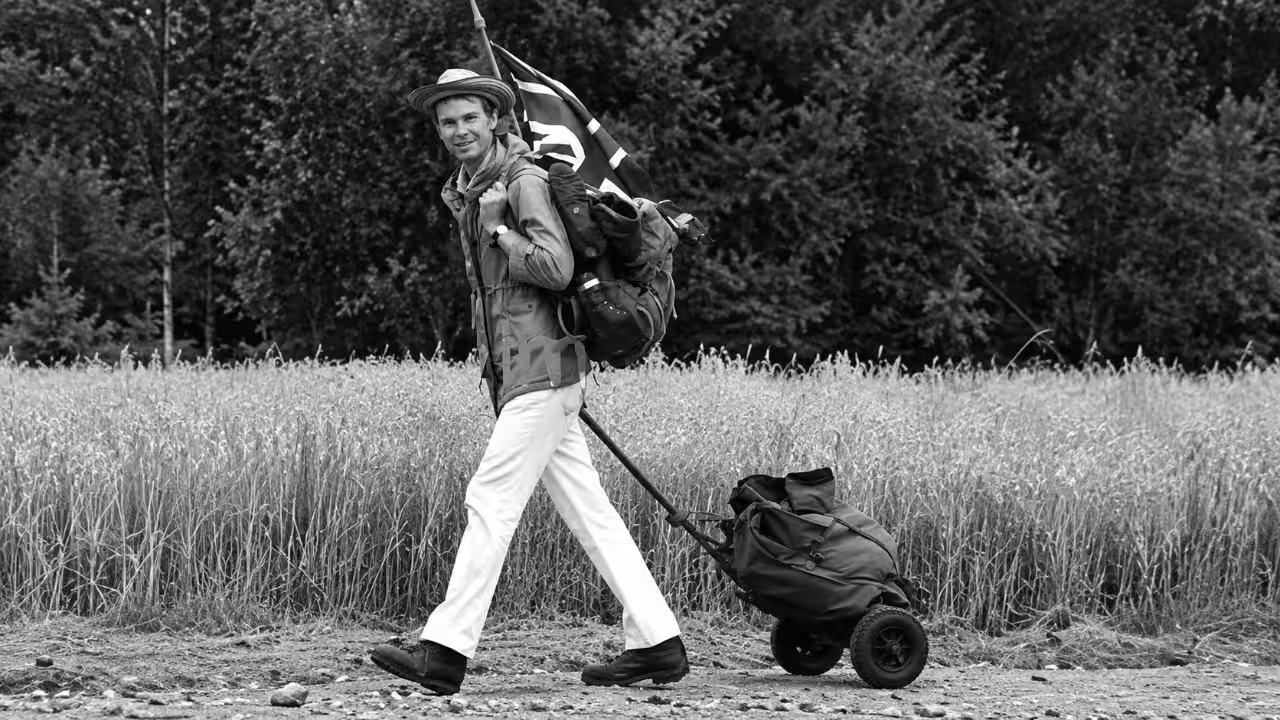
George Meegan was 24 when he stepped away from the southern tip of South America in January 1977 with an unusually ambitious destination in mind: Alaska. Meegan, a young British merchant sailor from Rainham, England, wanted to walk the length of the Western Hemisphere, a route that would take him through some of the most remote and politically unstable parts of America. He completed the journey in September 1983 after covering 19,019 miles on foot.According to The New Yorker, the idea began while Meegan was working aboard a British merchant ship. Looking at a map from his bunk, he became fascinated by the apparent closeness of the world's continents and wondered whether the distance could actually be covered on foot. He did not travel with a large support team. Meegan travelled largely without funding, carrying his belongings in a two-wheeled cart and relying on help from people he met along the way.From Tierra del Fuego into the DariénMeegan began his walk on January 26, 1977, in Ushuaia, Argentina, near Tierra del Fuego. From there, he headed north through South America, crossing countries including Bolivia, Peru, Ecuador and Colombia. He then reached the Darién Gap, a major natural barrier between Colombia and Panama, before continuing through Central America and into North America.The Darién Gap was unlike any terrain Meegan had crossed before. There were no roads through its rainforests, swamps and rivers connecting North and South America. Although he tried crossing during the dry season, Meegan still faced many water-related challenges. As The New Yorker described it, he had to wake early and collect water droplets from leaves.Walking through a country at warMeegan arrived in Nicaragua at a time when the country was facing some difficult political moments. This was after the Sandinista Revolution had removed Anastasio Somoza Debayle from power, plunging the country into civil war. Meegan came into Nicaragua just two days after the removal of Somoza. Being seen in public could arouse suspicion. Meegan was carrying a Swiss flag on his back, and he was stopped by the Sandinista soldiers as they thought that he might be an American posing as a Swiss citizen. He convinced them that he was British and was allowed through. After entering the U.S. in Brownsville, Texas, Meegan made an unusual choice. Instead of heading north, he detoured east across the South toward Florida before continuing north. This diversion added two years to the journey and took him farther along the Atlantic coast.The final miles to AlaskaHowever, by the time he had arrived in Canada, the journey had already become an experience that would change his life. While on the walk, he married Yoshiko and became a parent. He gave his children Japanese names related to walking. However, the last leg was not easy. Meegan reached the Canadian Yukon before continuing into Alaska. In September 1983, Meegan was near Prudhoe Bay, where he faced difficulties crossing oil-field land. At first, permission to pass through the Prudhoe Bay oil field was denied, but he eventually received it.According to UPI Archives, George Meegan reached the shore of the Beaufort Sea at Prudhoe Bay, Alaska, on September 18, 1983, after 2,426 days on the road. Contemporary reports put the distance at 19,019 miles, covering the length of the Americas from the southern tip of South America to the Arctic Ocean. Rather than celebrating immediately, Meegan was overcome with emotion at the finish and said he felt as though he had lost his “best friend” because the walk was over. After almost six years and eight months of travelling, the journey had come to an end.Catch the latest World News and Live updates. Download the TOI app.
Topics in this story
Gathered from external sources. Rights to this text belong to whoever originally published it.