Marble Hosmer sculpture mistaken for garden ornament in Cotswolds
The 19th Century bust, which spent more than 70 years outside, could fetch up to £18,000 at auction.
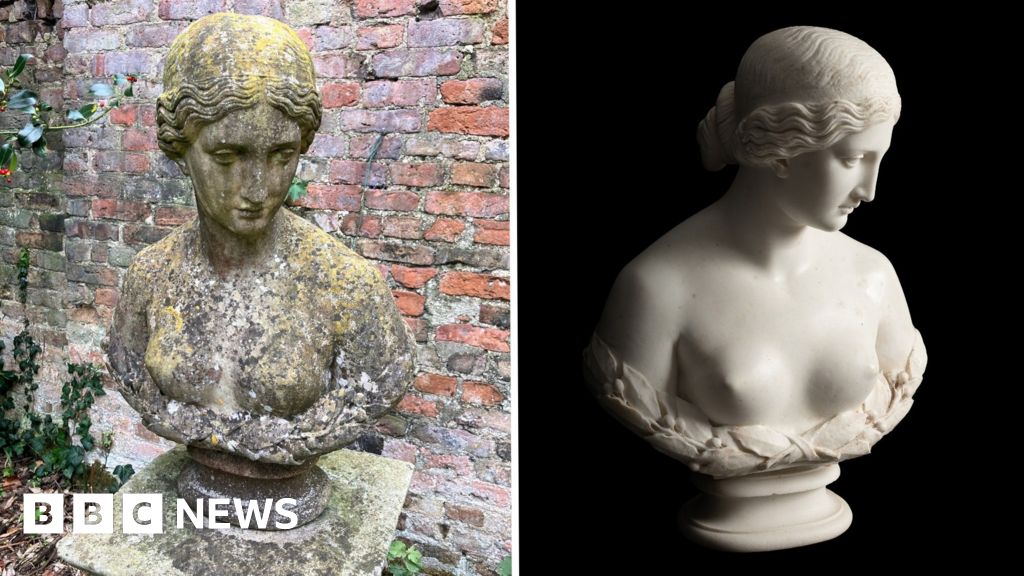
A rare marble sculpture could fetch up to £18,000 at auction after it spent more than seven decades sitting outside, mistaken for a garden ornament.
The lichen-covered bust from 1854 was discovered by Thomas Jenner-Fust, director of Chorley's Auctioneers, during a routine house valuation in the Cotswolds.
What the family thought was a reconstituted stone bust turned out to be the work of pioneering 19th-Century artist and feminist figure, Harriet Goodhue Hosmer.
Jenner-Fust said it is a reminder that some of the most valuable objects are not tucked away in stately homes but hiding in plain sight, waiting to be rediscovered.
Three sisters rising through the ranks of bowls
Boats stuck as silt builds up in city docks
Jury discharged in Boris Johnson wedding plot trial
The statue will go under the hammer at Chorley's Auctioneers in Gloucester later.
Hosmer was an American neoclassical sculptor born in Massachusetts in 1830, and is widely regarded as the first professional female sculptor in the United States.
She spent much of her career in Rome, where she developed an international reputation in a field that was overwhelmingly dominated by men.
Hosmer was also openly gay during a time when same-sex relationships were widely condemned, and in some places, illegal.
"She was somebody who was exceptional - a real trailblazer and a feminist icon," Jenner-Fust said.
The bust on sale depicts Daphne, Apollo's first love in Greek mythology, and is inscribed with the Latin phrase "me fecit Roma" - translating to "Rome made me".
As Hosmer's debut sculpture, only a small handful were ever created.
Historians from the Metropolitan Museum of Art in New York recognise only three verified marble versions surviving today - all on display in museums across the US.
It is unclear exactly how the sculpture came to be in the Cotswolds, but the family presume it was bought at auction by an ancestor in the mid 1900s.
Jenner-Fust said the homeowners were "quite surprised" by the discovery, who had been "blinded by familiarity" after seven decades.
"They had no idea it was marble, no idea who it was by, and no idea it was so valuable," he said.
Jenner-Fust urged others to "be extra careful" when clearing out older homes, "to make sure you don't throw anything out that could be very important".
"It's a bit like a treasure hunt. You never really know what you're going to find next, and that's the thrill of the chase," he added.
"It also gives us a bit of comfort as auctioneers that there are still things out there, waiting to be discovered."
Follow BBC Gloucestershire on Facebook , X and Instagram . Send your story ideas to us on email or via WhatsApp on 0800 313 4630 .
Lost Turner oil painting found after 150 years
The eye-catching sculptures found across the West
Topics in this story
Gathered from external sources. Rights to this text belong to whoever originally published it.