Millions of hours of Ukraine drone data being used to train AI: Report
Europe News: Ukraine’s war with Russia is generating a resource that could outlive the conflict itself. Reports suggest that vast amounts of battlefield data are i.
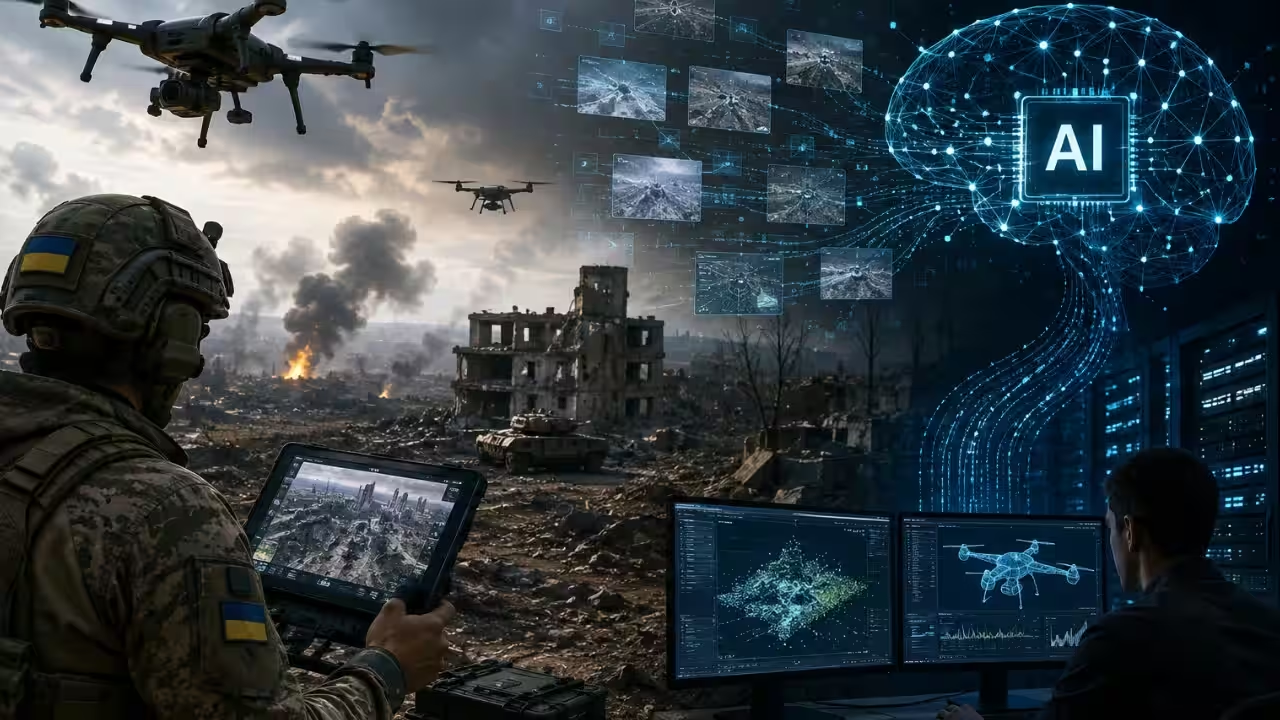
Ukraine’s war with Russia is generating a resource that could outlive the conflict itself. Reports suggest that vast amounts of battlefield data are increasingly being used to train artificial intelligence systems, creating a new and largely unregulated market around the technology.Every drone flight can generate thousands of data points, including images, video, sensor readings and information about how operators respond to changing conditions. Ukraine has begun turning those records into training material for AI systems, giving defence companies access to real-world combat experience.According to an analysis by MIT Technology Review, Ukraine’s Ministry of Defence announced in January that it would make millions of data points collected during tens of thousands of drone flights available to military contractors and commercial companies. Since then, more than 100 companies and the UK government have gained access to the data.The UK’s access came through a new defence partnership with Ukraine that allows British universities and companies to work with battlefield data through Ukraine’s AI Avengers Labs. The platform contains millions of frames collected from cameras and infrared sensors across the battlefield.Why battlefield data is so valuableAI systems need enormous amounts of data to learn how to operate when conditions are unpredictable. The most useful training material often comes from situations that are difficult to recreate in controlled environments, when visibility suddenly disappears, communications are jammed or an operator has to improvise.War produces those situations constantly.MIT Technology Review noted that battlefield data therefore offers defence companies a volume of machine experience that laboratories cannot easily replicate. Ukraine’s constantly changing terrain and combat conditions create source of material for developing more robust autonomous systems.That has also opened the door to commercial applications. US-based Enabled Intelligence has already made more than half a million hours of Ukrainian drone footage available for AI training, with potential applications spanning military and commercial systems.The process effectively turns combat experience into a reusable training asset: operational records are processed, labelled and matched with information about what a drone or its operator was doing, creating datasets that can then be fed into new AI models.From war machines to civilian technologyThe development is part of a broader shift in which technologies originally developed for civilian use are being adapted for warfare, while the data generated on the battlefield can eventually flow back into civilian industries.Drones operating in Ukraine, for instance, have generated data from signal-jammed and otherwise difficult environments. Some technologies trained using such conditions are already being applied in agriculture, including systems used to map and survey fields in areas where conventional connectivity is limited.This creates what MIT Technology Review described as a new loop: commercial technology enters warfare, generates data under extreme conditions, and that data can then return to the commercial sector as an input for the next generation of products.The precedent is not entirely new. US drones operating over Syria and Yemen generated data that helped inform early generations of semiautonomous military systems.The problem: Who owns battlefield experience?Military laws regulate how countries conduct war, but they say far less about what happens after information generated during combat is extracted, packaged and licensed to private companies.Ukraine has introduced controls around access to its battlefield datasets, but there is no broader regulatory framework governing what happens after that information is absorbed into AI models and potentially moves into civilian markets.The data can contain images, locations and sensor records involving soldiers, civilians and people caught in attacks. Those individuals never necessarily agreed to have their experiences turned into training material for products that could be developed and sold years later.There is also a deeper economic concern. Frontline countries bear the physical cost of generating this data, while companies and wealthier countries far from the fighting could ultimately capture much of its commercial value. That could create an extractive market in which the human risks of war become a source of digital capital.A new AI market without clear rulesUnlike conventional datasets, where the movement of information can sometimes be tracked, it can become nearly impossible to determine where specific battlefield information went after being incorporated into an AI system.MIT Technology Review argues that battlefield data should therefore not be treated like ordinary commercial material. Governments granting access could instead treat it more like a controlled weapons transfer, tracking its origin, licensing users and restricting onward sharing.Catch the latest World News and Live updates. Download the TOI app.
Topics in this story
Gathered from external sources. Rights to this text belong to whoever originally published it.