In 2003, 57-year-old Welsh widow Rosie Swale Pope began circling the world on foot with a cart; five years, wolves, frostbite and 53 pairs of shoes later, she reached home on crutches
UK News: People go on unexpected paths when they are grieving. A small percentage of people conclude that the best way to deal with loss is to move on until th.
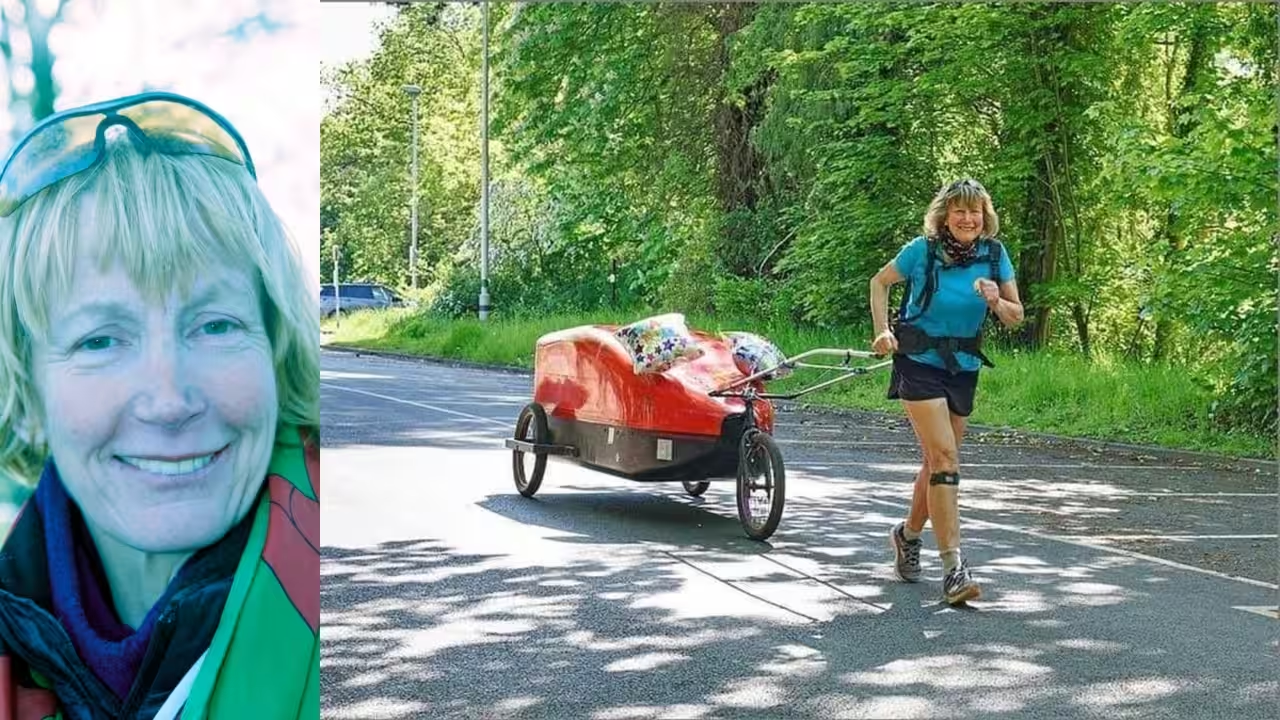
People go on unexpected paths when they are grieving. A small percentage of people conclude that the best way to deal with loss is to move on until the grief finds a new home, while others choose to retreat from society. One of the most remarkable endurance treks in recent memory began when a 57-year-old woman from Tenby, Wales, left her home in October 2003 and didn't actually stop for five years.Rosie Swale Pope had lost her husband, Clive, to prostate cancer the year before. Instead of mourning in silence, she chose to run across the Northern Hemisphere to raise awareness of prostate cancer and support the Prostate Cancer Charity, which later became Prostate Cancer UK. She had no video crew, no support vehicle and no team following her, simply a little cart she called Icebird that carried her tent, food and camping supplies as she went.A run born from lossWhat Swale Pope set out to do was remarkable, even for top endurance racers. She was going to run around the Northern Hemisphere, covering as much land as possible before continuing across North America and back to Britain. She travelled through Europe and Russia, took a short flight from Siberia to Alaska (there is no road connecting the two), then continued through Canada and the United States before making the final leg home via Iceland and Scotland.She started in her late fifties, an age when most people are winding down rather than preparing for a journey of over 32,000 kilometres. But she'd already crossed the Atlantic alone and travelled overland across Chile on horseback, so a life without a physical challenge waiting for her was harder to comprehend than the run itself.Wolves, ice and a broken wagonMost of these kinds of schemes fail in execution, but Swale Pope pushed on despite conditions that would have stopped most travellers for weeks. In Siberia she awoke to discover a group of wolves circling her tent, but they trotted along with her for a while as if they had adopted her. The World Runners Association, which tracks long-distance runners and their completed routes, has chronicled in detail the entire stage-by-stage breakdown of her trip, from Tenby to Chelyabinsk, then on through Eurasia to Magadan, across North America and back through Europe.Temperatures in the Alaskan winter plunged to -60 degrees Celsius, and the cold often forced her to travel only a few hundred metres a day, inching her cart out of the snowdrifts. While in Siberia, she was hit by a bus, later broke ribs and injured her hip in a fall on ice, and also suffered frostbite and a possible tick-borne illness near Lake Baikal.Back home on crutchesThe last part of the journey home to Tenby, after five years on the road, proved almost as difficult as any of the others. Swale Pope had stress fractures in both legs and had to hobble the final few miles on crutches, not exactly the way she had envisioned her steady jog to be. On 25 August 2008, she arrived home to a gathering of well-wishers and holiday visitors who had assembled to witness her finish a voyage of around 32,000 kilometres. A full description of the journey is kept in the archives of the Museum of Travel and Tourism.On the trip she had worn out 53 pairs of shoes, a fact that lent its title to her memoir, and raised almost 250,000 pounds for the causes she carried with her, including an orphanage in Russia. Swale Pope’s journey has subsequently been used as an example that sadness, no matter how great, doesn’t have to be the end of a person’s goals. She kept on with longer and longer distance runs into her seventies, but it is the original five-year loop of the globe, performed mostly alone and frequently in difficult conditions, that is her distinguishing achievement.Catch the latest World News and Live updates. Download the TOI app.
Topics in this story
Gathered from external sources. Rights to this text belong to whoever originally published it.