‘Helpless’: The families facing winter in tents on the beach in Gaza
An innovative idea to turn damaged cooking pots into seawater barriers is providing families in Gaza with some relief.
Khan Younis, Gaza – A few metres from the sea, near al-Qarara port on Gaza’s coast, Anas al-Shami, 33, is trying to keep his family of six warm and dry in a dilapidated tent. It offers little protection from wind and rain, while the damp seeps into their bedding and belongings at every moment. The swelling waves in the sea also pose a constant threat as winter approaches.
The beach was not al-Shami’s choice of place to live, but the refuge his family took shelter in after being displaced from their home quickly became overcrowded. They can’t afford anything safer than this tent.
Now, he and his family are living in constant fear of a repeat of last winter’s flooding.
Al-Shami and his family were forced to leave Bani Suheila, east of Khan Younis in southern Gaza, when it became part of Israel’s so-called “Yellow Zone” beyond which Palestinians are not permitted to go.
“I searched for land in displacement areas where I could pitch a tent, but overcrowding and high rental costs made that impossible,” he tells Al Jazeera. “I was therefore forced to stay on the beach, despite the dangers facing my family and me.”
Al-Shami recalls last winter, when seawater and rain flooded his tent while the family was asleep. He would wake to find his children lying in water. Their bedding and belongings were repeatedly soaked, leaving him unable to protect them from the cold as the tent turned into a pond.
Despite trying all year, the family has been unable to find anywhere else to go, leaving them facing another winter on the beach.
“My children’s repeated exposure to water, cold and damp caused serious illness which threatened their lives,” he says.
‘I feel helpless in front of my children’
It’s a familiar story along this stretch of coastline.
Ibrahim Abu Tair, 47, whose family has also been displaced from eastern Khan Younis, is sharing a cramped tent with his seven children on the port’s shoreline. The dilapidated shelter lacks any basic necessities and offers little protection from the cold, rain and wind.
“What hurts me most is feeling helpless in front of my children,” he says. “I cannot provide winter clothes to protect them from the cold or even a dry mattress for them to sleep on.”
The strong wind and the sound of the rising waves keep him awake at night, he says, and he is terrified of another flood like last year’s, when water inundated the tent and forced the family to endure the cold in the open. His greatest wish is to find safe shelter where his children can sleep without fear.
Some families have found a makeshift solution to keep the water at bay.
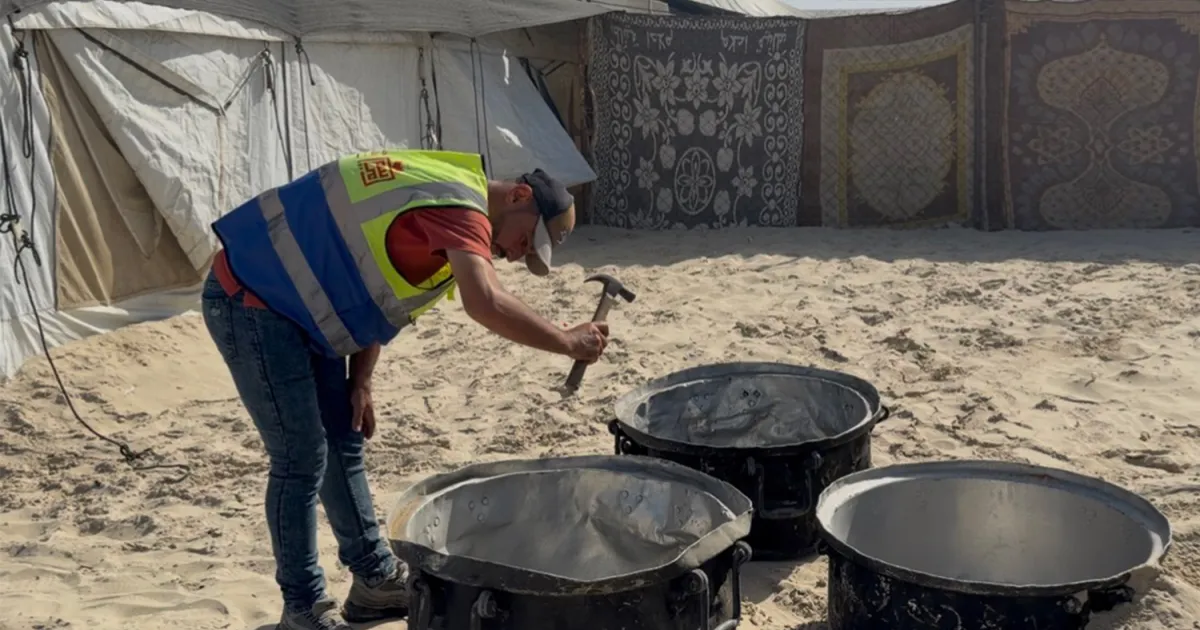
By filling damaged cooking pots with earth, they have forged a barrier against encroaching seawater alongside the tents.
Mayasem Association, an aid organisation which works in cooperation with World Central Kitchen, has seized on this innovation and is now producing these pot-barriers for families in this area close to al-Qarara port.
The initiative reuses large pots rendered unusable by repeated exposure to flames, corrosion and holes. Three pots, donated by World Central Kitchen, are filled with soil and stacked on top of one another, reaching approximately 150 centimetres in height to form barriers that hold back the incoming water and prevent waves from reaching shelter sites.
“The initiative initially involved building barriers to protect the association’s safe space, which hosts its education programmes, school, cultural activities, arts and heritage programmes,” Khalil Abu Lahia, the association’s emergency response coordinator, tells Al Jazeera. “The idea later developed into an attempt to protect the displaced families’ tents along the coastal strip.”
While this is an example of the innovative thinking which can help families who are destitute and at risk in Gaza, it is nevertheless only a temporary measure which cannot make up for the widespread lack of safe shelter.
The initiative comes amid a warning from Gaza’s Winter Emergency Committee of a worsening humanitarian catastrophe, as tents and caravans remain in critically short supply as Israeli authorities continue to prevent their entry into the Gaza Strip, alongside the delivery of critical construction materials and fuel.
The committee has reported that Israeli forces have also destroyed about 70 percent of municipalities’ essential operational equipment and 90 percent of civil defence rescue equipment. The fuel crisis means machinery and generators will soon stop functioning altogether, further limiting the ability to respond to floods, carry out rescue operations and clear roads.
In all, there are about 200,000 dilapidated tents sheltering hundreds of thousands of displaced people, including children, women and people with disabilities.
Some 7,800 of them are located in extremely hazardous areas, the committee has warned, including on dry riverbeds which may now flood, rainwater collection ponds and beaches exposed to crashing winter waves. These need to be urgently relocated to safer locations.
About 2,000 cracked buildings are also at risk of collapse, threatening families who have sought refuge inside them. Building materials, caravans, shelter and fuel are all urgently needed, the committee says.
Topics in this story
Gathered from external sources. Rights to this text belong to whoever originally published it.