Brazil: An election of choice?
On the eve of a bitter election, two Brazilians explain how a country that cheers for politicians like soccer clubs ends up voting not for the candidate
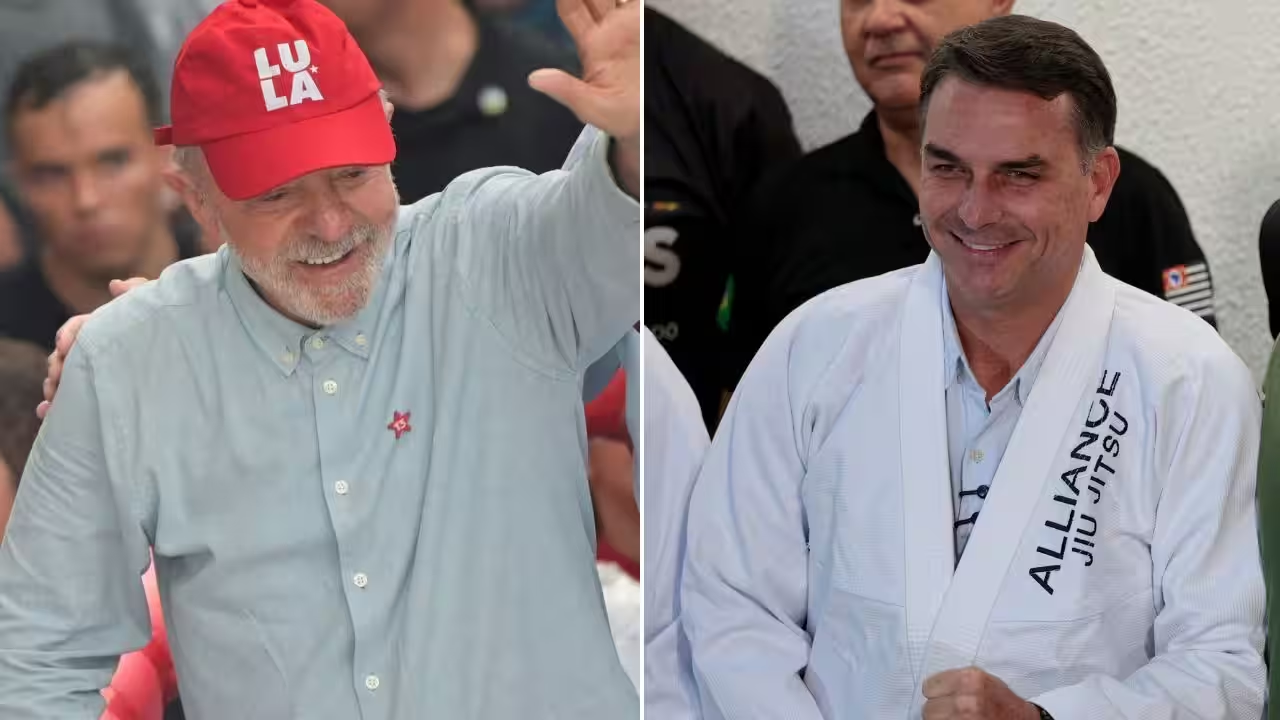
On the eve of a bitter election, two Brazilians explain how a country that cheers for politicians like soccer clubs ends up voting not for the candidate it likes more, but against the one it dislikes most — and why, either way, less will change than anyone expects.There is a particular fatigue that settles over a country asked the same question too many times. On Sunday, October 4th, Brazil will be asked it again: Lula or Bolsonaro?This time, the Bolsonaro on the ballot is the son. Senator Flávio Bolsonaro is running in place of his father, Jair, who was convicted last year of plotting a coup and is barred from the race. The Lula is Luiz Inácio Lula da Silva himself: eighty years old, seeking a fourth term, and, across a single career, a union firebrand, the most popular president in modern Brazilian memory, a prisoner whose convictions were later annulled, and a president once more.From India, the contest can look like a referendum on democracy itself. The two countries rhyme in ways that are easy to recite and hard to ignore: continental scale, vast informal economies, loud and partisan media, infrastructure that lags ambition. But from inside Brazil, the election looks less like a battle for the republic's soul than a careful negotiation over which disappointment to live with.Days before the vote, I sat down with two Brazilians — Lucas Bento, a business lawyer, and his compatriot Joaquim Alves — to ask what their country is really arguing about. Neither offered a fan's account. "Neither side has a clean past and beautiful morals," Bento told me. "It's a dispute of narratives: who is right and who is wrong."A free press, in team colorsBento begins by correcting a premise. Brazil's problem, he says, is not a lack of press freedom. "We have a very strong free press," he said. "The government doesn't pressure the channels to take its opinion. But if a channel supports the government, it supports it through and through. If it's against, it's against from the beginning of the candidacy to the end of the term."For decades, that partisanship mattered less, because one network mattered most. TV Globo, Bento recalls, once held more than eighty per cent of the national audience. "When it's eighty per cent of the audience, the opinion of that channel is pretty much the opinion of the country." Globo cultivated an air of impartiality, but Bento's critique is subtler than bias. "Every single decision brings a traffic of ideology," he said. "The fact that you showed it makes it popular. The fact that you decided not to show it — no one would know it."Smaller broadcasters built their audiences on exactly the commentary Globo avoided. Bandeirantes, controlled by the Lebanese-Brazilian Saad family, made stars of anchors who delivered the news and then their verdict on it. RecordTV, owned by Edir Macedo, the founder of the Universal Church of the Kingdom of God, wears its religious convictions in its coverage. By Bento's reckoning, Globo and Band now lean toward Lula; Record and SBT toward the Bolsonaros.The decisive shift, he argues, came when the gatekeeper lost the gate. "Bolsonaro in 2018 was only able to be elected because of the internet," he said. Globo was not with him; neither were the country's intellectual elites. What carried him were what Bento calls "the minority opinions" — not minority populations, he is careful to add, but the views the mainstream had declined to air.This year, the asymmetry is gone. "It's the first time that I see Lula's side being a master of the internet as well," he said. Television, in his view, has become something close to a bystander. "The dispute of narratives on WhatsApp, on Instagram, on TikTok — that's what is making the difference."The soccer-club theory of politicsI put to them the question that, from abroad, seems unavoidable. How does a nation this proud keep in contention a family whose patriarch was convicted over a coup plot — one that, prosecutors said, contemplated assassinating Lula — and whose supporters ransacked the seats of government in Brasília while he sat out the aftermath in Florida?Bento's answer was about information, not ideology. For most of modern Brazilian history, he explained, the millions of Brazilians with little formal education got their news almost entirely from television; the morning paper belonged to a narrower, better-schooled slice of the country. Then cheap smartphones arrived. "Every single person would be bombarded with information the whole day, from various different sources," he said. "They were not well prepared to receive this amount of information. They cannot really tell what's right and what's wrong — especially now, with artificial intelligence, when you can see photos and videos that are fake."The result, in his account, is not that voters forgive the scandals. It is that they disbelieve them. "Why do we even consider candidates with criminal records?" he asked. "Because the population doesn't see the backgrounds as weird. They don't even believe the backgrounds."Alves sees the same reflex on both sides. Bolsonaro's base follows him blindly and reads every charge as persecution, he said; Lula's base does exactly the same. To each camp, its own man's time behind bars proves nothing. "That's not true," he said, ventriloquizing the partisan. "It was planted."Bento then offered the image that, more than any poll, explains the mood. "We like to support our soccer teams, right? Doesn't matter if it's a good season or a bad season, we always support our team. Now people do it with politicians."A ban, nine days outIf this campaign has a defining controversy, both men agreed, it is neither the Amazon nor inflation. It is the "bets."Online betting exploded in Brazil over the past several years, first through offshore sites and then through a licensed domestic market. Betting companies are now, in Bento's words, the biggest sponsors of the country's soccer clubs and of its most famous influencers. They have also become, critics argue, a public-health crisis concentrated among the poor. "People were getting the money to eat and putting it on bets," Bento said. "Losing this money, and not being able to eat. Bringing hunger back."On September 25th, nine days before the first round, Lula signed an executive order banning online betting outright. It took immediate effect, though Congress must approve it within a hundred and twenty days. Flávio Bolsonaro called it an "electoral measure"Here the lawyer in Bento takes over. The irony, he notes, is that Lula's own government built the legal market — regulation arrived only about two years ago, Alves pointed out and charged each licensed operator a concession fee of thirty million reais, roughly five to six million dollars. It also created a national self-exclusion registry, which Bento calls the "auto-ban," letting a gambler block himself from every licensed site at once. "But addiction is a psychiatric issue," Bento said. "If the person could say no, there wouldn't be an addiction."He does not presume to say whether betting should be banned — "I'm a doctor of law, not a medical doctor" — but the timing offends him professionally. "You paid me five million dollars, I gave you the concession, and now I ban the concession and don't give you back the money," he said. His verdict: "Incoherent, but convenient."The ban splits the country along unexpected lines: soccer culture and the influencer economy against, the intellectual class and families who have watched a relative lose everything to an app in favor. If the polling holds, the second camp is the larger; recent surveys, Reuters reported, show roughly three-quarters of Brazilians support a complete ban. Bento sets the move beside another pre-election gift, discounts of up to eighty per cent for a decade's worth of graduates settling their federal student loans. "He used the machine very well," he said — the machine being the apparatus of incumbency.Hanging over all of it is the judiciary. Bento ranks the collapse of Banco Master as the biggest banking scandal in history, and alleges that it reaches as many as two-thirds of the Supreme Court — a sweeping charge, and his own. He also cites a recent ruling in which, he says, the Court overturned an order to take down a false report about Flávio Bolsonaro, on free-speech grounds. "False information," he said, "is never freedom of speech."Eggs, orange juice, and sovereigntyThe other force in the race comes from abroad. President Trump, Bento says, backs Flávio Bolsonaro and is openly hostile to Lula; at the last G7, he said. The two presidents could barely bring themselves to speak, trading jabs through their speeches instead.Flávio's pitch, as Bento describes it, is a patriotism routed through Washington: love of Brazil, expressed as alignment with the United States. Lula's is the reverse, and Bento tells a story to show it. At a summit in 2003, Lula's first as president, the leaders rose to applaud as George W. Bush was announced. Lula stayed seated and, by Bento's account, pulled his standing foreign minister back into his chair. Asked why, Lula is said to have replied that no one had stood when he walked in. "Brazil is a country with sovereignty and independence, just as the U.S.," is how Bento renders the logic. "If someone stands in applause when I arrive, I stand in applause. If someone doesn't, I don't."When Trump raised tariffs on Brazilian goods last year, Lula's response, per Bento, was a shrug: if America didn't want Brazil's products, he would sell them elsewhere. In Bento's telling, the standoff ended at the American breakfast table. "In two days, there were no eggs, no orange juice," he said, and Washington backed down. The real sequence was slower and messier — relief on many Brazilian food imports came months later — but the parable is the point. Sovereignty is a campaign issue in Brazil now, and Lula has planted his flag on it."We don't need to put on the Brazilian T-shirt and say we are proud," Bento said, summarizing Lula's posture. "We are proud because we respect ourselves." It is a pointed line in a country where the yellow national-team jersey became the uniform of Bolsonaro's movement.The lesser dislikeWho wins? Both men expect no candidate to clear fifty per cent on Sunday, forcing a runoff on October 25th that will go, as Bento put it, "until the last moment." He forecasts Lula — not out of affection but out of the arithmetic of aversion. "There are a lot of people who won't vote for Lula in the first round," he said. "But when it comes to a decision between Bolsonaro and Lula, it will be a decision on which one I oppose more. And there are more opposers of Bolsonaro than opposers of Lula."Alves put it more plainly. "It's not the one I like the most," he said. "It's the one I like less — the one I'm not able to vote for." Bento, who declined to reveal his own ballot, said he would decide the same way, and so would most of the country. "Some people cannot stand looking at Lula because of their ideological issues," he said, "and some people cannot stand looking at Bolsonaro because of their psychological issues." It is hard to miss which half of that sentence carries the sharper edge.And once the votes are counted, what changes? "Way less than we think," Bento said. "It doesn't matter who wins," Alves added. Bento pointed to Jair Bolsonaro's own term, Brazil's first openly right-wing government since the military dictatorship, an arrival that was supposed to be seismic. It changed little, he said. A powerful Congress and a strong judiciary, bruised as it now is, absorb the shock of any single president. "We will move forward with more of the same," he said. "Fortunate or unfortunate."It is tempting, from abroad, to read this election as a battle for a democracy's soul. The Brazilians I spoke with described something more durable and more sobering: institutions strong enough that no single president can remake the country, and an information ecosystem chaotic enough that no single fact can settle an argument. Indian readers will recognize much of it — the WhatsApp forward, the anchor as partisan, the giveaway timed to the ballot. On Sunday, Brazilians will cheer for their teams. On Monday, the country will still be there, largely as it was. Whether that is Brazil's weakness or its quiet strength depends, like everything else this season, on which team you support.Quotations have been condensed and lightly edited for clarity.You use AI every day. Now get your AI Quotient. Take the AIQ test.
Topics in this story
Gathered from external sources. Rights to this text belong to whoever originally published it.