Ross Perot Jr. began buying Texas land in 1985; his vision helped transform Fort Worth
In the 1980s, much of northern Fort Worth consisted of farms, ranches and open prairie. Ross Perot Jr.
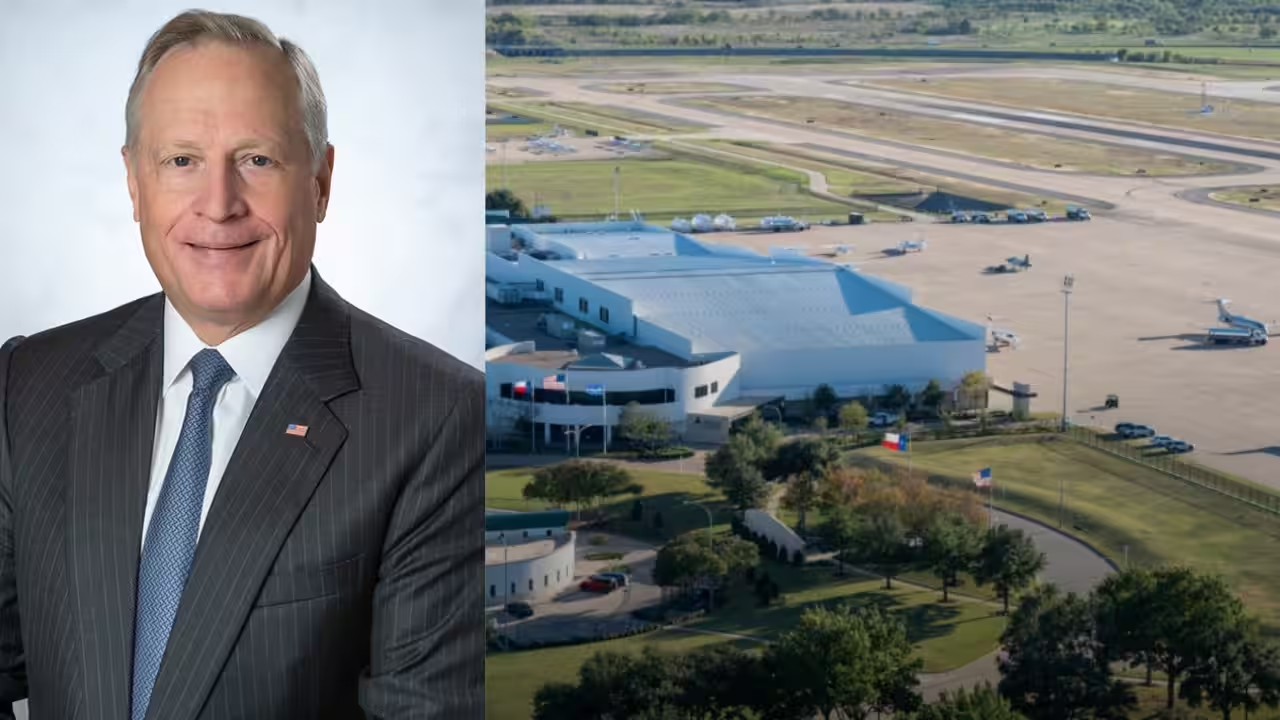
In the 1980s, much of northern Fort Worth consisted of farms, ranches and open prairie. Ross Perot Jr. saw an opportunity to transform the largely rural landscape into a major business and transport centre. He began buying the land that became AllianceTexas in 1985, laying the foundations for a development that would eventually cover 27,000 acres. Over the following decades, the project attracted hundreds of companies, an industrial airport, freight facilities, warehouses, corporate campuses and residential communities. Here’s how Perot's long-term vision helped change the region's economic landscape.Ross Perot Jr.'s early land purchases laid the foundations for AllianceTexasRoss Perot Jr. began buying the land that became Alliance in 1985, when much of the area north of Fort Worth remained rural. According to Hillwood's retrospective, published on 20 December 2024, the property eventually formed part of a 27,000-acre development along Interstate 35W. At the time, comparable land around Dallas was significantly more expensive. Perot told the Fort Worth Star-Telegram that many families who sold him their ranches were the first generation to do so, unlike landowners in the Dallas area, where properties had often changed hands repeatedly.The scale of the acquisition gave Perot room to pursue a long-term development plan. Rather than building a single commercial project, he envisioned a destination where aviation, industry, transport and businesses could operate alongside one another. The development's success was far from guaranteed. Perot invested in land before the area had attracted the number of companies that would eventually establish operations there. His decision laid the groundwork for one of North Texas's largest planned developments.How the industrial airport helped turn Perot's vision into realityA major milestone came on 14 December 1989, when Fort Worth Alliance Airport opened. Perot had agreed to provide land for an airport after the Federal Aviation Administration identified a need for additional aviation capacity in the Dallas-Fort Worth region. His aviation contacts advised that the area would benefit from an industrial airport rather than one focused on general aviation. The airport was intended to support freight and industrial operations, giving businesses access to transport infrastructure that could encourage further investment. Its opening marked an important step in turning the wider Alliance project into a functioning commercial development.A breakthrough came earlier that year, when American Airlines chairman Robert Crandall announced plans for a major aircraft maintenance facility at the airport. The investment was initially expected to create 4,500 jobs. Hillwood explained that the announcement helped establish confidence in Perot's plans. Although American Airlines eventually closed its maintenance centre in 2012, the wider Alliance development continued to expand, attracting businesses and generating employment across the region.Railways, warehouses and major companies fuelled AllianceTexas's growthAlliance's growth accelerated as additional transport infrastructure and commercial facilities arrived. In 1994, BNSF Railway opened an intermodal hub a few miles from the airport, strengthening the area's role in freight transport. FedEx also broke ground that year on a $300 million sorting hub at the airport, which was expected to employ at least 600 workers.These investments helped establish Alliance as a logistics centre, connecting air freight, rail transport and major road networks. The availability of industrial space and warehouses subsequently attracted more businesses, encouraging Hillwood to expand into residential and retail development as the area's workforce grew.According to the Fort Worth Star-Telegram, at least 575 companies operated within Alliance, including Amazon, Walmart and LG Electronics. More than 14,600 homes had also been built within the development since 1990. The combination of employers, transport links and housing helped change northern Fort Worth from a largely rural landscape into a substantial business and residential corridor.How AllianceTexas generated billions in economic impact for North TexasBy December 2024, Alliance had grown far beyond the airport-centred project Perot first envisioned. Hillwood estimated that the development had generated $119.8 billion in economic impact for North Texas since its inception. The company also reported that the wider project had created more than 66,000 direct jobs over its history. The financial impact extended to local government. According to the Fort Worth Star-Telegram, Alliance had generated more than $3.8 billion in property taxes across the region over three decades, including more than $752 million for the City of Fort Worth.The development had also attracted investment in retail and community facilities, including a shopping centre featuring Tarrant County's first H-E-B supermarket. Hillwood's business had expanded to include multi-family housing, property management and other services supporting the growing population. Despite the scale of the project, approximately one-third of Alliance remained undeveloped at the time of the 2024 report. Perot said he wished he had bought more land when he began the project, reflecting how dramatically the region had grown beyond its original rural setting.Alliance's future also remains a focus for Perot. In an interview with Fort Worth Business Journal in October 2026, the Hillwood chairman said he believed Fort Worth had significant room for further growth. He predicted that businesses the region had yet to imagine would eventually establish a presence there, describing the coming decades as particularly promising. His comments suggest that, despite Alliance's scale today, Perot continues to see substantial opportunities for expansion across Fort Worth and the surrounding region.How Ross Perot Jr.'s land investment helped reshape Fort WorthRoss Perot Jr.'s decision to buy land north of Fort Worth in 1985 laid the foundations for AllianceTexas, a development that grew through decades of investment in aviation, freight transport, industry, housing and retail. What had once been largely rural land became a major business centre with hundreds of companies and thousands of homes.The transformation was not immediate. It depended on attracting employers, building transport infrastructure and expanding the development as demand increased. By December 2024, Hillwood estimated that Alliance had generated $119.8 billion in economic impact for North Texas, illustrating the scale the project had reached.The story also highlights the importance of distinguishing AllianceTexas from other properties in Perot's portfolio. Although Circle T Ranch lies within the wider North Texas development landscape, the two approved sources do not establish the specific claim that Perot bought a 2,500-acre Circle T Ranch in 1993 for about $20 million. The documented history of Alliance itself provides a clear account of how his earlier land purchases helped reshape the region.You use AI every day. Now get your AI Quotient. Take the AIQ test.
Topics in this story
Gathered from external sources. Rights to this text belong to whoever originally published it.