Built by convicts in the 1830s, Australia's oldest in-use vehicle bridge nearly collapsed; engineers rebuilt it from the bedrock
Rest of World News: Thomas James Bridge, also known as Settlers Road Bridge, crosses a creek near Lower Macdonald in New South Wales and holds a rare distinction: it is t.
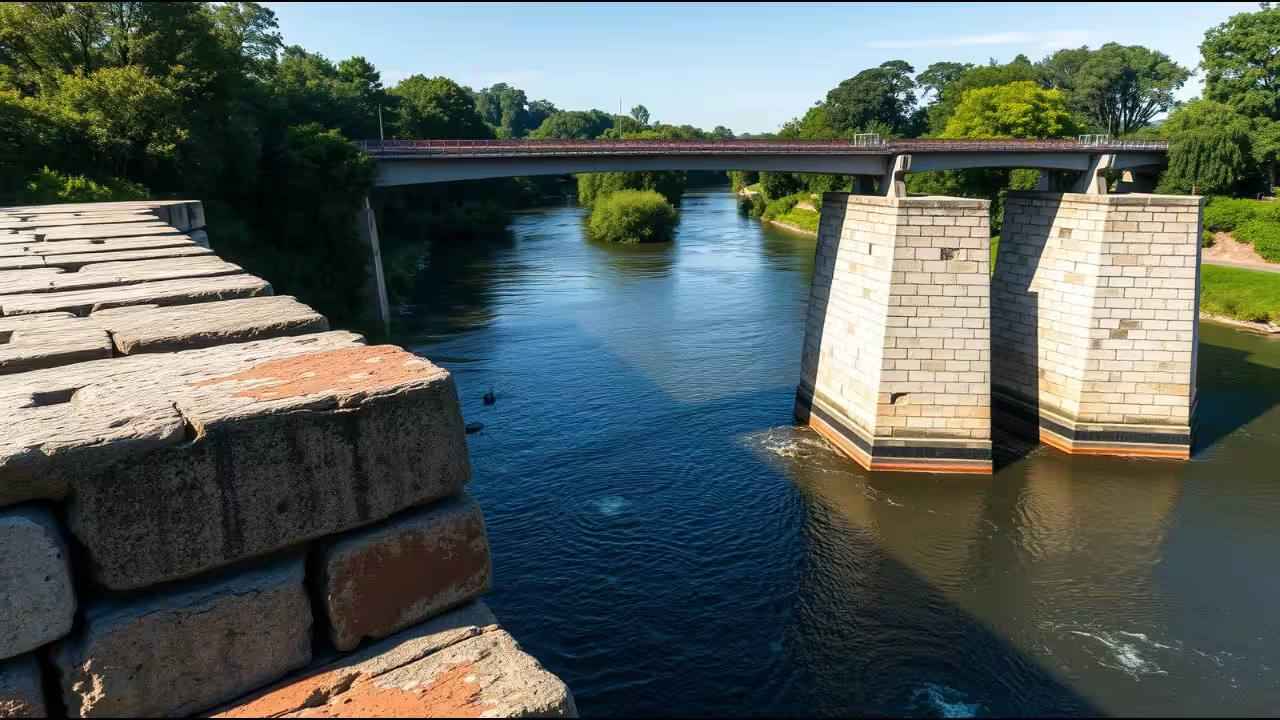
Thomas James Bridge, also known as Settlers Road Bridge, crosses a creek near Lower Macdonald in New South Wales and holds a rare distinction: it is the oldest in-use vehicle bridge on mainland Australia. Built in 1830 using convict labour, the bridge has a simple single-span timber deck supported by massive stone abutments, with the sandstone quarried from the surrounding hillside and worked by hand on site. In 2022, severe floods and storm events damaged the bridge significantly, including the near-total collapse of the eight-metre-tall sandstone retaining walls supporting its abutments. What followed was a two-year reconstruction that required engineers to excavate the site down to bedrock, install new foundations and carefully take apart and number the original sandstone blocks before putting them back in their original positions. Completed in November 2025, the project has now received the Judges' Excellence Award in Heritage at the 2026 IPWEA NSW & ACT Engineering Awards.How engineers rebuilt Thomas James Bridge from the bedrock upAccording to Hawkesbury City Council, the restoration required a tailor-made engineering solution developed in close consultation with heritage experts. Engineers excavated the site down to bedrock before installing new steel and concrete footings and drainage systems designed to withstand future flooding and heavy rainfall. The work was not simply about replacing the structures damaged in 2022. The new foundations had to provide greater resilience while allowing the historic bridge above them to retain its original appearance and character. The project was completed in November 2025 after two years of work, with Hawkesbury City Council managing the project alongside delivery partner Delaney Civil.Why every sandstone block had to be numberedThe most painstaking part of the restoration involved the bridge's original hand-cut sandstone retaining wall. Rather than demolishing the damaged structure and rebuilding it with new stone, workers carefully dismantled it block by block. Each individual piece was numbered, its original position recorded, and the stone placed into storage while the new foundations were constructed. Once the structural work was complete, the original blocks could be put back together in their previous configuration. The timber bridge deck was also reinstated, preserving the historical appearance and significance of the site. The stone itself has been part of the bridge's story since its construction. Heritage records say it was quarried from the surrounding hillside, cut on site and moved into place entirely by hand. The resulting stonework forms a 16.3-metre-long channel along the banks of the creek. Evidence of the original quarrying and splitting of the sandstone can still be seen around the gully.Who Thomas James was, and why a convict's name is attached to the bridgeThomas James was a ticket-of-leave convict who directly supervised the No. 25 Road Party responsible for building the bridge. He arrived in New South Wales in December 1819, aged 24, aboard the Recovery with 187 other convicts. He had been sentenced to life for an unknown crime. By 1824, he was working with the Bathurst Road Party stationed at Richmond before being transferred to the No. 25 Road Party at Wisemans Ferry. By 1830, he had obtained his ticket of leave and was overseeing the road party that built the bridge. The bridge was constructed under the broad supervision of Percy Simpson, a surveyor, engineer and administrator who played a major role in the construction of the Great North Road. Thomas James later lived in Penrith, where he was recorded by 1837, and received a conditional pardon in 1842. The bridge is one of only eight surviving bridges from the original 22 built along the Great North Road.How the $23.5 million reconstruction protects the bridge from future floodsHawkesbury City Council managed the $23.5 million reconstruction, with funding from Federal and State Government infrastructure recovery programmes. The restoration was intended not only to repair the damage caused by the 2022 floods but also to maintain a reliable connection between Wisemans Ferry and the Macdonald Valley. Council said the disaster-affected community was kept at the centre of its decision-making throughout the project. The finished bridge still looks like the historic structure built by the No. 25 Road Party almost two centuries ago. Beneath the original sandstone, however, it now has new foundations and drainage designed to better withstand the flooding that once threatened to cut the valley's road connection. That combination of modern structural engineering and original historic fabric is what earned the reconstruction its 2026 heritage engineering award.Catch the latest World News and Live updates. Download the TOI app.
Topics in this story
Gathered from external sources. Rights to this text belong to whoever originally published it.