A 500-year-old football was found in a queen’s bedroom; in 2026, scientists scanned it so the object could live digitally
Revolutionary scanning process allows the world’s oldest football, found in Stirling Castle, to be digitally preserved, offering unprecedented access for enthusiasts and researchers alike.
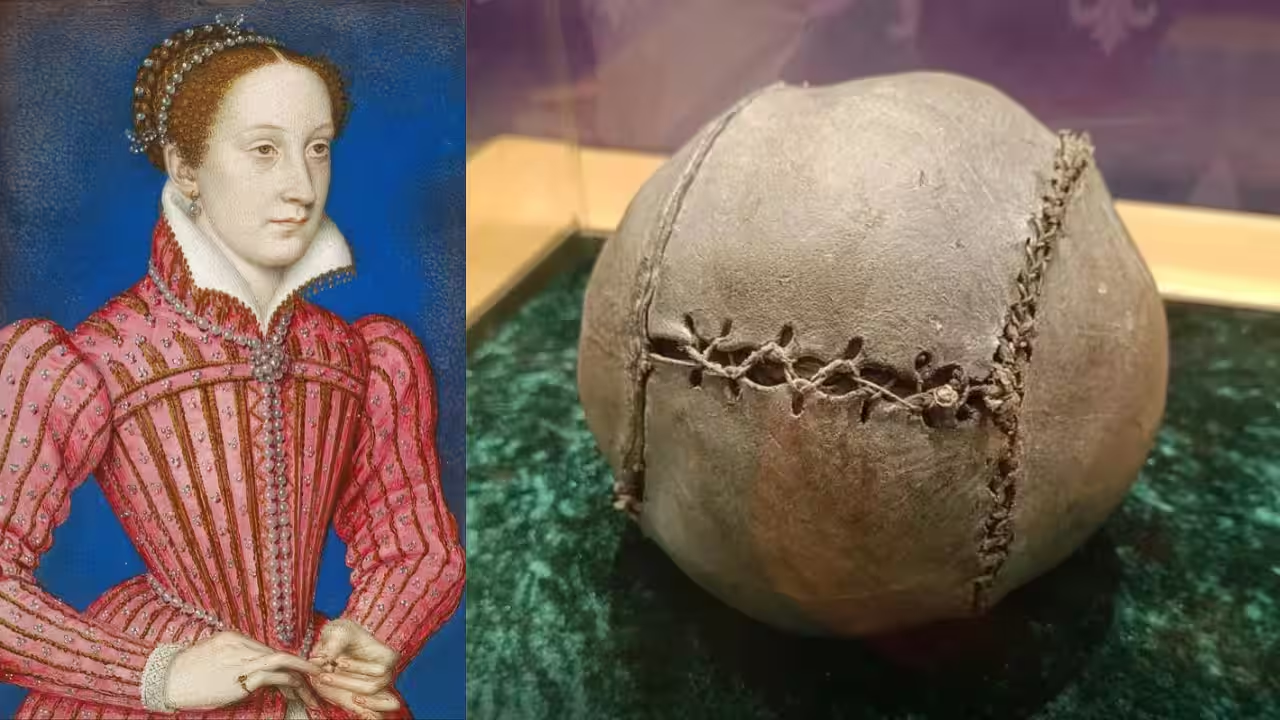
A leather football that dates to around 1540 has spent centuries behind the walls of Stirling Castle and was discovered during renovation work in the late 1970s. The ball was recognised by Guinness World Records as the world’s oldest football, and was found behind panelling in the Queen’s Chamber at Stirling Castle in Scotland. The chamber had been decorated in the 1540s, when Mary, Queen of Scots, was a child at the castle. The ball itself is dated to between 1540 and 1570, according to the Stirling Smith Art Gallery & Museum, which now holds it.The ball stopped at the University of Glasgow, where specialists began scanning it to produce a museum-quality digital twin, before travelling to the United States for the FIFA World Cup. The digital project uses a process called photogrammetry that combines photographs that are taken from different angles to build a detailed three-dimensional representation. University of Glasgow specialists Conor Fraser and Ben Morris captured the ball before it travelled to Miami for the Scotland-Brazil match on June 24. The university said the digital version will allow people to examine details such as its stitching and worn leather surface.The ball spent centuries out of sightThe Stirling Smith describes the football as roughly the size of a small melon, and measured about 160 millimetres long, 150 millimetres wide and 140 millimetres high. It was made from thick leather panels that were stitched together and turned inside out, and inside was an inflated pig’s bladder, which provided the ball’s shape. The museum says that several repairs remain visible on its surface, which is evidence that the object was used rather than made simply for display.How it ended up behind the panelling is not known, with one possibility being that it was kicked into the roof space and became trapped there, while another is that someone deliberately put it there and forgot about it. The museum also notes the possibility that it was placed there for a symbolic purpose, although there is no evidence establishing which explanation is correct.The ball was found in a chamber that was associated with Mary, Queen of Scots, and historical records show that she took an interest in sport. But there is no evidence that she personally owned or played with this particular football, and Guinness World Records says that it is more likely that soldiers or staff at the castle used the ball for a form of handball.From castle rafters to a World CupThe football was eventually placed in the collection of the Stirling Smith Art Gallery & Museum, where it became one of the institution’s best-known objects. Guinness World Records lists it as the oldest football and dates its manufacture to the 1540–1570 period. The ball was scheduled to appear at the Coral Gables Museum in Florida from June 20 to 24 before being taken to the Scotland-Brazil World Cup match in Miami, and the University of Glasgow said it was the first time that the football had travelled to the United States.The university has been developing its “Wonder” platform through its Museums in the Metaverse programme, and used 3D models to let people examine cultural objects virtually. For a museum object that normally has to remain protected behind glass, the digital version changes how it can be viewed. A visitor does not have to travel to Stirling to see its surface at close range, and the model can be enlarged or examined from different angles without handling the original.The physical football remains at the Stirling Smith when it is not travelling, with its leather surface, old repairs and unusual construction still belonging to a fragile object that survived from the 16th century. The new scan just gives researchers and visitors another way to examine the same evidence.You use AI every day. Now get your AI Quotient. Take the AIQ test.
Topics in this story
Gathered from external sources. Rights to this text belong to whoever originally published it.