Virginia redesigned Reston’s Lawyers Road after targeting a 20% crash reduction; after four lanes became two with turn and bike lanes, reported crashes fell from 16 to five a year
Discover how Virginia's road diet on Lawyers Road drastically reduced accidents by 69%, improved cyclist safety, and transformed community perceptions about road design.
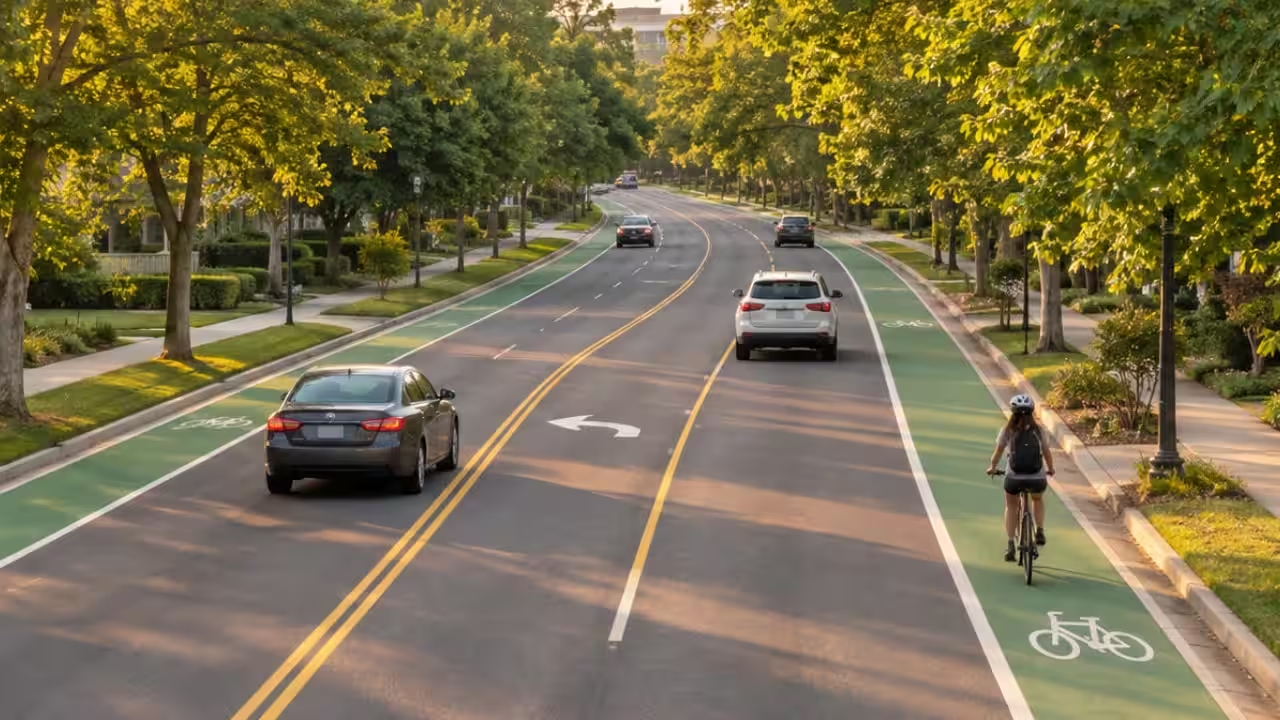
Sometimes the smartest way to fix a dangerous road might just be to take away space. That's what happened on Lawyers Road in Reston, Virginia. The 2015 National Roadway Safety Awards guide from the US federal Highway Administration (FHWA) says the Virginia Department of Transportation (VDOT) changed four lanes to two, put in a centre turn lane and made the extra width into bike lanes. VDOT announced the goal of reducing crashes by 20%. After the project, they fell from 16 a year to five, a drop of 69%.A busy road with a speeding problem Lawyers Road is two miles long, approximately three kilometres. The number of vehicles using this road was 10,000 per day before the changes. According to the guide, the road is noted for speeding problems, and it experiences an average of 16 accidents per year. The layout didn't help much. On a four-lane road with no divider, fast-through traffic shares the inside lane with drivers waiting to turn left. Such roads, the document adds, tend to have relatively higher accident rates. Imagine a corridor where some people are running past, and some are suddenly stopping to turn. This situation here was similar.How a road diet works The fix was called a road diet. Nobody loses weight; the road just gets narrower. Four lanes of traffic on Lawyers Road were reduced to two with a centre lane for turning vehicles. There was also space for bike lanes. The work was little more than pavement markings, so VDOT added it to a resurfacing project already planned. FHWA’s write-up said that meant the cost to the state was minimal. VDOT also ran an enormous outreach effort, and it was during this effort that engineers publicly shared the 20% forecast.More than just fewer crashesThe crash drop wasn’t the only win. Speeds fell too. The average running speed decreased by 1 mph, which is about 1.6 km/h. However, the speeds of the fastest-moving traffic, where the drivers drove at least 5 mph (about 8km/h) faster than the speed limit, were significantly reduced. Cyclists got something too. The road got dedicated bike lanes and a signal that bicyclists can trigger, which the guide says has made biking safer. In short, the typical driver slowed down a little, but the riskiest speeding was almost gone.Residents came aroundNot everyone was sold at first. The idea was initially met with mixed support, which is to be expected when a road that people use every day suddenly changes. A VDOT survey showed a 74% approval rating after the project. The early concerns were resolved with the success of Lawyers Road. When nearby Soapstone Drive came up for resurfacing, many Reston residents supported a similar road diet. That project also gave positive results, the guide notes. Lawyers Road won the Infrastructure and Operational Improvement category of the 2015 awards, which FHWA and the Roadway Safety Foundation had jointly sponsored since 1998.Is this just a one-off?Not exactly, although Reston’s result was good. A 2010 FHWA study, ‘Evaluation of Lane Reduction “Road Diet” Measures on Crashes,’ examined 45 sites in California, Iowa, and Washington. Iowa sites saw a 47% dip in total crashes. In California and Washington, it dropped 19%. Together, the drop was 29%. Lawyers Road beat all of these figures. The same summary says that sites with smaller gains tended to have heavier traffic. This means that the benefits may dwindle as roads get busier. So, a road diet is not a magic fix, and one road cannot speak for all cities. However, it's a useful reminder: before widening a road, ask if a calmer layout could do the job.You use AI every day. Now get your AI Quotient. Take the AIQ test.
Topics in this story
Gathered from external sources. Rights to this text belong to whoever originally published it.