From the 1920s, Australia deliberately planted African buffel grass for cattle feed and erosion control; it invaded desert habitats and helped fires burn more than 100,000 hectares of national park in 2023
Rest of World News: Explore the devastating ecological impact of buffel grass in Australia, highlighting its role in worsening wildfires and threatening native habitats in Tjoritja/West MacDonnell National Park.
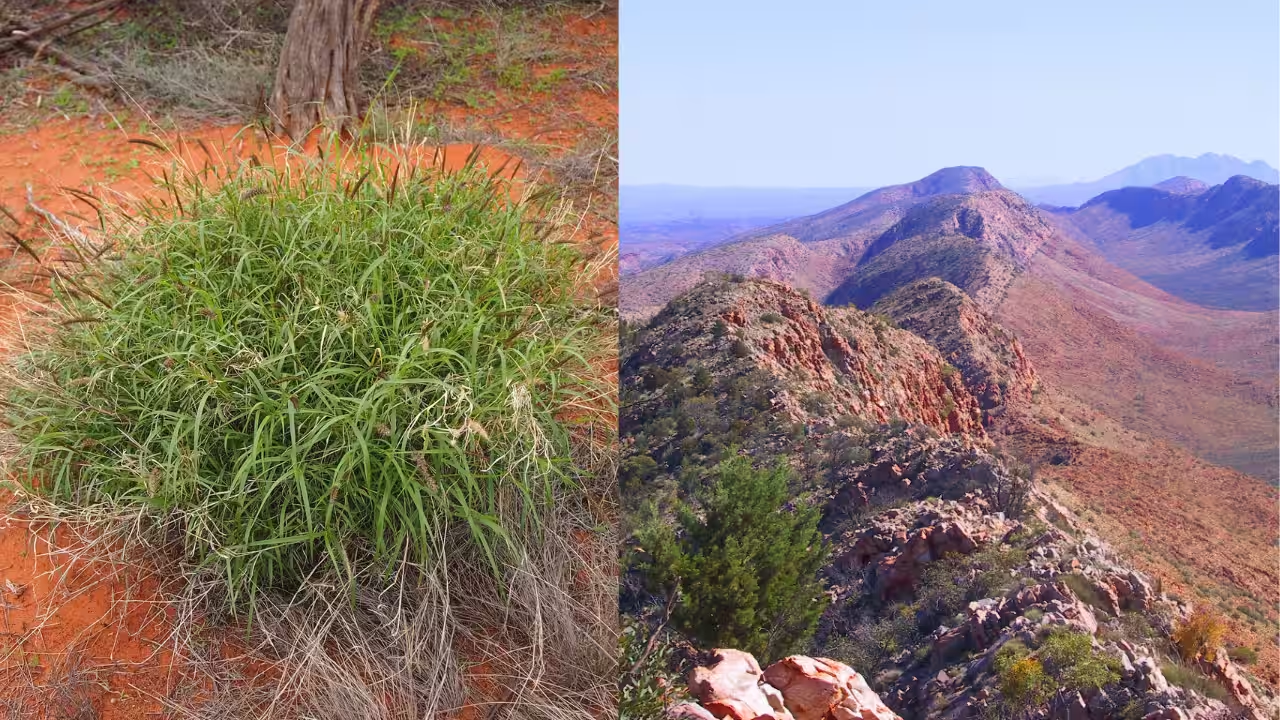
Buffel grass arrived in Australia's deserts more than a century before a fire swept through Tjoritja/West MacDonnell National Park in 2023. The African perennial was initially introduced to Australia in the 1870s for pastoral and erosion-control purposes. It had spread across large parts of the country's arid interior after decades, where dense stands could replace native vegetation and provide continuous fuel for fire.Parks Australia identifies buffel grass as the most invasive weed managed in Uluṟu-Kata Tjuṯa National Park, and the agency says the grass was first introduced to Australia's deserts in the 1870s and subsequently spread across much of the country. It can outcompete native grasses and provide additional fuel for wildfires, especially in areas where fire was historically less frequent.A pasture grass spread beyond the places where it was plantedBuffel grass, or Cenchrus ciliaris, is native to Africa, India and parts of Asia, and is drought tolerant, deep rooted, long lived and capable of producing large amounts of seed. The Australian government's threat-abatement advice says buffel grass can rapidly colonise arid ecosystems and compete with native vegetation. It is still valued as a productive forage species by many rangeland pastoralists, which has made its management more complicated than that of a weed that does not have a lot of economic use.Its early use was tied to practical concerns such as providing pasture for livestock and reducing erosion, and later planting expanded its presence in arid and semi-arid regions. A recent Australian government review describes buffel grass as a high-biomass tussock grass that can dominate native vegetation once established. It can also spread along waterways and into riparian areas, while seeds can be transported by animals, water, vehicles and other disturbances.Fire changed when buffel grass filled the gapsDense buffel stands can produce much more continuous ground fuel than the native vegetation they replace, and fires can then move through areas that previously contained natural breaks in the fuel. The Australian government's threat-abatement advice says buffel grass can increase both the frequency and intensity of fires, and hotter fires are capable of damaging vegetation that evolved under different fire conditions.At Uluṟu-Kata Tjuṯa, Parks Australia says buffel grass provides fuel for wildfires in areas that were not previously burned as frequently. The agency has been removing the grass by hand and testing combinations of burning and herbicide treatments. The problem is not simply that buffel grass burns, as fire can also reinforce its spread. After a fire, buffel grass can recover quickly, while native species that are less adapted to repeated intense burning may take longer to return. A cycle can develop in which grass produces more fuel and the resulting conditions favor the grass again.More than 100,000 hectares burned in 2023Northern Territory Parks and Wildlife officials reported that about 94,000 hectares of the park had burned by August that year, after a series of fires and managed burns. Officials said the amount of buffel grass affected fire behavior and noted that areas with only native grasses would have experienced less intense fires. Later research that used satellite imagery and field observations put the total area burned by the 2023 wildfires at more than 100,000 hectares, which is roughly one-fifth of Tjoritja/West MacDonnell National Park. The researchers found dense buffel grass stands along creeks, drainage lines, riverbanks and floodplains and reported that buffel infestation had contributed majorly to the park's two most recent major wildfires. Weather, accumulated vegetation, terrain and fire management all affected how the fires spread, but buffel grass increased the available fuel in parts of the landscape, making it an important factor in the fire regime.Removing it is difficult once it takes holdThe federal threat-abatement advice recommends preventing new introductions, identifying high-priority areas and removing new infestations where eradication is still possible. Authorities are instead advised to contain the grass and protect threatened species in heavily infested areas, ecological communities and Indigenous cultural sites.The Australian government says hotter and more frequent fires can damage native food plants and carry into the canopies of trees that are important components of arid ecosystems. Infestations around water sources can also affect access to sites with Indigenous cultural significance. The history therefore stretches from a practical agricultural introduction to a much larger ecological problem. In Tjoritja/West MacDonnell National Park, the 2023 fires covered more than 100,000 hectares while buffel grass remained one of the factors managers were trying to control.Catch the latest World News and Live updates. Download the TOI app.
Topics in this story
Gathered from external sources. Rights to this text belong to whoever originally published it.