In Cambodia’s Kep waters, conservationists installed interlocking concrete blocks to snag trawler nets; the barriers reduced patrol needs, saving an estimated 500,000 litres of fuel a year
Learn how innovative interlocking concrete blocks are transforming marine conservation efforts in Cambodia, reducing illegal fishing and saving fuel while supporting local communities.
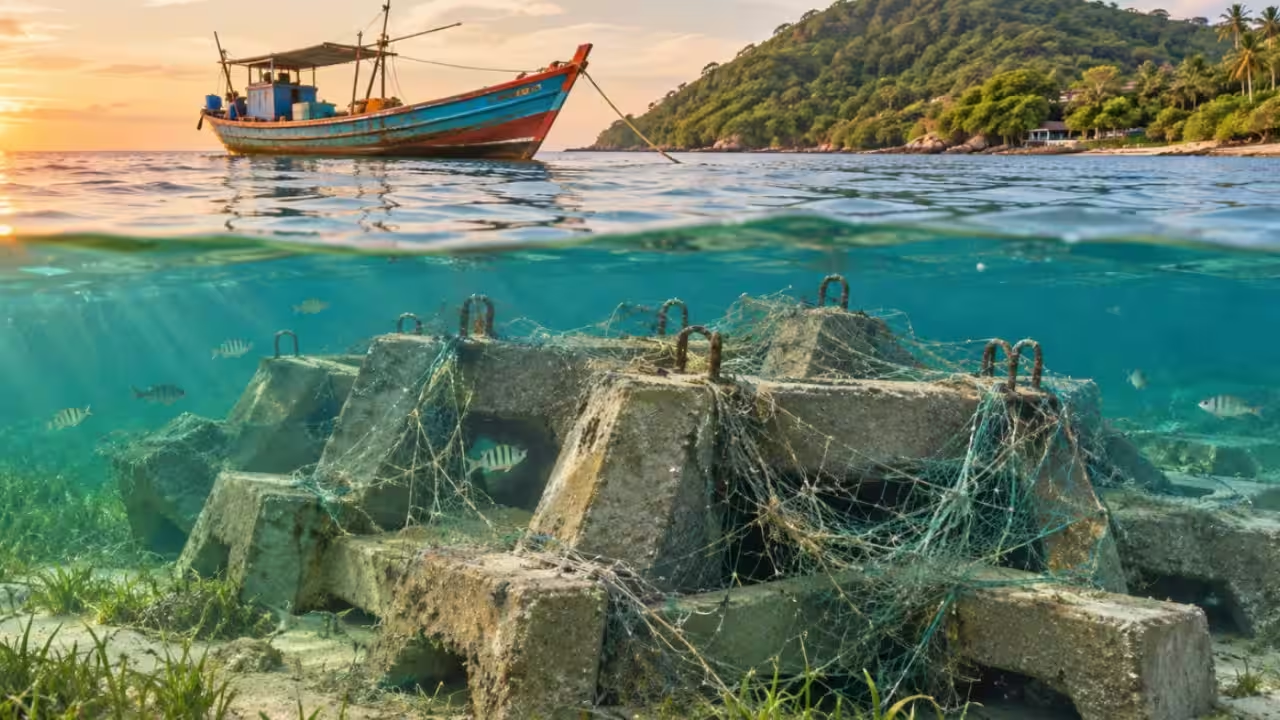
Off the coast of Kep in Cambodia, a low-cost idea is helping protect the seabed. According to the Asian Development Bank’s Southeast Asia Development Solutions team, conservationists have installed interlocking concrete blocks that snag the nets of illegal bottom trawlers. With the barriers, the need for patrols has been reduced, saving around 500,000 litres of fuel per year. It was a simple idea with a big goal: helping fish and the families that depend on them bounce back.Why Cambodia’s coast needed a handFishing is a big part of life in Cambodia. The Asian Development Bank says the industry contributes 8% to 10% of the country's GDP and provides a livelihood for millions of people. Fish is also the most commonly consumed food in the country after rice. However, the bank’s research shows that the fish stock experienced a dramatic decline of about 40% to 60% between 2017 and 2022. It blames overfishing as well as mangrove loss and the deterioration of seabeds, the latter largely due to bottom trawling. Without stronger coastal and marine ecosystems, the bank predicts stocks could drop by a further 30% by 2030.How the blocks work Since 2018, Cambodia's Fisheries Administration has been working with Marine Conservation Cambodia, a community-based group, to place large passive structures in the sea. The group came up with modular concrete and rebar blocks that were low-cost and easy to build. They were built and placed by local communities, with the blocks assembled underwater to form a complete structure. The structures mark the edge of a marine protected area and act as barriers against illegal bottom trawling. The nets of trawling vessels get caught on them, discouraging illegal fishing. The blocks do more than just stop nets. They also create an artificial reef and habitat for young fish. In Kep, they were seeded with locally grown oyster spat, which gave the community another income source and helped filter the water. The work also helped protect the habitats of endangered species such as the Irrawaddy dolphin, dugong, sea turtles and seahorses.What the research shows A 2025 Frontiers in Marine Science paper by Amanda Ho and team looked at the area in detail. According to the study, researchers surveyed an area of 62,146 hectares in four zones during the dry seasons of 2022 and 2023. Outside the protected Kep marine fisheries management area, seagrass was found only in shallow waters out of reach of trawlers. Within the protected zone, where the structures were in place, seagrass thrived in deeper areas. Halophila, a pioneer seagrass genus, was abundant near the blocks, hinting at regrowth. The authors saw it as an early sign of recovery. In Kampot, a neighbouring survey zone with no structures, Ho and colleagues noted that seagrass cover fell by 39% from 2013 to 2023. The authors worked for Marine Conservation Cambodia and said future studies should directly measure trawling activity.Plans to scale up In December 2022, the bank approved a $73 million financing package for Cambodia's marine fisheries, which included support for deploying more of these structures. France’s Agence Française de Développement was also set to provide co-financing equivalent to $20 million on top of that, administered by the bank. The project covered four coastal provinces: Kampot, Kep, Koh Kong and Preah Sihanouk. The idea was to place 5,000 structures in almost 40% of the near-shore fishery. The blocks would be made by the local community under a wage-for-work programme. The project would also support sustainable mariculture and business incubators for small firms, especially women-led ones. It was expected to benefit nearly 20,000 households and a wider coastal community of around 200,000 people. Sometimes protecting the sea can start with something as simple as concrete.You use AI every day. Now get your AI Quotient. Take the AIQ test.
Topics in this story
Gathered from external sources. Rights to this text belong to whoever originally published it.