Indian-American candidates in 2026 US midterms: Key races, profiles, latest polling & what's at stake
The 2026 US midterm elections are shaping up to be a significant test of Indian-American political representation.
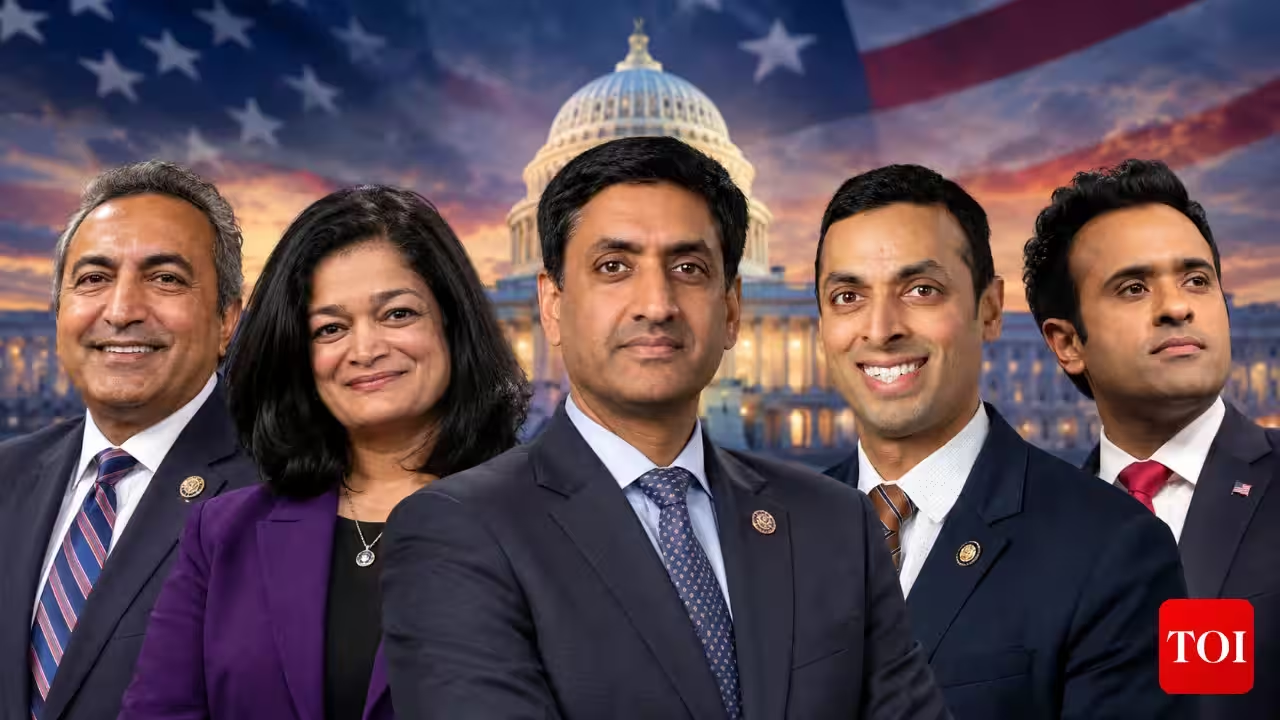
The 2026 US midterm elections are shaping up to be a significant test of Indian-American political representation.Four Indian-origin Democrats — Ro Khanna, Pramila Jayapal, Ami Bera and Suhas Subramanyam — are seeking re-election to the House of Representatives. Meanwhile, Vivek Ramaswamy is locked in a high-octane race for governor of Ohio, and physician-turned-politician Amish Shah is attempting to capture an open Arizona congressional seat.Read also | US midterm elections 2026: Why it's a do-or-die fight for Trump & the Democracts - explained in 10 chartsThe contests extend beyond Congress. Indian-American candidates are competing for attorney-general positions, mayoralties and seats in state legislatures across the country.The elections on November 3 will take place against the backdrop of a closely divided Congress and a national debate over the economy, immigration, healthcare, technology and Trump's policies. The outcomes could determine not only which party controls Capitol Hill but also how much influence Indian-American lawmakers exercise in Washington and state governments.Indian-Americans in key congressional races1. Ro KhannaRo Khanna, one of the most prominent Indian-American Democrats in Congress at the moment, is seeking a sixth term from California’s 17th Congressional District, which covers much of Silicon Valley, including parts of Santa Clara and Alameda counties. He faces Republican Ritesh Tandon in the midterms, after comfortably finishing first in California’s June 2 nonpartisan primary with 62.3% of the vote. Tandon advanced with 14.8%.The district, home to major technology companies and a large population of technology workers, has consistently favoured Democrats.First elected to the House in 2016, Khanna has established himself as a progressive voice on economic policy, technology, foreign affairs and the role of American power overseas.Born in Philadelphia to Indian immigrant parents, he studied economics at the University of Chicago and earned a law degree from Yale University. Before entering Congress, he taught economics at Stanford University, practised law and served as deputy assistant secretary of commerce under President Barack Obama.He now sits on the House Armed Services Committee and has been an influential voice on issues ranging from artificial intelligence and semiconductor manufacturing to US competition with China.Read also | US midterms 2026: Meet Ro Khanna, Indian-American Congressman behind Epstein files pushKhanna has been a vocal critic of President Donald Trump, particularly over his economic policies, immigration crackdown and approach to democratic institutions. He has challenged the administration’s priorities on taxation and economic inequality, arguing that government policy should benefit working families rather than disproportionately favour wealthy individuals and corporations. His opposition to Trump also extends to the president’s use of executive power and his approach to foreign policy, where Khanna has advocated greater congressional oversight of military action and a stronger emphasis on diplomacy.At the same time, Khanna has sought to distinguish himself from the Democratic establishment by championing a more populist economic agenda, including investment in manufacturing, clean energy, education and healthcare.His views on technology, economic inequality and America’s global role frequently place him at the centre of the party’s policy debate.2. Pramila JayapalPramila Jayapal is seeking re-election from Washington’s 7th Congressional District, which includes much of Seattle and surrounding communities. She faces Republican Nirav Sheth in the midterms after dominating the state’s nonpartisan primary, securing 84.4% of the vote against Sheth’s 9.8%.The result underlined her strong standing in a heavily Democratic district, where she has built a substantial political base through her advocacy on immigration, healthcare and economic inequality.Elected to Congress in 2016, Jayapal made history as the first South Asian American woman elected to the House of Representatives.Born in India, she moved to the United States at 16 to attend Georgetown University and later earned an MBA from Northwestern University. Before entering electoral politics, she founded OneAmerica, a Washington-based immigrant-rights organisation, and became a prominent campaigner for immigration reform and civil liberties. Her experience as an activist has shaped her legislative priorities, particularly on deportations, detention, family separation and pathways to legal status.Jayapal has championed Medicare for All, stronger labour protections, affordable housing, climate action and expanded access to education. She has also held leadership positions in the Congressional Progressive Caucus and serves on the House Judiciary, Foreign Affairs and Budget committees, giving her influence over debates on immigration enforcement, federal spending and American foreign policy.Read also | US midterms 2026: From immigration reform to $15 minimum wage, all about Pramila JayapalA vocal critic of President Donald Trump, Jayapal has repeatedly challenged his administration’s immigration crackdown, deportation policies and restrictions on legal immigration. She has argued that the administration’s approach threatens civil liberties and undermines protections for immigrant communities. Her opposition also extends to Trump’s economic agenda and broader use of executive power, with Jayapal advocating stronger social protections and greater accountability for the administration.Her politics frequently put her to the left of the Democratic leadership, although she has worked within the party to advance progressive priorities.3. Ami BeraAmi Bera, one of the longest-serving Indian-American members of Congress, is seeking another term in California’s 3rd Congressional District, which covers Sacramento County and surrounding communities. He faces Republican Robb Tucker in the November 3 midterm elections.In the state’s nonpartisan primary, Bera secured 34.3% of the vote against Tucker's 29.9%.His re-election bid comes as Democrats seek to regain control of the House, with the Sacramento region offering a test of whether his established local support can withstand the broader national political climate.First elected in 2012, Bera has represented the Sacramento area in Congress since January 2013. The son of Indian immigrants, he grew up in California and earned his medical degree from the University of California, Irvine. Before entering politics, he worked as a physician and served as Sacramento County’s chief medical officer.His background has helped shape his political identity as a pragmatic Democrat who emphasises healthcare, public services and evidence-based policymaking rather than the more sweeping economic agenda associated with the party’s progressive wing.Read also | US midterms 2026: Who is Ami Bera, Indian-American Democrat seeking re-election from California's newly redrawn districtHealthcare remains a central part of Bera’s political profile. He has advocated improving access to medical care, reducing prescription drug costs and strengthening Medicare, while also focusing on education, infrastructure, veterans’ services and economic development. His approach generally favours targeted reforms and bipartisan cooperation, positioning him closer to the Democratic Party’s moderate wing on several policy questions.Foreign affairs, however, have become one of his defining areas of influence.Bera has served on the House Foreign Affairs Committee and the House Permanent Select Committee on Intelligence, with a particular interest in the Indo-Pacific. He has supported stronger US engagement with India and closer cooperation with regional partners, while emphasising the strategic challenge posed by China. His work has given him a prominent role in debates over US-India relations, regional security, intelligence oversight and the future of American engagement in Asia.4. Suhas SubramanyamSuhas Subramanyam is seeking a second term in the US House of Representatives from Virginia’s 10th Congressional District, which includes Loudoun County and parts of the surrounding Northern Virginia suburbs. He faces Republican Dave Beckwith and independent candidate Ahsen Mujeeb Malik in the midterms.The district, home to technology professionals, federal employees and government contractors, has generally favoured Democrats, but the Trump administration’s cuts to the federal workforce and changes to government spending have made these issues particularly consequential for local voters.Subramanyam entered Congress in January 2025 after defeating Republican Mike Clancy in the 2024 election. His victory made him one of the newest Indian-American members of the House. Born in Houston to Indian immigrant parents, he studied at Tulane University and earned a law degree from Northwestern University. Before entering electoral politics, he worked with technology startups and served as a technology policy adviser in the Obama White House. He was elected to Virginia’s House of Delegates in 2019, becoming the first South Asian American elected to the state legislature, and later served in the Virginia Senate before moving to Congress.His political profile combines technology policy, economic affordability and a focus on practical local concerns. During his time in the Virginia legislature, he worked on issues including utility bills, prescription drug costs, education and gun safety. In Congress, he has emphasised support for small businesses, infrastructure investment, healthcare access and protecting federal workers. His background in technology has also shaped his attention to the rapid expansion of data centres in Northern Virginia, where new developments promise investment and jobs but raise concerns about electricity demand, water consumption, land use and higher infrastructure costs.Read also | US midterms 2026: Meet Suhas Subramanyam, Indian-origin Democrat who served as advisor to Barack ObamaSubramanyam has been critical of Trump’s policies on federal employment and government restructuring, arguing that abrupt cuts and uncertainty can harm public services and communities that depend on government jobs. His district is particularly exposed to such changes because of its concentration of federal agencies, contractors and defence-related businesses. He has also advocated reproductive healthcare protections, stronger gun-safety measures and policies aimed at lowering household expenses.New entrantsAmish Shah is running as the Democratic nominee in Arizona's 1st Congressional District. He previously contested the seat in 2024, losing to Republican David Schweikert. Schweikert is now running for governor, leaving the congressional seat open. Shah won the July 21, 2026, Democratic primary with 39.4% of the vote, defeating Marlene Galán-Woods, who received 34.4%. He faces Republican Jay Feely, a former NFL kicker, in November. The district is competitive, making this one of the more consequential races involving an Indian-origin congressional candidate. A FirstStrategic poll conducted on October 1 found Shah at 44.4% and Feely at 41.6% among registered voters, with a margin of error of 5.4 percentage points. A forecast updated October 23 projects Shah at 63% to win.Read also|US midterms 2026: Meet Amish Shah, the doctor seeking a second shot at CongressPia Dandiya is the Democratic nominee in Florida's 22nd Congressional District, an open seat where she faces Republican Casey Askar. Dandiya won the August 18 Democratic primary with 68.6% of the vote, defeating Kaysia Earley. Askar won the Republican primary with 30.9% in a crowded field.Read also | US midterms 2026: Meet Pia Dandiya, Indian-origin Democrat running for Florida’s open 22nd House seatRitesh Tandon is the Republican nominee challenging Khanna in California's 17th Congressional District. He advanced through the June 2 top-two primary with 19,793 votes, or 14.8%, finishing behind Khanna. The district is heavily Democratic, and current forecasts show Khanna with a substantial projected advantage.Nirav Sheth is the Republican challenger to Jayapal in Washington's 7th Congressional District. He secured second place in the state's nonpartisan primary, receiving 21,282 votes, or 9.8%. Jayapal won 84.4%. Sheth's advance means the November ballot will feature two races where Indian-origin candidates are facing off from opposing parties.Indian-American politicians not on the ballot Raja Krishnamoorthi lost the Democratic primary for the Illinois Senate seat and will not be the party's nominee in the November Senate election. His absence removes a high-profile Indian-American candidate from one of the year's most prominent Senate contests.Shri Thanedar lost the Democratic primary for Michigan's 13th Congressional District and is not the Democratic nominee in the November race.Gubernatorial race attracting national attention: Vivek RamaswamyVivek Ramaswamy, the Indian-American entrepreneur who emerged as a prominent voice in the Republican Party during the 2024 presidential race, is seeking to become governor of Ohio, the state where he was born and raised. The Republican nominee faces Democrat Amy Acton, a physician and former director of the Ohio Department of Health. The contest has become a closely watched test of Ramaswamy's transition from conservative political outsider to candidate for executive office.Born in Cincinnati to Indian immigrant parents, Ramaswamy studied biology at Harvard University and law at Yale. He made his fortune in biotechnology and investment management, founding Roivant Sciences in 2014. His 2021 book, Woke, Inc., established his political identity as a critic of corporate diversity initiatives, environmental, social and governance investing and what he considers excessive ideological influence over business.During the 2024 Republican presidential primary, he advocated cutting government bureaucracy, restricting federal spending and challenging established political institutions. Although he withdrew from the race and endorsed Donald Trump, his combative campaign style helped establish him as a nationally recognised conservative figure.Trump subsequently selected Ramaswamy to co-lead the Department of Government Efficiency initiative alongside Elon Musk, although he left before the initiative's major restructuring efforts as he turned to the Ohio governor's race.His gubernatorial platform centres on reducing government costs, deregulation, education reform and expanding economic opportunity. His political relationship with Trump remains a defining feature of his campaign, even as he seeks to establish an independent record as a candidate for state leadership.The campaign has recently been embroiled in controversy over an advertisement featuring Acton's estranged mother criticising her daughter.Read also | US midterms 2026: Meet Vivek Ramaswamy, Trump-backed Republican seeking the Ohio governorshipThe ad drew bipartisan condemnation, including from DeWine, who urged Ramaswamy to withdraw it. Trump, however, defended the advertisement and encouraged Ramaswamy to continue running it, while Vice-President JD Vance also criticised Republicans who opposed it. The dispute has sharpened questions about the role of personal attacks in the campaign and whether the controversy could affect Ramaswamy's standing with voters.Polling has shown Acton ahead, although the size of her lead varies. The RealClearPolling average for October 19 put Acton at 48.7% and Ramaswamy at 44.3%, while a Fox News poll conducted October 15–19 found a narrower 50-48 margin.Other statewide contestsNirav Shah, a physician and public-health administrator, is the Democratic nominee for governor of Maine. He previously served as director of the Maine Center for Disease Control and Prevention from 2019 to 2023 and as principal deputy director of the US Centers for Disease Control and Prevention from 2023 to 2025. Shah won Maine's June 9 Democratic gubernatorial primary with 26.9% of the vote.Aruna Miller, Maryland's lieutenant governor, is seeking to continue in office on the Democratic ticket led by Governor Wes Moore. Born in India, Miller immigrated to the US as a child and built a career as a transportation engineer before entering politics. Her career includes service in Maryland's House of Delegates and election as lieutenant governor in 2022. Miller's political position differs from that of a standalone gubernatorial candidate: the lieutenant governor runs on a joint ticket with the governor. Her electoral prospects therefore depend on the performance of the ticket as a whole as well as her own profile.Read also | US midterms 2026: Indian-American Democrat Aruna Miller seeks re-election as Maryland Lt Governor alongside Wes MooreSaritha Komatireddy, a Republican lawyer and former federal prosecutor, is the Republican nominee for New York attorney general. She is challenging Democratic incumbent Letitia James. Her campaign offers Republicans an opportunity to contest an office that has become nationally prominent because of high-profile investigations and litigation involving major businesses and political figures.Read also | US midterms 2026: How 9/11 shaped Saritha Komatireddy’s legal career as she runs for New York attorney generalJosh Kaul, Wisconsin's Democratic attorney general, is seeking re-election.Nithya Raman: Running for Los Angeles mayorRaman is a Los Angeles City Council member and urban planner seeking to unseat Mayor Karen Bass. Her campaign focuses on housing, homelessness, city services and the cost of living. She has become a prominent figure in the city's progressive political movement.Raman advanced to the November 3 mayoral runoff after the June 2 primary. Certified results gave incumbent Bass 34.3%, Raman 29.0% and Spencer Pratt 25.5%. Raman's advance to the runoff turned the race into a direct contest between two Democrats.Read also | US midterms 2026: Indian-born Nithya Raman challenges LA mayor Karen BassA McLaughlin & Associates/California Post poll conducted October 15–18 put Raman ahead by 7.9 percentage points. An Impact Research poll conducted October 2–7 put her ahead by 10 points, while a UC Berkeley Institute of Governmental Studies/Los Angeles Times poll from September 15–20 showed an 11-point lead.Raman's candidacy is significant beyond her own electoral prospects: a victory would make her the first South Asian woman to serve as Los Angeles mayor. Her campaign will test whether her progressive coalition can expand sufficiently to defeat an incumbent in a city facing persistent housing and homelessness challenges.(function(){function e(){window.addEventListener(`message`,function(e){if(e.data[`datawrapper-height`]!==void 0){var t=document.querySelectorAll(`iframe`);for(var n in e.data[`datawrapper-height`])for(var r=0,i;i=t[r];r++)if(i.contentWindow===e.source){var a=e.data[`datawrapper-height`][n]+`px`;i.style.height=a}}})}e()})();What's at stake for Indian-AmericansFor the Indian-American community, the November 3 midterms are about more than individual victories. They are a test of how far a once-underrepresented community has come in American politics — and whether its growing presence can translate into greater influence in Congress, state governments and the national debate.The stakes are particularly high for the so-called ‘Samosa Caucus’, the informal label for Indian-American lawmakers in the US Congress.Ro Khanna, Pramila Jayapal, Ami Bera and Suhas Subramanyam are fighting to retain their House seats, while challengers such as Amish Shah and Dandiya are seeking to expand the community’s footprint on Capitol Hill. Their outcomes will help determine whether Indian-origin representation in Congress consolidates, grows or faces a setback at a time when immigration, technology, healthcare, economic opportunity and America’s role in the world are fiercely contested.The stakes extend beyond Washington. Vivek Ramaswamy’s bid for governor of Ohio could take an Indian-American politician from national prominence to one of the country’s most powerful state offices. Nirav Shah’s campaign in Maine adds another dimension to the contest for statewide leadership. Success in races such as these would signal that Indian-origin candidates are competing not just in safe districts or within established political networks, but for executive power and leadership across the political map.Yet there is no single Indian-American political story. The candidates span the ideological spectrum — from progressive Democrats to more centrist lawmakers and conservative Republicans — and are campaigning on sharply different visions of government. Their fortunes will reflect not only the strength of their personal brands and local coalitions, but also how voters respond to their parties, their policies and the national political climate. Representation, in other words, does not automatically translate into a common agenda.Ultimately, November 3 will test whether Indian-American candidates can turn growing political visibility into electoral power. The results will shape not only the careers of individual candidates, but also the scale and reach of Indian-American representation in American public life — and the influence the next generation may be able to wield in setting the country’s political priorities.You use AI every day. Now get your AI Quotient. Take the AIQ test.
Topics in this story
Gathered from external sources. Rights to this text belong to whoever originally published it.