In 2016, a New Zealand ranger became the only human living on a predator-free island; he stayed to guard the last refuge of the world’s heaviest parrot
Rest of World News: Discover the inspiring story of a New Zealand ranger dedicated to protecting the critically endangered kakapo on Whenua Hou, a predator-free island, and the innovative conservation efforts behind their survival.
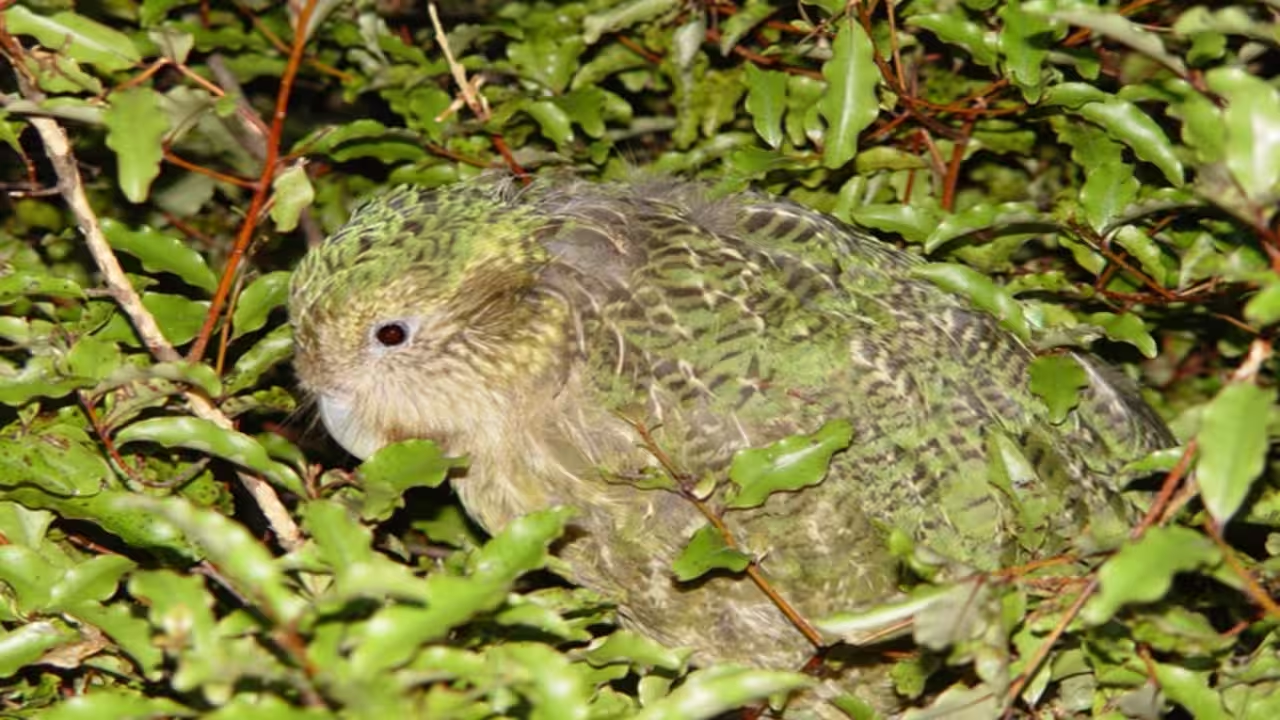
Off the northwestern coast of Stewart Island sits a small, forested reserve that visitors are not allowed to see. Codfish Island, known in Māori as Whenua Hou, is closed to the public and free of the rats, stoats and possums that have wiped out ground-dwelling birds across mainland New Zealand. For months at a stretch, Department of Conservation rangers were sent there to protect the kakapo, a flightless parrot so rare that every living bird has a name.Kakapo once ranged across much of New Zealand, but introduced predators drove them to the brink of extinction by the mid-20th century. Conservation staff transferred the last wild birds to a series of cleared, predator-free islands, and Whenua Hou became the centrepiece of that effort once rats and possums were eradicated there in 1998, according to the Department of Conservation, which now runs the recovery programme. The island offers kakapo habitat similar to that on nearby Stewart Island, including rimu forest, whose fruiting seasons trigger breeding.Using isolated islands as sanctuaries was not a new idea. In the 1890s, self-taught naturalist Richard Henry rowed hundreds of birds to Resolution Island in Fiordland, hoping to create this kind of refuge decades before the scale of the threat was widely understood, according to Atlas Obscura. Stoats reached his island in 1900 and undid much of his work within a few years, but the underlying idea of a landmass scrubbed clean of predators eventually became the backbone of the modern kakapo programme.Life on a closed reserveGetting onto Whenua Hou today involves strict quarantine, since even a single stowaway seed or insect could threaten the island's pest-free status. Access is limited to small planes or helicopters landing on the beach at Sealers Bay, and visitors' gear is checked beforehand to keep the island free of new pests. During the 2016 breeding season, a small rotating team of rangers and volunteers lived on site for months, tracking nests, weighing chicks and hand-feeding birds when the forest's natural food supply ran short, work later described by one of the volunteers on the department's own blog.For long stretches, that handful of staff effectively remained on the island, since the reserve has no permanent settlement and no visitor facilities beyond a single hut. It is quiet, physically demanding work: climbing steep tracks at night with headlamps to check burrows. The isolation is real, too, since the nearest town is a short flight away across open water. Rangers describe losing weight over a season from the effort of covering the island's terrain on foot while carrying supplementary feed for the birds.A parrot's long road backThe result of that isolation has been a gradual recovery. Kakapo numbers fell to just 51 individuals by 1995, before intensive management on islands such as Whenua Hou began reversing the decline. Conservation biologist Andrew Digby, who works on the programme, has described spending entire breeding seasons on the sanctuary islands, using trackers, activity monitors and drones to move fresh semen between birds and improve fertility rates, in an account published in Nature.The species remains critically endangered, and setbacks still occur, including a serious outbreak of the fungal disease aspergillosis that killed several birds in a recent breeding season. But the population has climbed well past its 1990s low, helped by the work done inside places like Whenua Hou that most New Zealanders will never be permitted to visit. The kakapo is the heaviest living parrot and the only one with a lek breeding system, in which males gather to call for mates rather than pairing off directly. Its survival now depends almost entirely on a small number of predator-free islands and the rangers willing to live there in short, solitary shifts.What began as one naturalist's rowboat experiment in the 1890s has become a carefully managed, technology-assisted rescue effort, but the basic principle has barely changed. Remove predators from a patch of land, put dedicated people there to watch over the birds, and give a flightless species the closest thing possible to a second chance.Catch the latest World News and Live updates. Download the TOI app.
Topics in this story
Gathered from external sources. Rights to this text belong to whoever originally published it.