Stock investors are giving up on China
Chinese stocks are hitting lows for two fundamental reasons.
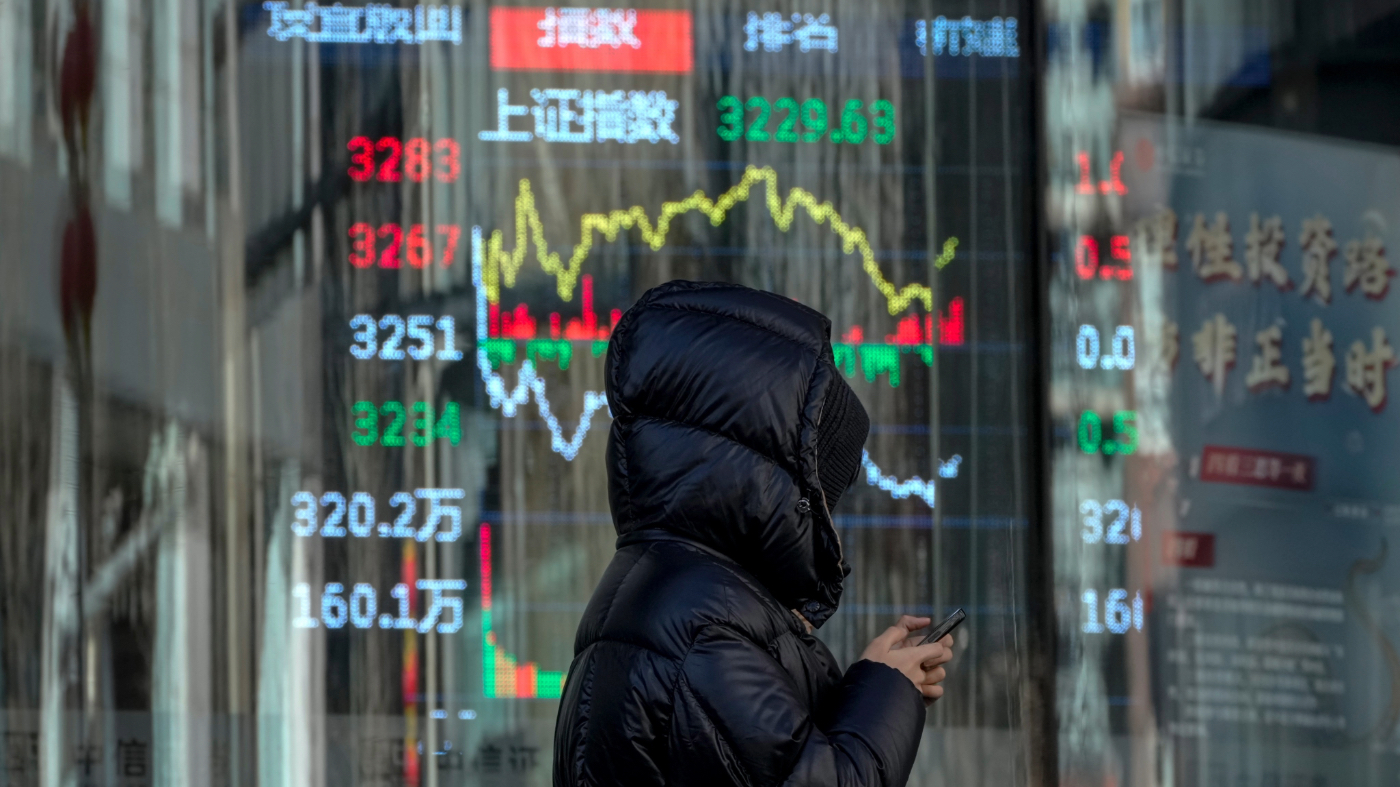
China’s closely watched CSI 300 Index has fallen 20 percent from June highs and is now officially in bear-market territory.
Chinese stocks have lost more than $3.5 trillion in value since the middle of the year. Many analysts believe that shares are still on a downward path. Morgan Stanley, for instance, sees perhaps another 15 percent drop .
“If the country is winning the future, why are its investors so glum?” asks the Economist in an article titled “China’s Stock Markets Are the Great Global Exception.” The S&P 500 in the U.S. has gained 53 percent over the last five years. In Europe, the FTSE 500 has gained 45 percent. The CSI 300 has now lost 18.5 percent in the same period.
Chinese stocks are hitting lows for two fundamental reasons. For one thing, Xi Jinping’s economic plans are not working. Second, Xi is adopting policies that reduce or even eliminate profits at listed companies, scaring away investors — especially domestic investors.
On the first point, the Chinese economy, especially from the outside, looks bright and shiny because of the country’s leadership in a number of crucial technology areas. Xi’s Made in China 2025 initiative and five-year plans — China is now in the first year of its 15th five-year plan — along with associated programs, are all tech-heavy.
“The country’s technology companies are forging ahead,” Andrew Collier, a research fellow at the Harvard Kennedy School’s Mossavar-Rahmani Center, told me this month. He noted that corporate profits for high technology manufacturing rose 52 percent in the first nine months of this year. However, such manufacturing only accounts for roughly 6 percent of the country’s economy.
Optimists point out that the export sector is another success story. The country’s trade surplus at the end of October hit a stunning $1.04 trillion . But paradoxically, many export-oriented factories are earning only thin margins and are not doing well. This appears to be the reason why the central government, through brazen currency interventions, is slowing the rise of the renminbi . The manipulation is of course attracting criticism from the country’s trading partners.
The rest of the economy is deteriorating fast. The property sector at the end of last decade accounted for about a quarter of gross domestic product. Now, the extreme oversupply — the country has more vacant housing than its entire population of 1.4 billion people could fill — is weighing heavily on growth.
With housing prices falling, a negative wealth effect is weighing on consumption. Furthermore, Xi’s relentless drive for automation, which is producing the world’s most advanced robots, is aggravating both unemployment and underemployment.
Urban unemployment, officially pegged at 5.2 percent in September, is probably closer to 20 percent overall and much higher for the crucial 16 to 24 age cohort. Some recent college graduates are not even looking for white-collar jobs, heading straight to menial employment out of school. Gig jobs employ a stunning 44 percent of the country’s workforce.
Consumption in China accounts for only about 38 percent of GDP , one of the lowest consumption-contribution rates in the world. And from all indications consumption’s role is continuing to decline.
The central government has sporadically introduced measures to stimulate consumer spending, but they are almost always one-off programs that have no lasting effect. Xi has not implemented structural reforms that will empower consumers at the expense of state enterprises and state banks.
In sum, GDP growth, in reality, is almost certainly less than the 4.5 percent reported for the third quarter of this year.
“China’s split economy — booming in tech and slowing in everything else — is coming apart,” says economic analyst Andrew Collier.
Second, domestic investors realize that Xi is trying to take away almost all of the benefits of the country’s tech wonders. For instance, he is commoditizing China’s tech products so that they flood the world. This process, however, reduces corporate profits and therefore investor interest.
Take the initial public offering of CXMT on July 27. The memory chip firm became the most valuable Chinese public company on its first day of trading. But as Alicia Garcia-Herrero of The Wire China wrote , investors viewed the company as just “another heavily subsidized entrant” that “would now be racing to add capacity into a market already braced for a price war.”
Investors know by now that they do not control company decisions; Xi does. And he has very different goals than they have. It does not help, as Collier noted, that the “Nvidia blow-up” and related concerns “have scared away some investors in the artificial intelligence boom.”
Because of these fundamental problems, the Chinese government’s support measures have not been particularly effective this year. China’s officials every so often mount a rescue operation by the so-called “national team,” as they did in the middle of July when state-controlled firms went into the market to buy $8.9 billion of shares . But investors this year have been ignoring the government’s desire that they buy stocks.
Earlier this month, the government banned initial public offerings and large stock sales. As the Wall Street Journal’s Lingling Wei wrote , “Intervention looks more like a Band-Aid than a cure.”
Nothing seems to be working to keep stock prices high, and nothing will work until Xi stops trying to command the economy and the markets.
Topics in this story
Gathered from external sources. Rights to this text belong to whoever originally published it.