In 1922, a Hawaiian family bought a remote Pacific atoll to harvest coconuts; they later fought the US Navy, rejected casino plans and sold it for conservation
US News: Explore the remarkable journey of Palmyra Atoll, a Pacific paradise transformed from a coconut farming venture into a protected ecological haven, highlighting its battles with the US Navy and commitment to conservation.
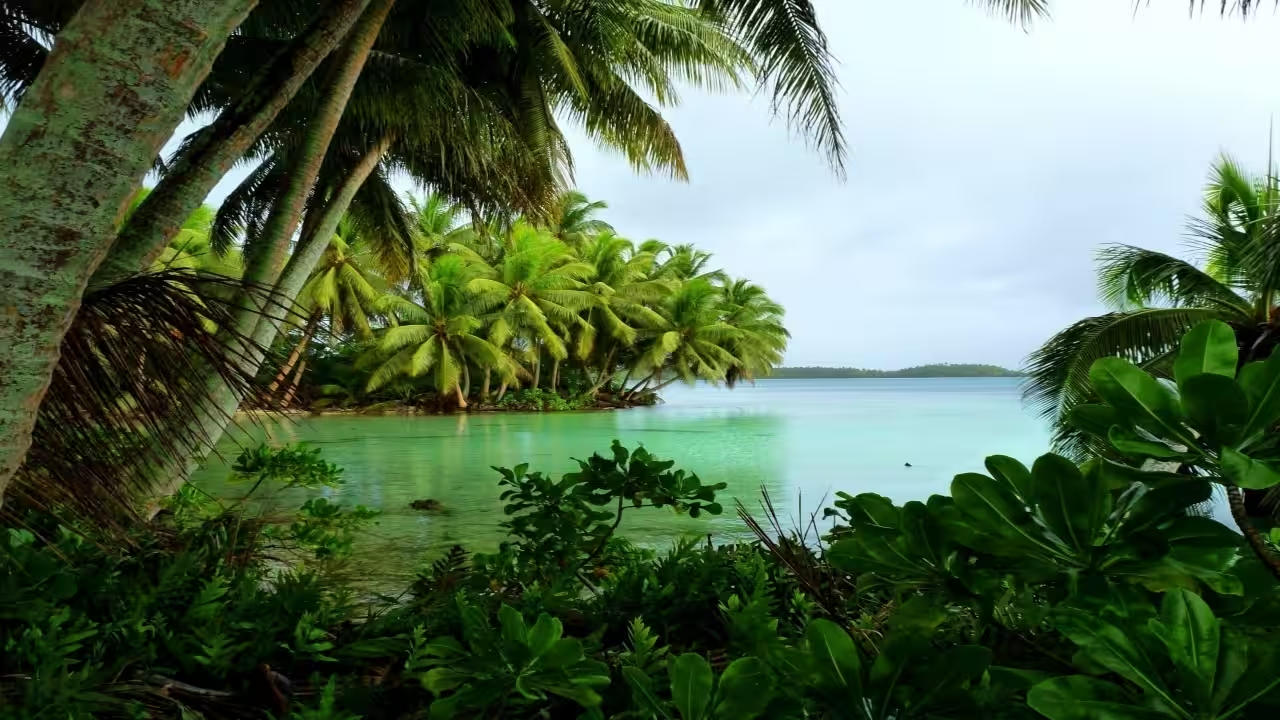
A remote ring of islets about 1,000 miles south of Hawaii has spent more than a century passing between coconut farmers, the US Navy and, eventually, conservationists. Palmyra Atoll was bought in 1922 by a Honolulu couple who wanted nothing more than to harvest copra. What followed was a court battle with the federal government, decades of quiet stewardship and a final sale that turned the atoll into a scientific reserve.Leslie Fullard Leo and his wife purchased Palmyra from Judge Henry Cooper on 19 August 1922, paying fifteen million dollars for all but two of its islets. The couple set up the Palmyra Copra Company to harvest coconuts from the atoll's dense palm groves, according to the Department of the Interior, which still oversees the territory today. Palmyra had already changed hands several times since Hawaiian sea captains claimed it under royal commission in 1862, and Cooper himself had tried and failed to build a commercial settlement there a decade earlier. For the Fullard Leos, though, the purchase was meant to be straightforward business, a tropical outpost that would supply copra for years to come.That plan held until the Second World War arrived at their doorstep. The Navy took over Palmyra in 1941, stationing thousands of personnel there, dredging a seaplane runway through the lagoons and building an airstrip that the Air Force would use until 1961, a detail also recorded in the Department of the Interior's own history of the atoll. The family's quiet coconut operation was suddenly a military base, and getting it back would take another kind of fight altogether.A fight with the NavyWhen the war ended, the Fullard Leos wanted their atoll returned. The government resisted, and the dispute climbed all the way to the Supreme Court, which ruled in the family's favour in 1947 in United States versus Fullard Leo, a case still cited today in discussions of territorial ownership, as recorded by Justia. The Court found that a lost royal grant could reasonably be inferred from the atoll's long history of private possession and tax payment, restoring ownership to the family that had bought it a quarter century earlier.Palmyra then settled into an unusual rhythm for more than five decades. It remained privately owned by the Fullard Leo brothers, who lived in Hawaii and visited only occasionally, while the atoll itself stayed largely untouched by permanent settlement. Over those decades the family also weighed and turned away various commercial redevelopment proposals for the property, choosing instead to keep the atoll much as it had always been, isolated and thick with seabirds, sharks and coral. That restraint is a large part of why Palmyra survived into the twenty-first century in such pristine condition.From family asset to nature reserveBy the 1990s, scientists studying the atoll's reefs had begun making the case that Palmyra deserved permanent protection rather than continued private ownership. University of Hawaii researcher James Maragos, who had surveyed the old wartime debris sites and catalogued around a hundred coral species there, helped convince the family to allow further study and eventually championed its purchase, a story the Nature Conservancy still tells as central to its own history on the atoll. In December 2000, the three Fullard Leo brothers sold Palmyra to the Nature Conservancy for around thirty million dollars.The sale did not end there. Within a year, most of the atoll's land and surrounding waters were transferred to the US Fish and Wildlife Service, which now manages Palmyra as a national wildlife refuge and marine national monument. Today the only regular occupants are visiting researchers and conservancy staff, running a station powered largely by wind and solar energy. Where copra crews once worked the palm groves, scientists now track coral health, seabird colonies and coconut crabs, treating the atoll as a rare, mostly unspoiled baseline for how a Pacific reef system behaves without a resident human population.The arc for the atoll was simple: bought to grow coconuts, taken during wartime, returned through the courts and later sold for conservation. The Fullard Leo family's decision to keep Palmyra out of commercial hands for much of the twentieth century, and their eventual willingness to sell it for conservation, shaped the fate of one of the most biologically rich atolls in American waters.Catch the latest World News and Live updates. Download the TOI app.
Topics in this story
Gathered from external sources. Rights to this text belong to whoever originally published it.