Future pilots hope RAF will still need them in the cockpit
Teenagers eyeing careers in the air force are facing a future of unmanned jets and AI technology.
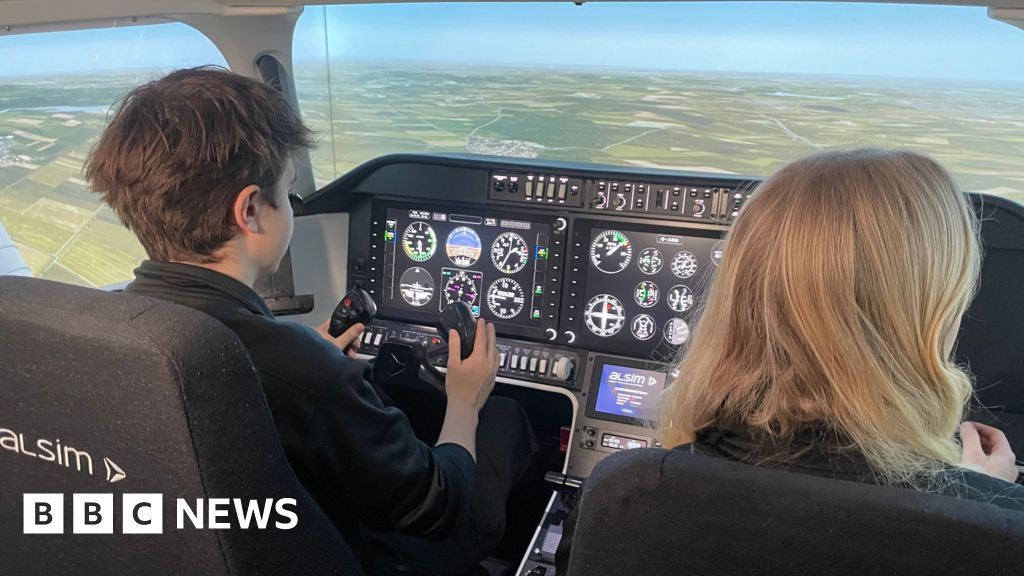
Britain's next-generation fighter jet could be the last to require a human crew before artificial intelligence (AI) takes over. So what does that mean for the teenagers hoping to become the pilots of the future?
It is a question students at Lincoln College's Air & Space Institute have been facing after the head of the RAF, Air Chief Marshal Sir Harv Smyth, said the Tempest – which is due to come into service in 2035 – would be "perhaps the last crewed fighter we will ever build".
Writing in the Telegraph last week, ACM Sir Harv said advances in technology and AI were transforming military aviation, with uncrewed fighter jets due to "start flying in UK airspace next year".
Students at the Air & Space Institute, based in Newark, are well aware that change is in the air.
Mati, 17, says he has long dreamed of being a pilot in the RAF, but accepts the role could become redundant eventually.
"There is that risk, there is that cause for concern, however AI and unmanned aircraft is the way forward.
"As a pilot when you're applying, you may no longer be in the cockpit, you may be sitting behind a screen."
He adds: "If I'm in the RAF and I'm flying an aircraft I've basically achieved my dream. I'm doing what I've wanted since I was a child".
The UK is developing the Tempest, as it is commonly known, in partnership with Italy and Japan.
The aircraft is expected to use advanced sensors and AI to assist the human pilot.
According to ACM Sir Harv, AI and machines will take on "the most dangerous tasks instead of humans" in future, though he has stressed that that technology should enhance human judgement and "not replace accountability".
His comments have come as no surprise to Jason Pimborough, curriculum director at the Air & Space Institute, who is encouraging students to be "open-minded" about the changes to military aviation.
"We work in direct partnership with the Royal Air Force to help develop our courses in order that we lay that talent pipeline for the future," he says.
"There will be pilot positions going forward but they will look a little bit different to perhaps what they do now and have done in the past."
Alicja, 17, is studying on the military and defence pilot pathway at Lincoln College, with the aim of becoming an RAF pilot or working in air traffic control.
She describes the thought of unmanned aircraft as "quite scary".
"Obviously, as a pilot you want to be in the cockpit actually doing the work," she says.
However, she remains confident that AI would not replace all pilots and still wants "to give it a go".
Engineering students are also gearing up for the opportunities the changes to aviation are likely to provide.
Josh, 17, is hoping to join the RAF after completing his course in military and defence engineering at Lincoln College.
He says tutors are holding "weekly" discussions with students to prepare them for the impact of new technologies on their chosen careers.
"It's going to be a bit of a challenge for engineers because we're going to think about all the AI stuff as well as the mechanical," he adds.
Fellow student Luke, 16, is hoping to become an aircraft technician at RAF Waddington, near Lincoln.
"I think the only challenge will be actually teaching the AI, because humans can be taught and they have different learning methods that we've used over the past hundred years or so," he says.
"I'm quite excited for it, honestly. I think the challenge is something I'm going to enjoy."
But despite the direction of travel, there will be opportunities for pilots for years to come, according to defence analyst Sean Bell, a former RAF fighter pilot and air vice-marshal.
"It's very likely we're going to see unmanned fighter jets," he says.
"There's no doubt that artificial intelligence is taking us down a path where we can look at ways to replace the pilot.
"We're seeing a lot more drones used, certainly in the last few conflicts and there's definitely a progression towards gradually finding out what's the optimum mix between AI and smart aircraft versus how you use the pilot in the future.
"Certainly for the next few decades we're still going to see a lot of manned aircraft required to actually defend this island nation."
Listen to highlights from Lincolnshire on BBC Sounds , watch the latest episode of Look North .
App Store Google Play for Android devices
RAF's next fighter jet could be last crewed combat plane, air chief says
RAF base prepares for threats at home and abroad
Inside the radar hub protecting UK skies
Britain 'on back foot' over Red Arrows replacement
Topics in this story
Gathered from external sources. Rights to this text belong to whoever originally published it.