In 2016, a Canadian diver hunting sea cucumbers spotted a giant metal “bagel” underwater; the Navy ruled out a bomb but its origin remained unknown
In 2016, diver Sean Smyrichinsky discovered a man-made object resembling a giant bagel off the coast of British Columbia. Investigations revealed its connection to a U.S. bomber incident, but its origin remains unidentified. The Canadian Navy confirmed it posed no threat, yet the mystery continues.
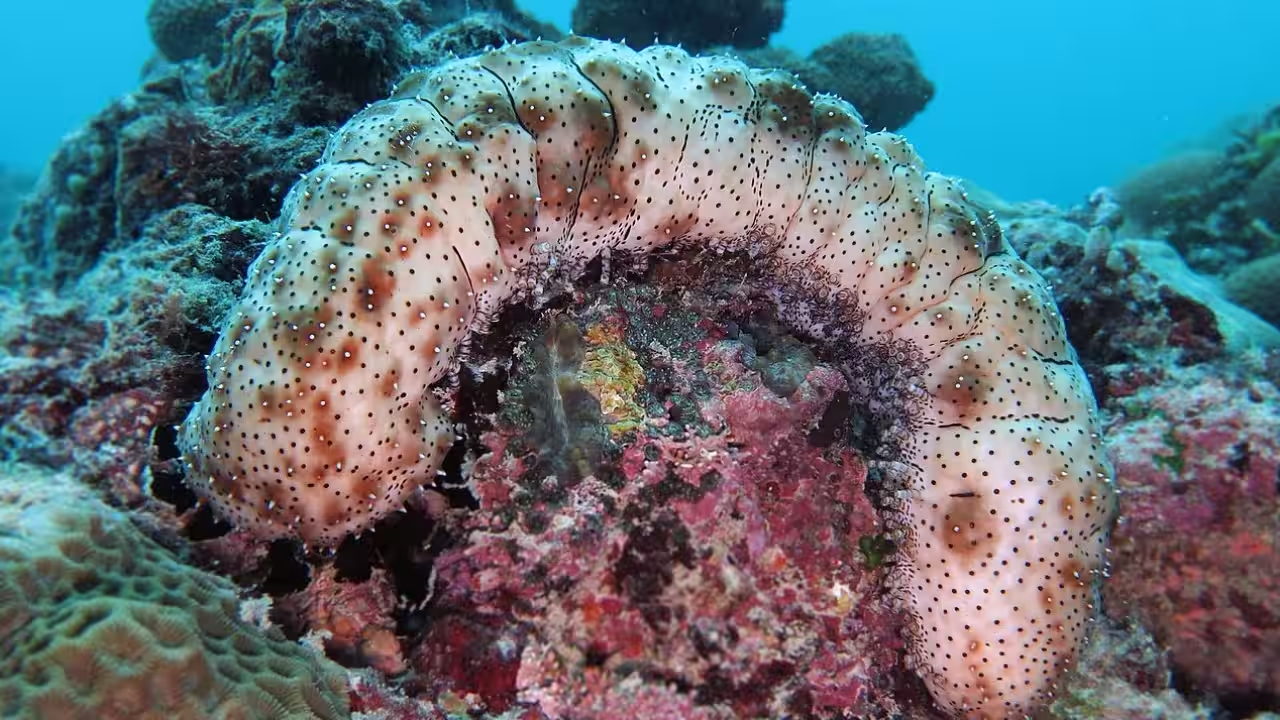
Banks Island lies off British Columbia’s North Coast, near Haida Gwaii, where the water is cold and the seabed is rocky. Commercial divers work this coast for seafood, and giant red sea cucumbers are one of the species they harvest. In October 2016, diver Sean Smyrichinsky was separated from his boat during an expedition, and on the seabed he spotted a large, unusual object. In an early November 2016 interview with CBC Radio’s Daybreak North, Sean Smyrichinsky described his discovery. The news about it quickly spread all over Canada and abroad. The shape was clearly man-made but had no clear function. Smyrichinsky mentioned his discovery to other fishermen, and one of them linked the object to an American bomber that had crashed in the area many years earlier. What began as a diver’s discovery became an investigation by the RCMP and the Royal Canadian Navy. This investigation answered one question, but kept the other open.Sean Smyrichinsky’s October 31, 2016 report to the Canadian Armed ForcesCTV News reported that Smyrichinsky contacted the Canadian Armed Forces on October 31, 2016, about an object he spotted approximately 80 kilometres from Prince Rupert. Looking down from above, he first thought it was a big round rock, but he later concluded that it was man-made and far too big for any small boat to have brought there. Radio-Canada International quoted his description of a bagel cut into two pieces, with ball-shaped fittings molded around it that were larger than basketballs. After the fisherman’s suggestion, he searched online for images of the Mark IV bomb, and the resemblance became obvious to him.The B-36 that jettisoned a Mark IV bomb on February 13, 1950The Black Vault’s online reading room hosts the Department of Defense report Narrative Summaries of Accidents Involving US Nuclear Weapons, 1950-1980, which documents the bomber incident. Aviation Safety Network lists the B-36 as flying from Eielson Air Force Base to Carswell Air Force Base and notes that a dummy core was inserted in the bomb it carried, while Legion Magazine described the mission as a planned 24-hour non-stop flight with simulated bomb runs over California before continuing to Texas. After six hours of flight, serious technical problems forced the crew to shut down three engines at 12,000 feet, and icing prevented the aircraft from flying level. The plane flew over the Pacific and dropped the weapon from 8,000 feet. The summary said that only high explosive material exploded, after which the aircraft was flown over Princess Royal Island, and the crew parachuted.The crew’s survival and the wreckage found in 1953 on MountAtomic Archive’s list of broken arrow accidents gives the bomb’s weight as 10,800 pounds, and the records indicated that the bomb carried a lead-filled dummy capsule rather than a plutonium core, so a nuclear explosion was not possible. History.com said that the bomber had 17 crew members, 12 of whom were recovered alive while five did not survive. The bomber continued to fly without its crew and crashed near Mount Kologet in northern British Columbia. B.C. Magazine reported that the Royal Canadian Air Force launched Operation Brix to find the missing airmen. Legion Magazine reported that the Royal Canadian Air Force spotted the wreckage in 1953 while searching for another missing aircraft, and that no radiation was found. ScienceAlert put the crash site on Mount Kologet about 300 kilometres from where the bomb was jettisoned.HMCS Yellowknife’s November 22 survey south of Prince RupertThe Northern View reported that the navy sent HMCS Yellowknife to the area on November 22, with Smyrichinsky aboard to help locate the object. The team used sonar, a remotely operated vehicle and dive teams in the search. The Canadian Press reported that the object lay under 8 metres of water, measured 5.5 metres long and 1 metre high, and was painted yellow.The navy announced that the discovered object was not unexploded military ordnance and did not pose any threat to nearby communities. The object was found underwater, but the available sources do not establish its origin or confirm that it was part of an industrial machine. The statement released by the navy did not give any details about the machine or its owner, and Radio-Canada International added that the Canadian Armed Forces were seeking help from the public in identifying the object.How the sea cucumber dive fishery works in British ColumbiaSmyrichinsky was in these waters because of a regulated fishery. Fisheries and Oceans Canada describes the giant red sea cucumber, Apostichopus californicus, in Science Advisory Report 2022/051 as the subject of a commercial dive fishery with 85 licences. As the life history of the species is not well known, four Experimental Fishing Areas were established in 1998 to assess the impacts of harvesting on the population density of sea cucumbers. The report proposed a limit reference point of 0.029 sea cucumbers per square metre of sea cucumber habitat and an upper stock reference level of 0.038 sea cucumbers per square metre for the commercial fishery. The department’s management plan summary adds that this is the only sea cucumber species harvested commercially in the province. It also adds that the vessels in the fishery have licenses for other dive fisheries, such as geoduck and sea urchin. Such activity may involve going through the seabed that few others venture to, and this could be why the unknown object was spotted.Why the navy’s findings left the object’s origin unresolvedThe navy’s findings settled the safety question but not the question of origin. They ruled out unexploded military ammunition, and CBC reported that the object was likely industrial machinery, yet none of the sources consulted prove where it came from. The dummy bomb was probably left on the seabed near where the crew dropped it, and Legion Magazine noted that the 2016 claim was dismissed as too far from that site. The Department of Defense report defines jettisoning as a nuclear weapons accident, so the 1950 case is included in its list of 32 accidents. That file was reopened more than six decades after the accident.You use AI every day. Now get your AI Quotient. Take the AIQ test.
Topics in this story
Gathered from external sources. Rights to this text belong to whoever originally published it.