James Baldwin arrived in France with $40 in 1948, then spent his final 16 years in an 18th-century home he bought piece by piece
Europe News: When James Baldwin arrived in Paris on November 11, 1948, he was 24 years old and had just $40 in his pocket. He had left the United States amid the r.
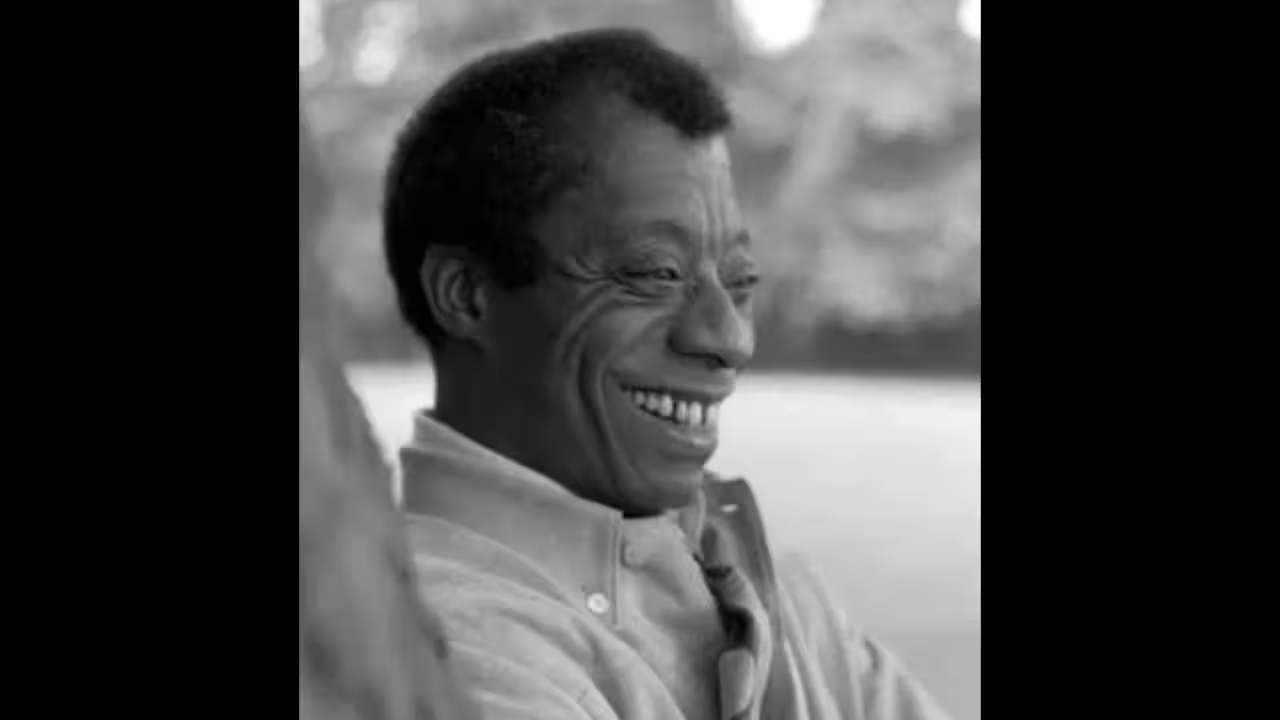
When James Baldwin arrived in Paris on November 11, 1948, he was 24 years old and had just $40 in his pocket. He had left the United States amid the racism and homophobia that had shaped much of his early life, hoping to find enough distance to write and understand the country he had left behind. France would remain central to his life for decades, but his final home was not in Paris. In 1971, after years of living between countries and spending time in Turkey, Baldwin settled in the small Provençal village of Saint-Paul de Vence in southern France. He moved into a house belonging to Jeanne Faure, initially renting rooms before gradually buying the property piece by piece with proceeds from his publications. The house, later known as “Chez Baldwin”, became his permanent home, workplace and gathering place during the final 16 years of his life. The purchase, however, was not legally complete when Baldwin died, leaving the property at the centre of a later dispute over its ownership.Paris gave Baldwin distance from the life he had left behindBaldwin left the United States in 1948 at a time when he was struggling to find the freedom and distance he needed to write. In Paris, he became part of the city's expatriate literary community and continued developing the work that would establish him as one of the most important American writers of the 20th century. France did not erase the difficulties Baldwin carried with him. The Smithsonian's National Museum of African American History and Culture notes that the assassinations of Black leaders during the 1960s took a profound emotional toll on him. Baldwin had known Medgar Evers, Malcolm X and Martin Luther King Jr., and their deaths contributed to a period of emotional and physical strain. The museum specifically documents King's 1968 assassination as a major turning point for Baldwin. In later accounts, Baldwin described the effect of King's death on his own life and said it contributed to his decision to seek refuge in the South of France. By 1971, Baldwin had settled in Saint-Paul de Vence. The official Saint-Paul de Vence tourism site describes the village as the place where he spent the last 16 years of his life, while the Smithsonian identifies his home there as his permanent residence from 1971 until his death.He gradually turned a rented house into his own homeBaldwin's arrival in Saint-Paul de Vence was not immediately straightforward. He initially rented several rooms and had to establish himself within a community where he was not initially well known. Simone Signoret, the French actress who was a friend of Baldwin, helped him find accommodation with Jeanne Faure. Faure initially had reservations about housing a Black man, but her relationship with Baldwin developed over time. He eventually decided to acquire the property, and according to the Smithsonian, he bought the sprawling 18th-century house piece by piece using proceeds from his publications.The arrangement was more complicated than the simple description of Baldwin as the house's owner suggests. Baldwin was still in the process of purchasing the property from Faure when he died on December 1, 1987. Because the transfer had not been fully completed, the house subsequently became the subject of a legal dispute involving Faure's family and Baldwin's estate. Accounts of the dispute describe disagreements over Faure's intentions for the property and whether it should remain within her family. That distinction does not change the fact that Baldwin had spent years transforming the house into the centre of his life. It does, however, mean that describing him as having acquired complete legal ownership during his lifetime would be inaccurate.Chez Baldwin became a place for writing and recoveryThe house was far more than somewhere Baldwin lived. The Smithsonian describes it as his permanent abode and an important social centre for artists, writers, intellectuals and members of his family from Europe, Africa and the Americas. It also provided Baldwin with a setting in which he could continue writing away from the pressures of the cities where he had previously lived. His years in Saint-Paul de Vence coincided with some of his later literary work, including Just Above My Head, published in 1979, and If Beale Street Could Talk, published in 1974. The house's location also placed Baldwin close to a network of people who became important to his daily life. He developed a close relationship with the Roux family of La Colombe d'Or, the celebrated restaurant and hotel in the village, where he regularly spent time. Dr Roger Boizard became the general practitioner for Baldwin's household for nearly a decade and also a close companion. Baldwin's circle in Saint-Paul de Vence included artists and writers such as Arman, Corice Canton, Wanda and Dick van Dijk and Nicholas Delbanco. The house gradually became a place where professional relationships and friendships overlapped with ordinary daily life.The French house remained Baldwin's final refugeThe social life surrounding Chez Baldwin extended well beyond the village. The Smithsonian's documentation of the house records visits from numerous writers, musicians, actors and artists, including Josephine Baker, Nina Simone, Miles Davis, Stevie Wonder, Maya Angelou, Toni Morrison, Henry Louis Gates Jr., Yves Montand and Simone Signoret. Harry Belafonte and Sidney Poitier are also documented among Baldwin's visitors. The garden and rooms of the house provided a setting for conversations, meals, writing and artistic exchange. Baldwin's French home therefore became closely associated with the community he built around himself during his final years. Baldwin died on December 1, 1987, at the age of 63. He had spent the previous 16 years living in Saint-Paul de Vence, making the house the longest-lasting home of the final chapter of his life. Although he had worked for years to acquire it piece by piece, the legal ownership remained unresolved when he died, setting up the dispute that followed over the future of the property.Catch the latest World News and Live updates. Download the TOI app.
Topics in this story
Gathered from external sources. Rights to this text belong to whoever originally published it.