'There was mangled mess of metal': Eyewitnesses recount Spain train crash
\"The train never braked, and I felt that with every millisecond that passed,\" one of the survivors of the Spain train crash said, describing the ordeal.
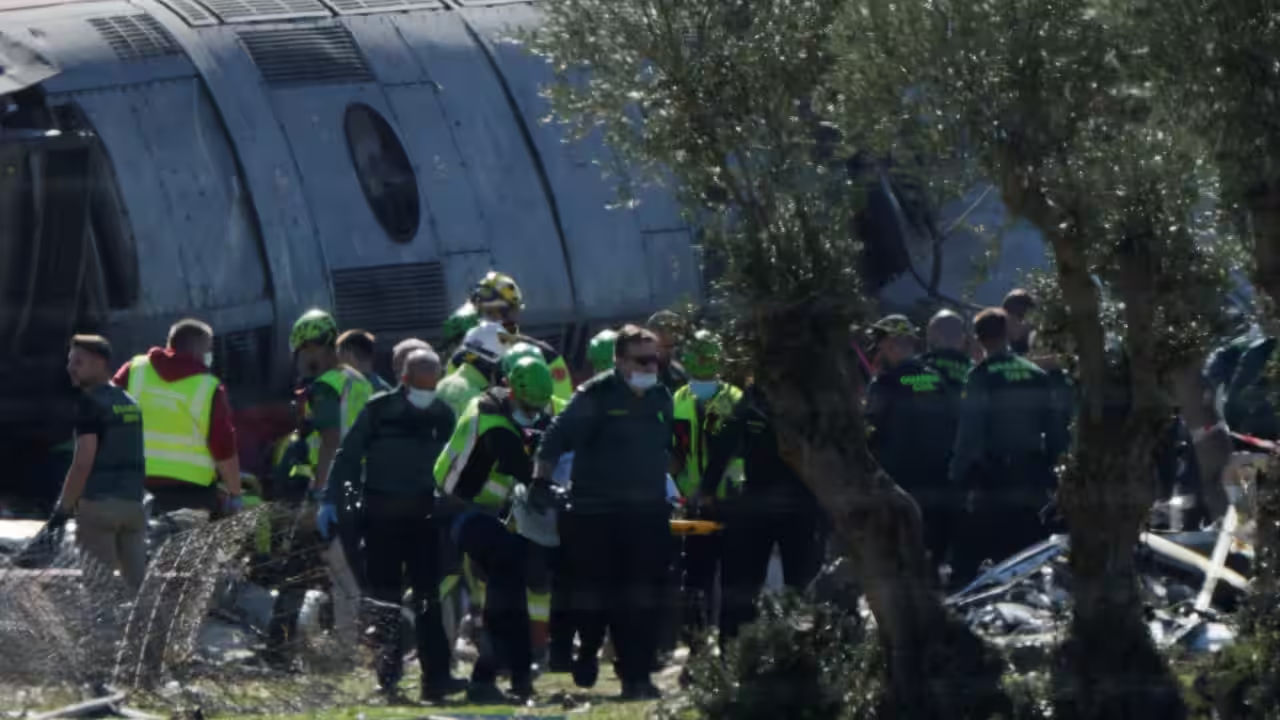
"The train never braked, and I felt that with every millisecond that passed," one of the survivors of the Spain train crash said, describing the ordeal. The collision between two high-speed trains near Urda in Spain’s Toledo province on Wednesday morning killed at least 68 people and left dozens injured.Spain will observe three days of mourning following the disaster, Prime Minister Pedro Sánchez announced. Speaking from the crash site in the central region of Castilla-La Mancha, he said "all of Spain is in mourning" and added that it was "not acceptable for a country like Spain to suffer two such disasters in the same year."Witnesses described scenes of terror and devastation after the two trains collided. Some saw passengers being thrown from the trains, while others struggled to escape through windows.Gonzalo, who was travelling alone in carriage six of an AVE high-speed train bound for Seville, described the experience as "terror" and "the longest seconds of my life", according to Spanish local media outlet ABC."The train never braked, and I felt that with every millisecond that passed, things were getting closer to becoming serious," he said.Describing the severity of the impact, Gonzalo said he saw people being thrown from the train, with some carriages flying off the tracks or disappearing from view."I was on the AVE high-speed train, in carriage 6. Towards Seville. It was the first carriage that stayed more or less on the track; all the ones in front of it either flew off or disappeared altogether," he said.He recalled being too scared to look at the wreckage."I mean, in fact, I didn't even dare to look; I just glanced around, and all there was was a mangled mess of metal, generally speaking. I don't know how many carriages were ahead of me, but mine was the first one that stayed more or less on the track," ABC quoted him as saying.Gonzalo suffered a severe blow to his back, leg and chest. His glasses were broken, and he left his work backpack behind while escaping."The important thing was to get out," he said. "I'm lucky."Passengers injured, strangers help each otherIn the immediate aftermath, passengers screamed inside the trains as some were thrown from their seats. Those in the cafeteria car were among those hurt, suffering head injuries, fractures and other wounds, according to Spanish outlet El País.Survivors made their way out and gathered in a field near the tracks. Some sat on the ground waiting for help, while others tried to contact their loved ones. By around 11am, doctors were treating dozens of injured people, and police were taking statements from passengers, El País reported.Patricia, who was sitting in the third carriage of the AVE train operated by Renfe, said the train had been stationary for around 20 minutes before the collision. Passengers had been told the delay was due to heavy traffic."After that we departed, and maybe not after even three minutes, there was a crash," she told CNN."Some people were hurled into the air. Not me. I was on the left side so I suppose that’s why I wasn’t hurled in the air, but it was awful," she said."Some of the train structure got into our train, in our carriage, and our carriage wasn’t even the worst."Other passengers described confusion and a lack of information in the minutes after the crash. A passenger identified only as Rey told CNN that people were unable to leave the trains immediately."There was terrible communication. No one could leave the trains for 10 minutes after the crash, we didn’t know what was happening," he said. He added that he and his family, who were travelling to Seville on holiday, were safe but "desperate to go".Yoander, 25, said he was asleep when the collision occurred."I was sleeping, and when I woke up I was already crashing into the seats in front of me," he told CNN."I hit my face and my leg," he said. "I’m in pain, but there are people that need more help than I do."Eduarda, another passenger travelling with her two cats, told Spanish radio programme Hoy por Hoy that she heard screams and saw a carriage on fire. She also saw people beneath the train who had died, according to the BBC.David Gómez, a bricklayer working with colleagues on a nearby property, told El País that they rushed to the scene after hearing the crash."We were working in the area. We heard the crash and came," Gómez said.Upon arrival, the locals found two train carriages derailed and passengers trying to escape through windows."People were trying to get out through the windows," he said.Gómez and his colleagues cut through barriers to reach the site and used their first-aid kits to help the injured, El País reported. Recalling the severity of the injuries, he said: "When they tried to pull a young woman out, there was a piece of her leg.""So yes, unfortunately, there are fatalities," he added.Ambulances, Civil Guard vehicles and officials arrived at the scene within about an hour of the accident becoming known. Gómez said he could not recall how long those involved had been waiting for help."I don't remember how long they were alone in that situation," he said.Passenger recalls violent impactJesús Jerónimo, 54, who was travelling in the second carriage of the AVE train, said he was working on his laptop when the train suddenly accelerated and threw him against the seat in front of him."I was working on my laptop when I felt a very strong acceleration, and I crashed into the seat in front of me," he told El País."People were thrown from the train. We thought we had derailed. Then, little by little, we got out and saw that our train was tilted. There were many injured people and a lot of people were shaken up. I saw papers on the floor and a child who was fine. Right now, we were helping the emergency services, holding IV bags with our hands. The firefighters, however, are working on the most damaged section of the train," he said.Jerónimo said the train had stopped shortly after leaving Madrid's Atocha station, about 20 minutes into the journey, before moving again.Hospitals treat injured as investigation beginsAt least 77 people were in hospital, including 15 who were seriously injured, Health Minister Mónica García said, according to the BBC. Hospitals activated contingency plans, reinforced emergency services and operating rooms, and reorganised care to respond to the casualties.The cause of the collision is under investigation. Transport Minister Óscar Puente said a computer failure had initially led to six moving trains being halted, including the two involved in the crash. The trains were later allowed to move again without speed restrictions, the BBC reported."In the event of a system failure, the control centre takes over," Puente said. The decision to allow the trains to resume movement was made "under inexplicable circumstances", according to the BBC.Sánchez said the government would investigate whether any failures or negligence had contributed to the disaster."At the moment it looks like the causes behind both crashes have nothing in common, but it's not up to me but to the investigation to establish that," he said, referring to another deadly rail crash in Spain earlier in the year."We will need to do everything in our power to restore public confidence in our high-speed railway network. It is unacceptable for a country like Spain to experience two high-speed rail accidents in the same year."He said the government’s immediate priority was to support the injured, victims and their families, while the transport and interior ministers worked to establish what had happened."The ministers of transport and interior are trying to determine what was the origin of this tragedy, of this terrible accident... and we will get to the bottom of this, and if there has been any negligence, it will come to light," he said.Emergency plan activatedSánchez expressed his shock at the incident and said he was in constant contact with Transport Minister Óscar Puente and Castilla-La Mancha President Emiliano García-Page.In a post on X, he said: "Shocked by the serious train accident in Toledo. I remain in constant contact with the Minister of Transport Óscar Puente, and with the president of Castilla-La Mancha, Emiliano García-Page."He added: "Emergency services are working on the ground to assist those affected and ensure their safety, in coordination with all the involved administrations. My affection, solidarity, and support to all the victims and their families."According to sources from the 112 Emergency Service cited by Europa Press, the collision occurred at 8.54am on Wednesday near the station in Urda, Toledo province.Firefighters from the Alcázar de San Juan and Orgaz stations, Civil Protection teams from nearby towns, three medical helicopters and two mobile intensive care units were deployed to the site.The regional government activated the Castilla-La Mancha Territorial Emergency Plan, known as Platecam, at Operational Situation 1 in Toledo.You use AI every day. Now get your AI Quotient. Take the AIQ test.
Topics in this story
Gathered from external sources. Rights to this text belong to whoever originally published it.