It’s always Shark Week in Putin’s world. That doesn’t bode well for Trump’s Ukraine peace hopes
When it comes to the war in Ukraine, Putin intends to double down, regardless of where the lines are on the battlefield and whatever economic pain Kyiv manages to inflict on ordinary Russians through a campaign of deep strikes.
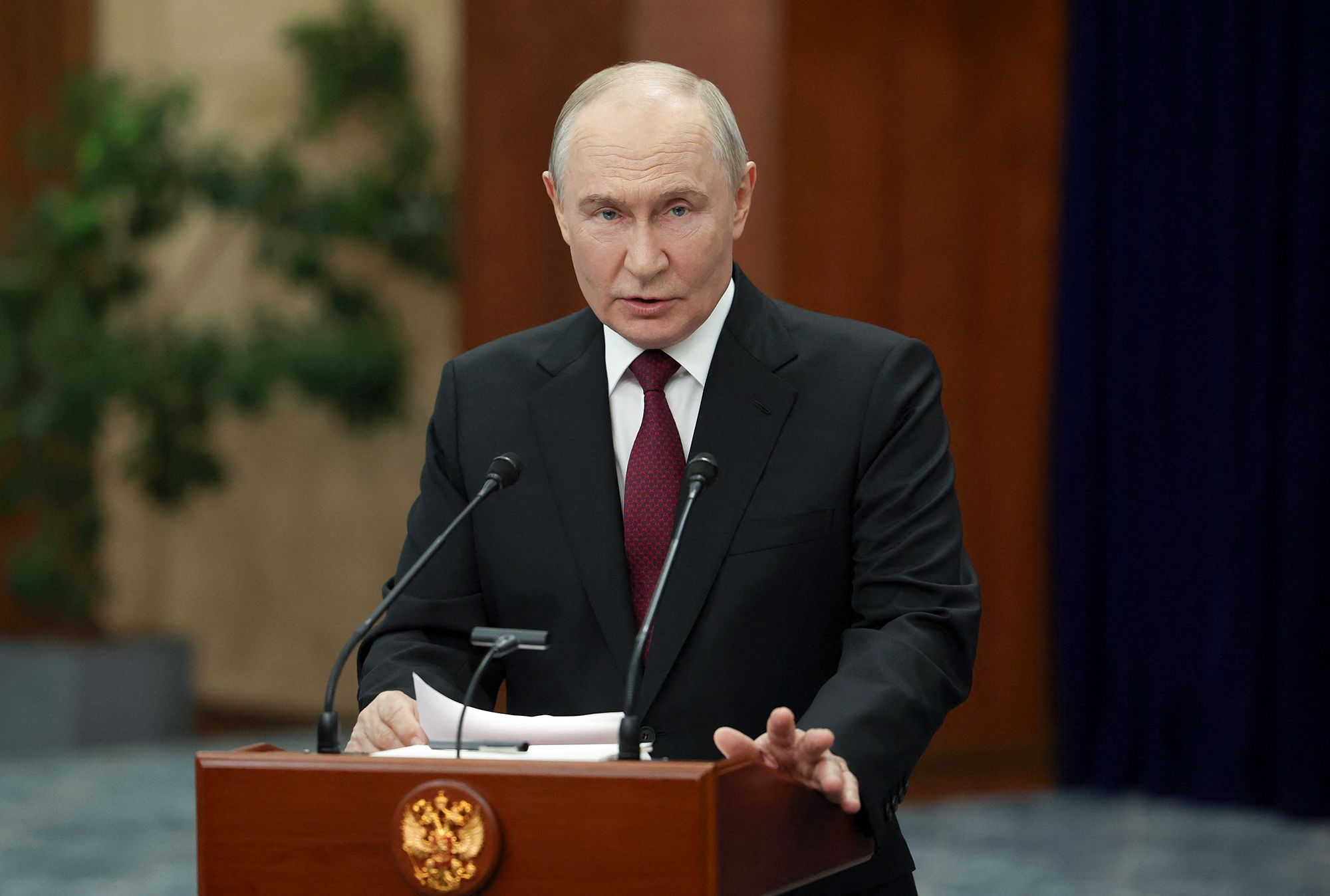
Russian President Vladimir Putin traveled to Kyrgyzstan this week for the Shanghai Cooperation Organization summit, a regional confab that also brought together Xi Jinping of China, Narendra Modi of India and Masoud Pezeshkian of Iran. The leaders convened in the capital Bishkek during a week of high geopolitical anxiety, with a fresh round of tit-for-tat strikes by Iran and the US, Russian drones and missiles pummeling Ukraine and Germany accusing Russia of being responsible for a drone attack targeting Leipzig airport last month. But Putin appeared firmly in his comfort zone. At a press conference late Tuesday, he seemed to go out of his way to make one point explicit: nations exist in a state of Darwinian competition, and Russia will prevail in a survival-of-the-fittest contest. Asked by Kremlin pool reporter Pavel Zarubin about some unusual remarks he made a few days earlier about killer whales eating polar bears – more on Putin’s views on marine biology in a moment – the Russian president described his statement as a “spontaneous” analogy for Russia’s ongoing confrontation with the West. “I would say that the orca is, without doubt, a formidable predator, yet it is also a highly intelligent creature, a cunning one,” he said. “The collective West, for its part, was assigned a specific definition in the Soviet era, which remains current to this day – the sharks of imperialism.” Sharks and orcas may not quite be the same class of animal, but Putin continued with his analogy. “The thrust of my remarks was that if anyone attempts to drag us down the food chain and devour us, to consume us, they would be well advised to expect their teeth to be broken,” he said. “And Russia stands ready to do precisely that, despite the insatiable appetites and ever-sharpening teeth of these sharks.” The messaging here was clear, both to a domestic audience and to Putin’s international counterparts. When it comes to the war in Ukraine, Putin intends to double down, regardless of where the lines are on the battlefield and whatever economic pain Kyiv manages to inflict on ordinary Russians through a campaign of deep strikes. Putin knows that Ukraine is on the back foot when it comes to defending its skies, and Russian forces have been blanketing Ukrainian cities with drones and missiles. While Ukrainian President Volodymyr Zelensky warned Tuesday that Russian airspace “will effectively be closing” due to the presence of Ukrainian drones, Putin dismissed the escalatory rhetoric, saying he had not heard the remark. Such comments, Putin said, “amount to nothing less than a call for state-sponsored terrorism. And I would point out that they are asking us to resume negotiations and requesting face-to-face meetings. One does not negotiate with terrorists.” Putin was equally dismissive of a claim by Germany that Russia was responsible for a recent drone attack at Leipzig airport, suggesting Berlin had planted evidence in a deliberate provocation. “There is only one explanation offered: the need to counter an ‘aggressive Russia,’” Putin said. “But where is the proof? Well, now some ‘proof’ has been planted.” Putin’s remarks in Bishkek may have been bellicose, but he was a bit more conciliatory when it came to the Trump administration. Asked about the recent visit by CIA Director John Ratcliffe to Moscow, Putin suggested Ratcliffe’s contacts with Russian intelligence officials were constructive, without letting slip any new details. “Contacts are always there, even during the most difficult times of the Cold War, and they are even more so now,” he said. “We favor negotiations, any negotiations, being filled first and foremost with concrete content. And if someone makes or can make a concrete contribution to this process, we’re all for it.” Putin also made clear whom he favors as interlocutors when it comes to striking any bargains with US President Donald Trump: the unconventional diplomatic duo of special envoy Steve Witkoff and Jared Kushner, Trump’s son-in-law. “These are people close to President Trump. In my opinion, they are sincere people and strive to bring concrete substance to our work. And the president trusts them, which is very important, and without this it is generally impossible to conduct any negotiations,” the Russian leader said. “Both Mr. Kushner and Witkoff are always welcome guests to us, and we are happy to work with them.” Witkoff and Kushner have made several trips to Moscow since Trump began his second term. But Putin’s preference may spark unease in Kyiv: Witkoff and Kushner have not visited Ukraine since taking on their roles as Trump’s point men for peace, and some observers worry they may support a deal weighted in Russia’s favor. Ukraine has a difficult winter ahead and there are fears Russia may launch a new wave of mobilization following parliamentary elections later this month. Putin said such speculation was “total BS.” But Putin’s comments about the animal kingdom may give a sense of where his head is these days. The orcas vs. polar bears story first surfaced during a meeting at Moscow Pedagogical State University on Saturday, when a participant mentioned a visit to the Arctic. That comment seemed to fire the imagination of the Russian president, who asked if the student had seen polar bears. “And killer whales live right next to them; they eat these bears like small fry – they attack in a pack and tear them apart,” Putin said, adding some political context: “That is the food chain, and children need to be told about this too, so they understand the world we live in and why we are conducting the Special Military Operation.” Several observers noted that orcas do not, in fact, hunt polar bears – and speculated whether Putin has been watching AI slop videos. But leaving aside the dubious zoology, Putin’s almost Trumpian non-sequitur suggested that, on the existential question of continuing war with Ukraine, his stance is as hard as ever. It’s always Shark Week in Putin’s world.
Topics in this story
Gathered from external sources. Rights to this text belong to whoever originally published it.