In 1993, Matera’s once-shunned cave districts became a UNESCO World Heritage site; restored stone homes now host hotels, shops and a living city
Discover how the Sassi districts of Matera transformed from overcrowded caves to a thriving UNESCO World Heritage site, blending history, architecture, and modern life.
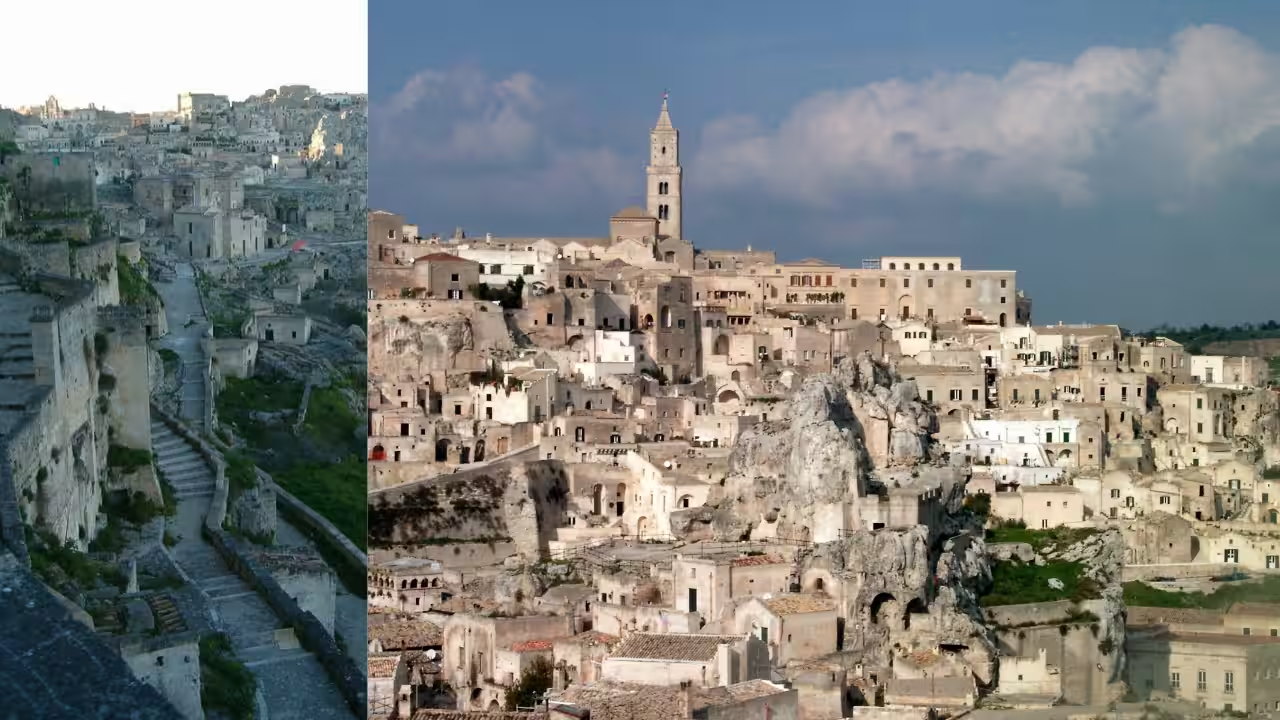
The Sassi districts of Matera were added to the UNESCO World Heritage List in 1993 and formally recognised as a settlement of homes, churches, monasteries and workshops that were carved into the rock of southern Italy. The designation came four decades after the Italian government had begun moving residents out of the caves because of overcrowding and poor sanitation.The Sassi are made up of two historic districts called Sasso Caveoso and Sasso Barisano, which were built into the natural rock of the Murgia landscape. UNESCO’s description explains that the World Heritage property covered 1,016 hectares and contained more than 1,000 dwellings, along with shops and workshops. There was evidence of occupation going back to the Palaeolithic period and the text describes the Sassi as an example of a settlement that adapted closely to its terrain and environment.But the ancient appearance of the district concealed serious problems by the middle of the 20th century, as families were living in cramped cave homes, often alongside animals, with inadequate sanitation and limited infrastructure. The Italian government passed legislation that called for the evacuation of the Sassi and the construction of new residential districts in 1952. The relocation continued through the following years, and by 1958 the population had abandoned the caves for newer housing.Empty homes created a new problemThe Sassi were no longer functioning as an ordinary residential district, and abandoned structures began to deteriorate. UNESCO's documentation says that the evacuation interrupted the site's continuous occupation in the 1950s, and also notes that abandonment caused some degradation, while the return of people from the 1980s helped restore the traditional function of the property.The recovery was not simply about repairing old walls, and Italy eventually developed a framework for using parts of the district. Law 771 of 1986 placed the historic area under the direct management of the Municipality of Matera and established urban plans that were aimed at the architectural, urban, environmental and economic recovery of the Sassi. One of those plans specifically emphasised residential development as a way to rehabilitate the area and re-establish a local population.UNESCO recognition came in 1993UNESCO's World Heritage Committee inscribed the Sassi and the Park of the Rupestrian Churches of Matera on the World Heritage List under cultural criteria that covered its historical continuity, architecture and relationship with the surrounding environment in 1993. The property includes churches, monasteries, hermitages and the wider landscape around the historic districts, and UNESCO considers the site to be an outstanding example of a rock-cut settlement that remained closely adapted to its environment over more than two millennia. The Sassi were no longer simply an abandoned part of Matera by then, with restoration and rehabilitation bringing buildings back into use, while residents were gradually returning.From abandoned district to living cityThe modern Sassi now function as part of Matera rather than as a sealed archaeological site, and visitors move through the old cave streets and underground passages, while shops, restaurants and other businesses operate within the historic districts. Italy's official tourism portal describes Sasso Caveoso as an area where ancient cave dwellings remain intact and Sasso Barisano as an area containing shops, while also pointing visitors toward the historic cave houses that show how people lived there before the evacuation.The old cave architecture now forms part of Matera's tourism economy, while the wider district continues to contain residential spaces and everyday urban activity, which creates a different preservation challenge from just protecting an abandoned monument. UNESCO notes that increasing tourism can affect the presentation and atmosphere of the historic property and says that visitor management is necessary. The Sassi therefore remain both a protected heritage site and a functioning part of Matera. The transformation took decades, and the same caves that had been emptied because they were considered unsuitable for modern living became the centre of an international heritage district after restoration, renewed occupation and UNESCO recognition. In 1993, that shift was formally recognised when the Sassi entered the World Heritage List.You use AI every day. Now get your AI Quotient. Take the AIQ test.
Topics in this story
Gathered from external sources. Rights to this text belong to whoever originally published it.