Hundreds of thousands march in France as protesters clash with police
France is bracing for what could be its biggest demonstrations in years with between 500,000 and 700,000 protesters. Follow for the latest updates.
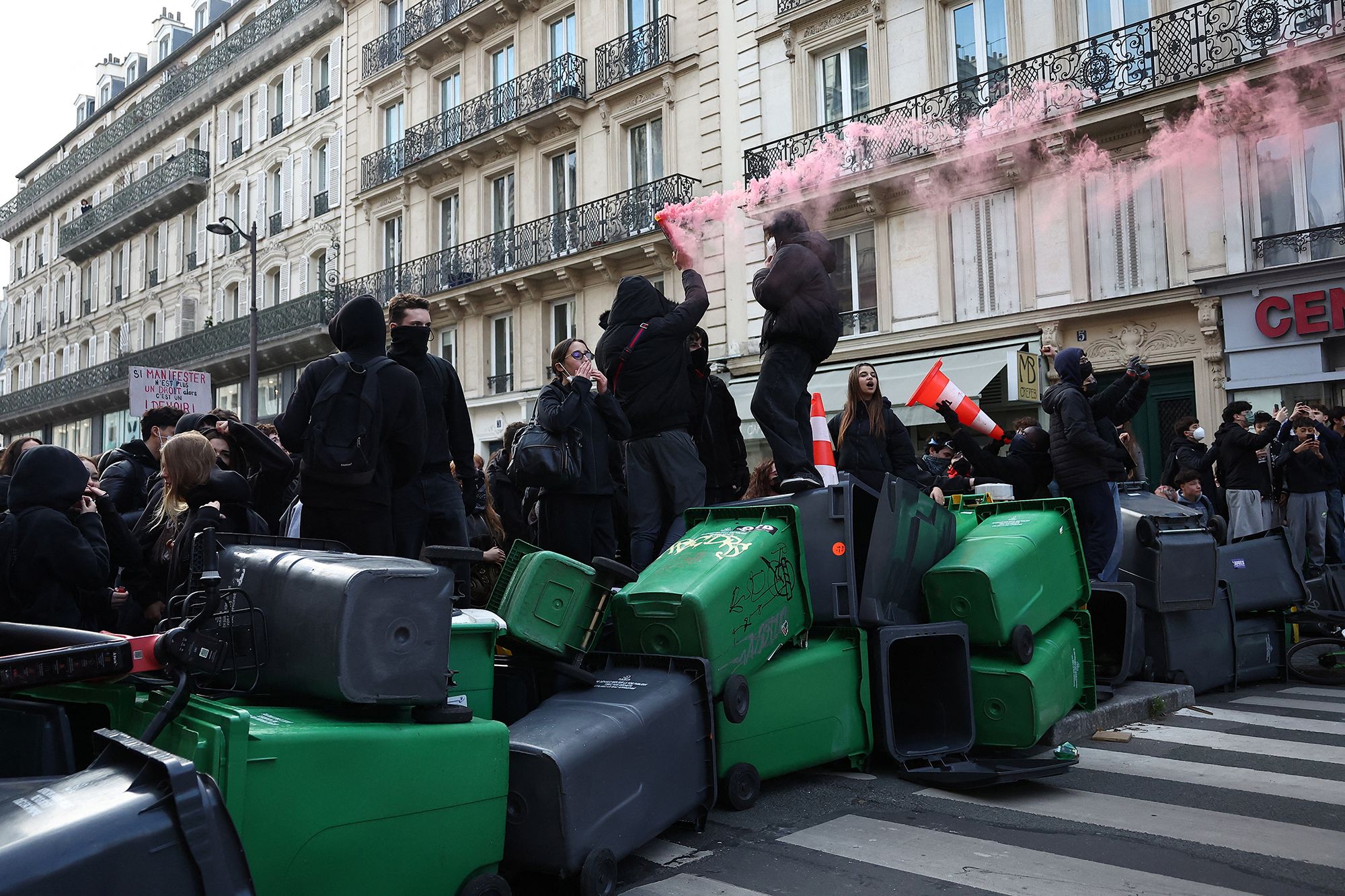
• General strike : Riot police have fired tear gas and charged a group of protesters in Lyon in central France while scuffles have broken out in the western city of Nantes, as demonstrations take place across the country. Around 270,000 people were taking part in nearly 200 demonstrations across France – not including Paris.
• Widespread disruptions : The strike is organized by L’intersyndicale, the group that represents all of France’s main trade unions. Education, health care, public transportation and other sectors are likely to be impacted with many services closed for the day. But the strikes go beyond the public sector with many employees of private companies planning to join in.
• Europe discontent : Anti-government protests have swept across the continent in recent weeks. In Greece , students and teachers gathered in central Athens to stress the importance of free public education and protest the rising housing and food costs affecting students, as marches were getting underway in France on Thursday.
Almost 600,000 protesters are on the streets of France today, the country’s interior ministry has just estimated, making Thursday the biggest day of protests since this current wave of unrest began in September.
Earlier today, at 1 p.m. local time (7 a.m. ET), the ministry had estimated that 270,000 people were protesting but that number excluded Paris, where a march began this afternoon.
The ministry is expected to release its final figures later today but, as of now, its current estimates indicate that these demonstrations are not quite as big as the 2023 pension reform protests.
French education minister Édouard Geffray has condemned what he said was a “deliberate act of arson” at a school near the city of Toulouse in southern France.
The minister thanked firefighters and law enforcement officials for helping to “limit the damage” cause by the flames.
“This deliberate act of arson could have had tragic consequences for human life. I condemn it in the strongest possible terms and call on everyone to condemn it unequivocally,” he added, while vowing to hold those responsible to account.
Earlier, France’s interior ministry said the blaze started after fireworks were directed at an office hosting the school’s student services.
Authorities in Rennes said they arrested “several dozen” masked individuals who vandalized a hotel, threw objects at police and “violently attacked” union members who were protesting earlier today.
Photos taken by local media show that vandals smashed the hotel’s glass doors and painted graffiti on windows.
Some masked individuals also tried to erect barricades to block some of the city’s roads, lit fires in garbage bins, and threw heavy pétanque balls – used in a popular French game – at police, authorities added.
Despite violent clashes like this, however, the protests today have largely been peaceful even as they have been attended by hundreds of thousands of people.
As today’s march in Paris got underway, the trade unions were in a jubilant mood. Music blared out as the crowd, dominated by left-wing groups, sang and chanted slogans against the government and the far-right.
A police helicopter buzzed above, but in the confines of the avenue we were walking down, there was little sense of the heavy police presence around the protest.
In the distance, the soaring statue of Marianne – the national symbol of France – got smaller and smaller as the march inched its way forward.
The protest route is packed. The movement of the crowd has been brought to a near standstill at points by the sheer quantity of people.
Later, several protesters were seen lying on the ground being treated by street medics, with blood flowing from the head of an older man. A bystander said the man was struck by police, but an officer at the scene said they were unaware of any incident.
At one point, protesters scattered as tear gas was deployed by police, followed by mass cries of “everyone hates the police.”
The mood of the crowd has lost its upbeat feel.
Several of France’s biggest unions, representing everyone from students, teachers and postal workers to doctors, pharmacists and transport workers, have called for a nationwide strike. So, how is that affecting these essential services?
Schools: About 13% of all school staff are participating in the strikes, France’s education ministry estimates, including 16% of all teachers. Around 19% of schools and 18% of colleges across France are affected by the strike.
Universities: About one in three of France’s higher education are “disrupted” because of the strikes and protests, the government told CNN.
Hospitals: Very few public hospital staff – only about 4% of the workforce – are participating in the strike, France’s healthcare ministry told CNN. “No significant disruption to healthcare services has been reported,” the ministry added. Two of France’s main unions representing both public and private healthcare workers had called on them to strike, citing the high cost of living and the deterioriation of public services.
Transport: Four in 10 of today’s scheduled trains have been canceled, though a handful of those cancelations are due to other factors like unavailable equipment, according to tracking website Trayn.
The labor unions that have called today’s demonstrations in France are demanding higher wages and pensions. In particular, the largest of the unions – the CGT – says the minimum wage needs to be increased immediately by 10%.
Last month, the CGT claimed there had been a big increase in the number of professions paying some employees less than the minimum wage. Another union - the CFDT – is demanding a 100 euro increase in the minimum monthly wage, about 7%.
Maud Millier, a CGT official in Lyon, said that the government’s announced minimum wage increase, from November 1, amounts to just €15 for someone earning the minimum wage, which she said was nowhere near enough given rising fuel and food prices.
Employers’ groups have warned that such increases would harm competitiveness and threaten employment.
Other groups involved in the protests have different demands. Students’ groups are demanding an increase of more than $10 billion in the education budget, as well as $1.5 billion investment in school infrastructure and 250,000 additional university places.
The Gilets Jaunes or Yellow Vests – a radical movement that first emerged eight years ago – is demanding the departure of President Emmanuel Macron and his government, and a new constitutional process. It also protests economic inequality but has no formal leadership.
Police have said that “Black Bloc” protesters are on the streets today – agitators accused by French authorities of provoking violence towards the end of largely peaceful demonstrations in recent weeks.
Black Bloc protesters usually wear matching or similar black clothing, face masks and hoods during protests to hide their identity. But it’s not an organization with formal leadership; rather it’s a set of protest tactics. They first appeared in Germany in the 1980s and are mostly associated with anarchist and anti-capitalist movements. These methods gained prominence in France during the 2016 labor protests before spreading further during the Yellow Vest movement.
One Black Bloc tactic involves small, highly mobile groups breaking away from the main march, forcing police to spread their forces thin, making it harder for them to respond in a coordinated way.
That was on display last month when a group of protesters attempted to reach the Elysee Palace, drawing riot police away from the October 17 demonstration. The maneuver worked. Police resources were stretched, and it contributed to officers being overwhelmed that day.
Police have clashed with demonstrators in the city of Lyon in central France. Riot police fired tear gas and charged a group of protesters, many of them masked, in scenes broadcast by CNN affiliate BFMTV. Some of the protesters were throwing objects towards the police, while a car was also set on fire.
There are 800 “Black Bloc” protesters present in the city, according to police.
Thousands of people are marching through central Lyon despite public transport workers being on strike, according to Maud Millier, regional secretary of the main labor union, the CGT.
There have also been scuffles in the city of Nantes in western France, where footage on BFMTV showed police firing tear gas as a tractor made its way through the city, surrounded by protesters.
The outlet also reported that a high school near the city of Toulouse was set on fire on Thursday morning.
At 1 p.m. local time (7 a.m. ET), 270,000 people were taking part in nearly 200 demonstrations across France in the nationwide day of action organized by labor unions, according to the Interior Ministry.
That total excluded the capital, Paris, where a march is due to get underway shortly, but is higher than the number involved in protests outside Paris last weekend.
“The marches are generally proceeding smoothly, and some are still ongoing. However, tensions have been reported in Lyon, where several hundred individuals have formed a black bloc,” the Interior ministry said. The “black bloc” refers to masked protestors.
“In Nantes, initial incidents have been reported as the march disperses,” the ministry said, while in Paris “numerous unauthorized marches are being systematically monitored and dispersed by police on public roads.”
Near Toulouse, a fire broke out on the grounds of a school after incendiary devices were thrown, the ministry said.
“Law enforcement remains heavily mobilized for the afternoon demonstrations to contain violent groups, prevent unrest and intervene whenever necessary to protect people, secure the marches and safeguard public buildings.”
Meanwhile in Greece, students and teachers have gathered in central Athens to stress the importance of free public education and protest the rising housing and food costs affecting students.
They held banners with painted-on phrases like “free and public education, safe facilities, that is what is right for students” according to Reuters, and forced roads in central Athens to close, the country’s national broadcaster ERT said.
“We demand dignified salaries, safe buildings, schools that educate all our students regardless of economic background, origin or gender,” Andreas Kargopoulous, president of a high school teachers union, told Reuters.
“We find the situation at the schools unacceptable, in terms of the facilities and the very nature of the schooling provided, which has been transformed into an exorbitantly expensive examination center.”
The Eiffel Tower, which attracts 7 million visitors a year, is closed today due to the national strike organized by French unions.
The 330-meter (1,083-foot) historic landmark has shut its doors before due to industrial action, including earlier this year during a strike by staff members. It was also closed in 2025 amid a searing heatwave .
Today’s general strike and protests have been organized by L’intersyndicale, the group that represents all of France’s main trade unions.
Education, health care, public transportation and other sectors are expected to be impacted, with many services shut for the day. But the strikes go beyond the public sector as employees of private companies are also joining in.
Other groups likely to be in attendance include students, climate activists and the Yellow Vests, the grassroots citizens’ movement established in 2018, as well as some allegedly extremist groups.
Some high street businesses in the French capital boarded up their stores ahead of today’s demonstrations, as Parisians braced for another round of protests over the cost of living and other grievances.
Meanwhile, local police have been deployed to train stations across the city, with searches being carried out to confiscate dangerous items.
“No equipment intended for committing acts of violence should reach the gathering places,” police posted on X.
French Interior Minister Laurent Nuñez said Wednesday that no level of disorder would be tolerated and arrests would be made if necessary.
He added that routes have been agreed between authorities and trade unions in almost all cities where protests are expected, but some disagreements remain.
CNN’s Lucie Lepellec and Pierre Bairin contributed reporting.
The US embassy in France has warned of possible rail, metro, road and flight disruption as a result of today’s demonstrations, as well as the potential closure of hospitals and banks.
In the statement, the embassy set out several anticipated impacts including “possible closures or reduced services in Paris and across France” affecting schools, hospitals, banks and government offices.
It also advised US citizens to avoid areas where demonstrations or large gatherings were due to take place and “plan alternative routes and allow extra travel time for travel.”
France is not the only European country seeing angry anti-government protests.
Belgium, Germany, Spain, Italy, Portugal and Albania have all seen unrest in recent weeks. Each country has its own unique problems which sparked their protests, but the economy is a key factor in all of them.
In Germany, a new youth-led movement dubbed “Gen Z has got this!” protested last weekend against the high cost of living, underfunded schools and universities, environmental concerns and a potential reintroduction of mandatory military service . While many of the protests were peaceful, water cannons and riot police were deployed in Cologne and Hamburg.
In Albania, anti-corruption protests were triggered by a proposed luxury resort project from Ivanka Trump and her husband Jared Kushner. In Italy, rising fuel prices first forced people into the streets, while in Portugal, the issue of affordable housing was initially the main driver.
In Spain, the Ceuta migration crisis and the nationwide lack of affordable housing are among the main issues on protesters’ minds.
Underneath this discontent across the continent lie similar themes: the poor state of the economy, rising cost of living and dissatisfaction with governments’ responses to these problems.
The protests in France come against the backdrop of a shaky economy, with the country’s growth lagging behind other EU members and its debt drawing scrutiny from credit rating agencies.
The French economy is perilously close to going into recession after shrinking 0.1% in the third quarter of the year. Consumer demand is weak, investment in manufacturing shrinking and its farming sector was hurt by a hot, dry summer.
The Bank of France is likely going to have to lower its already anemic forecast of 0.4% growth for 2026, Governor Emmanuel Moulin said this week.
“Unfortunately, I think it’s a bit too optimistic,” he said Tuesday.
France’s sovereign debt stands at $4 trillion, and it’s having to offer bonds at higher returns to attract buyers. This only increases the amount of interest the country must pay in coming years.
Fitch Ratings marked France’s credit score down at the end of October, saying it “reflects a deterioration since our August 2026 review comprising weaker growth, higher borrowing costs and a wider deficit.”
“These worsen debt dynamics from an already weak starting point,” Fitch added.
Successive governments have done little to rein in welfare payments beyond trying to raise the retirement age in 2023. France’s National Assembly has since suspended a reform that would have raised the retirement age from 62 to 64 for most workers until the 2027 presidential election.
Gathered from external sources. Rights to this text belong to whoever originally published it.