China planted a huge forest belt to fight desertification; scientists say the trees are creating a carbon-versus-water trade-off
Rest of World News: In November 2024, China completed a 3,046-kilometre green belt around the Taklamakan Desert, filling the final gaps in a project that has been under c.
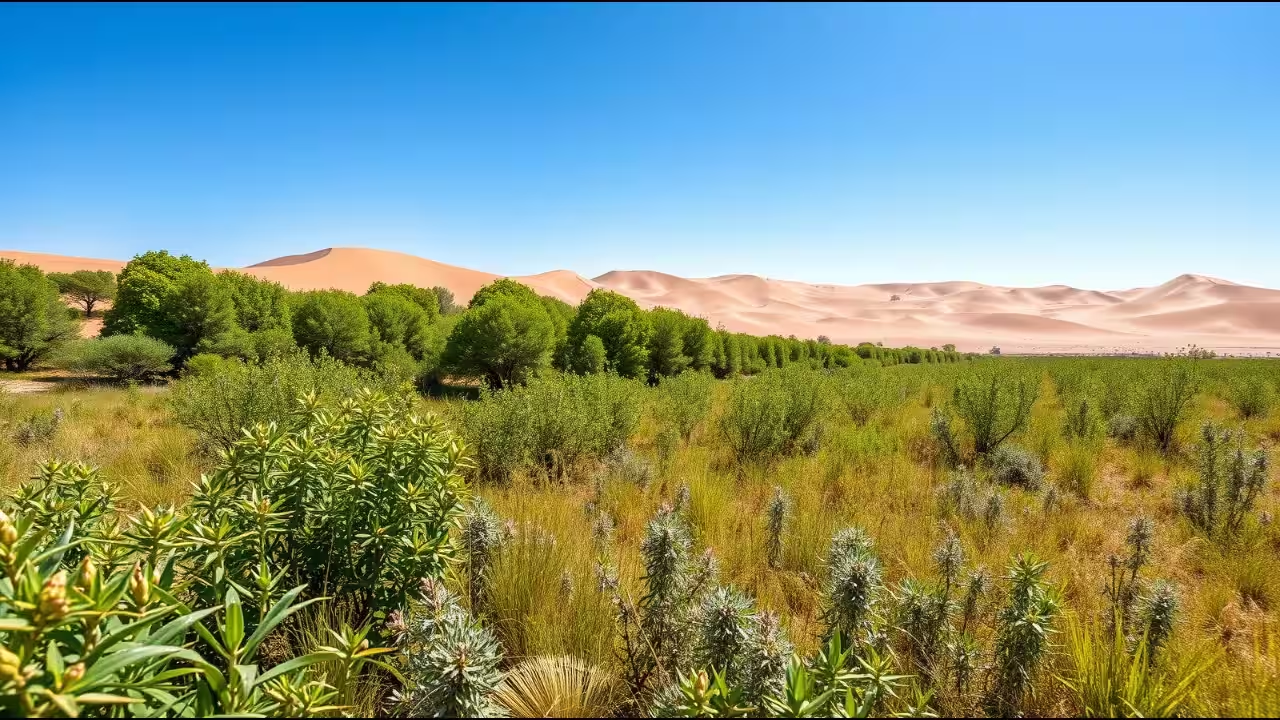
In November 2024, China completed a 3,046-kilometre green belt around the Taklamakan Desert, filling the final gaps in a project that has been under construction for decades. The belt forms part of the Three-North Shelterbelt Program, launched in 1978 as one of the world's largest ecological restoration efforts, designed to combat desertification, reduce the movement of sand and protect land across northern China. Now, researchers are examining another consequence of that transformation: how the expanding vegetation is changing the relationship between carbon and water across the region. A 2026 study titled Nonlinear carbon–water coupling in terrestrial ecosystems: Insights from China’s Three-North Shelterbelt Forest region, published in Regional Sustainability, analysed changes in net primary productivity, carbon use efficiency and water use efficiency across the Three-North Shelterbelt region between 2000 and 2020. The researchers found that both productivity and water use efficiency increased significantly, while carbon use efficiency showed a small, statistically insignificant decline, revealing a much more complicated picture than simply measuring whether the landscape has become greener.How researchers tracked 20 years of carbon and water dynamics across the shelterbeltThe study examined the spatial and temporal behaviour of three measures used to understand how vegetation handles carbon and water: net primary productivity, carbon use efficiency and water use efficiency. Researchers analysed the Three-North Shelterbelt Forest region across different climatic zones and vegetation types, using satellite and environmental datasets together with machine-learning and statistical modelling techniques. Between 2000 and 2020, net primary productivity increased at an average rate of 2.69 grams of carbon per square metre per year, while water use efficiency increased by 0.004 grams of carbon per kilogram of water per year. Both trends were statistically significant. Carbon use efficiency, by contrast, declined by approximately 5.40 × 10⁻⁴ per year, but that change was not statistically significant. The researchers also found that the relationship between water use efficiency and productivity was substantially stronger than the relationship between carbon use efficiency and productivity. Leaf area index was identified as the most important influence on both NPP and WUE, while elevation had the strongest influence on CUE. Rather than finding one simple response across the entire shelterbelt, the study found that the relationships between vegetation, climate and carbon-water processes were nonlinear and varied according to environmental conditions.Why increasing water use efficiency does not necessarily mean the forests are using less waterThe distinction between productivity and efficiency is important because water use efficiency does not simply mean that vegetation is consuming less water. Instead, it describes the amount of carbon gained relative to the amount of water used. A rise in WUE can therefore occur when vegetation produces more carbon for a given amount of water, without necessarily proving that total water consumption has fallen. The 2026 study found that NPP and WUE rose together across the Three-North region, suggesting that vegetation became more productive and more efficient in its relationship with water over the period studied. At the same time, the researchers found that carbon use efficiency did not increase significantly, meaning that greater productivity did not translate into a statistically significant improvement in the fraction of carbon retained by the ecosystem. These findings do not establish that the shelterbelt is depleting groundwater, nor do they demonstrate a quantified carbon-versus-water trade-off. Instead, they show why the ecological effects of large-scale vegetation restoration cannot be judged from increasing greenery or carbon uptake alone. Water availability, climate, vegetation structure and geographic conditions all interact to determine how these ecosystems function.What satellite research found as the Taklamakan Desert became greenerA separate study titled Human-induced biospheric carbon sink: Impact from the Taklamakan Afforestation Project, published in Proceedings of the National Academy of Sciences in January 2026 provides another piece of the picture by examining the Taklamakan Desert and surrounding areas over roughly two decades. Researchers analysed satellite measurements of vegetation cover and photosynthetic activity alongside atmospheric carbon dioxide and modelled carbon fluxes. They found a significant increase in vegetation cover and photosynthetic activity, with the strongest changes concentrated along the desert margins. Total green area increased by an estimated 162.2 square kilometres per year, while the researchers found that the greening areas had developed into stronger carbon sinks over the study period. The study linked the spatial pattern of this vegetation expansion to China's Three-North Shelterbelt project and concluded that the increased vegetation had enhanced the region's capacity to absorb carbon dioxide. The findings therefore reinforce one part of the newer research: China's long-running restoration efforts are not merely changing what the desert looks like from space, but are measurably altering its carbon cycle. At the same time, the two studies answer different questions. The Regional Sustainability paper examines the relationship between carbon and water indicators across the much larger Three-North Shelterbelt region, while the PNAS study focuses specifically on vegetation expansion and carbon uptake around the Taklamakan. Together, they show a landscape undergoing a profound ecological transformation, but they do not establish that China's green belt is simply “trading water for carbon.” The more defensible conclusion is that the restoration program is changing both carbon- and water-related ecosystem processes, and understanding whether those changes remain sustainable will depend on how vegetation responds to the region's highly variable climate and water availability in the decades ahead.Catch the latest World News and Live updates. Download the TOI app.
Topics in this story
Gathered from external sources. Rights to this text belong to whoever originally published it.