Russians are still fleeing abroad, citing fears of a new mobilization and a loss of freedom
This summer, a 28-year-old digital content marketer packed up his suitcases and duct-taped boxes and fled Russia, leaving behind his family and friends and n...
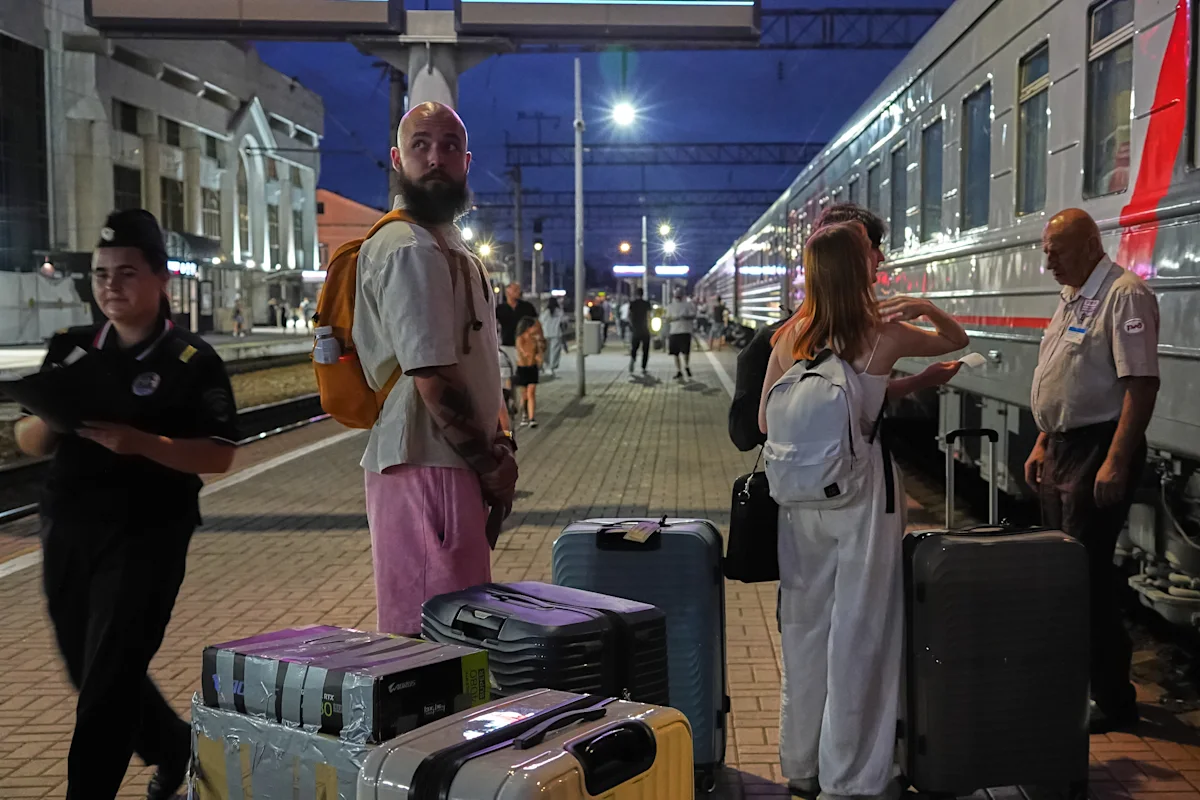
This summer, a 28-year-old digital content marketer packed up his suitcases and duct-taped boxes and fled Russia, leaving behind his family and friends and not knowing when he'll be able to return.
"It is very sad to leave Russia," he said in the southern city of Krasnodar before heading for the border with Georgia.
He blamed "the political situation" in Russia and complications over authorities restricting internet access as his reasons for leaving. Otherwise, "I never would have left for more than several months," he told The Associated Press, speaking on condition of anonymity because of security concerns.
He is one of a number of people who either left or are contemplating a move amid recent Ukrainian drone attacks inside Russia and persistent rumors of a coming mobilization of troops for the 4 1/2-year-old war.
The attacks this summer caused an unprecedented fuel crisis and dealt crippling blows to the booming e-commerce sector . Since last year, the government has cited the attacks to justify harsh restrictions on connecting to the internet.
The exodus is nowhere near as large as in 2022, when hundreds of thousands fled in the first year of the full-scale invasion. Still, a group that helps citizens who flee abroad said it received nearly eight times more queries last month than it had in May.
"It doesn't mean that there is a huge number of people right now at the borders," said Anastasia Burakova, the founder of Kovcheg, which means "ark" in Russian. "But we're seeing that people are preparing to emigrate, we're seeing that people are looking into what options are there."
On social media, Russians talk of moving abroad
The current numbers are hard to gauge. Unlike 2022, when droves of men fled a partial call-up for the military, there are no lines at border crossings or shortages of plane tickets to visa-free destinations like Armenia, Georgia, Kazakhstan and Turkey at the moment.
At the same time, AP found numerous social media videos from all over Russia of people saying they had decided to leave, citing war-related reasons. Others were worried about the declining economy , an uncertain future and shrinking freedoms.
Ukrainian President Volodymyr Zelenskyy and other officials in Kyiv have said Russia is planning another mobilization after the State Duma election that concludes Sunday — claims the Kremlin has repeatedly and vehemently rejected.
Yan Slovitsky, an urgent assistance coordinator for Kovcheg, described "a panicked wave" of emigration since mid-July linked to mobilization fears, the fuel crisis and internet restrictions.
A Moscow-based diplomat told AP about "a palpable rise in public anxiety this summer," and pointed to "anecdotal evidence of higher than usual numbers of Russians appearing in neighboring Georgia and Armenia, possibly fearing another mobilization after the Duma elections." The diplomat was not authorized to comment publicly and thus spoke on condition of anonymity.
Alen Simonyan, secretary of Armenia's Security Council, told independent Russian TV channel Dozhd last month that his country "will not interfere in any way, and if necessary, will help" Russians who are moving there to avoid being drafted.
That drew a sharp rebuke from the Russian Foreign Ministry, which called Simonyan's remark "provocative."
Russian lawmaker Viktor Sobolev told the RTVI channel that the country doesn't need people who "don't love their Motherland so much that they leave because of rumors," adding: "Let them leave."
Some emigres seek to avoid military service
The digital content marketer, who describes himself as a pacifist, says this was his second attempt at emigrating.
He left Russia in 2022 to avoid the partial call-up of 300,000 new troops, an announcement by President Vladimir Putin that shocked the nation.
He said he isn't technically eligible for military service in peacetime due to a hip ailment, but felt it was safer to leave because he didn't know what to expect from authorities.
Some officials in 2022 said such men could legally be drafted in a mobilization, as did some rights groups helping conscripts. Others said martial law had to be declared for it to be legal. Russia has not formally declared war on Ukraine, and the Kremlin only imposed martial law in the four Ukrainian regions it illegally annexed in 2022 but doesn't fully control.
The digital content marketer returned to his hometown of Ulyanovsk in 2025 and worked remotely for clients in other countries. But Russia's unrelenting clampdown on thousands of internet platforms, sites and services made it harder for him to do his job, he said, having to switch virtual private network servers to find one allowing him to get around the restrictions.
Another factor was the rumored new mobilization. "You never know what will happen tomorrow," he said from an apartment in the Georgian capital of Tbilisi, where he settled.
A 23-year-old Muscovite who left Russia last month also cited the persistent mobilization rumors and fears that her husband might end up in the military.
The woman, who spoke to AP on condition of anonymity because of security concerns, said her father narrowly escaped being drafted in 2022 by fleeing the country. This year, her husband learned he would no longer have a deferment from military service after getting his master's degree.
"A person can figure anything out, but we were really afraid that (my husband) could end up in the army, because at this point it is a one-way ticket," she said.
Ivan Nazarov, a new university graduate who moved to the Armenian capital of Yerevan, echoed her sentiment.
He said he was aware of reports of conscripts in mandatory service who are not supposed to be deployed to Ukraine being forced to sign contracts that send them to the battlefield.
"For me, it is a question of survival," Nazarov added, speaking at a gathering organized by Kovcheg in Yerevan for new immigrants.
Queer activist Daniil Neonov left Russia this summer after a series of detentions and a 10-day jail term on charges of displaying extremist symbols — a photo featuring a T-shirt with a rainbow-colored print on it he posted on social media.
Russian authorities have outlawed what they call "the international LGBT movement" as extremist, leading sometimes to misdemeanor charges for carrying items with a rainbow on them.
Neonov told AP in Yerevan that he feared a criminal case would be brought against him.
He said he knows other people who left Russia after being detained for gathering outside the Supreme Court last month to support the opposition Yabloko party when the court struck it from the parliamentary election ballot . Yabloko was the only party on the ballot that openly opposed the war.
"The police came to them and filed reports. I know several people who, after they were held in detention, also left. I mean, I'm not the only one," Neonov said.
A 35-year-old Russian told AP he was preparing for leaving the country because he doesn't want to live in a land without free speech, where the economy is on a downward spiral and where schoolchildren have to listen to propaganda touting war, normalizing violence and promoting isolation from the rest of the world.
The man, who also spoke on condition of anonymity for safety reasons, said he had been thinking about leaving Russia for over a decade but still had hope that "everything would work out."
Now, he said, Russians "live in a huge digital jail. You can't say anything, you can't do anything. You have absolutely no rights."
Sophiko Megrelidze in Tbilisi, Georgia, and Ani Khachatryan in Yerevan, Armenia, contributed.
Topics in this story
Gathered from external sources. Rights to this text belong to whoever originally published it.