In Wyoming, AI cameras detected approaching eagles and slowed nearby turbines; a field study reported an 82% lower eagle-fatality rate than at a control wind farm
A field study in Wyoming demonstrated that AI technology effectively reduced eagle fatalities at wind farms by 82%, offering a promising solution for protecting wildlife while generating renewable energy.
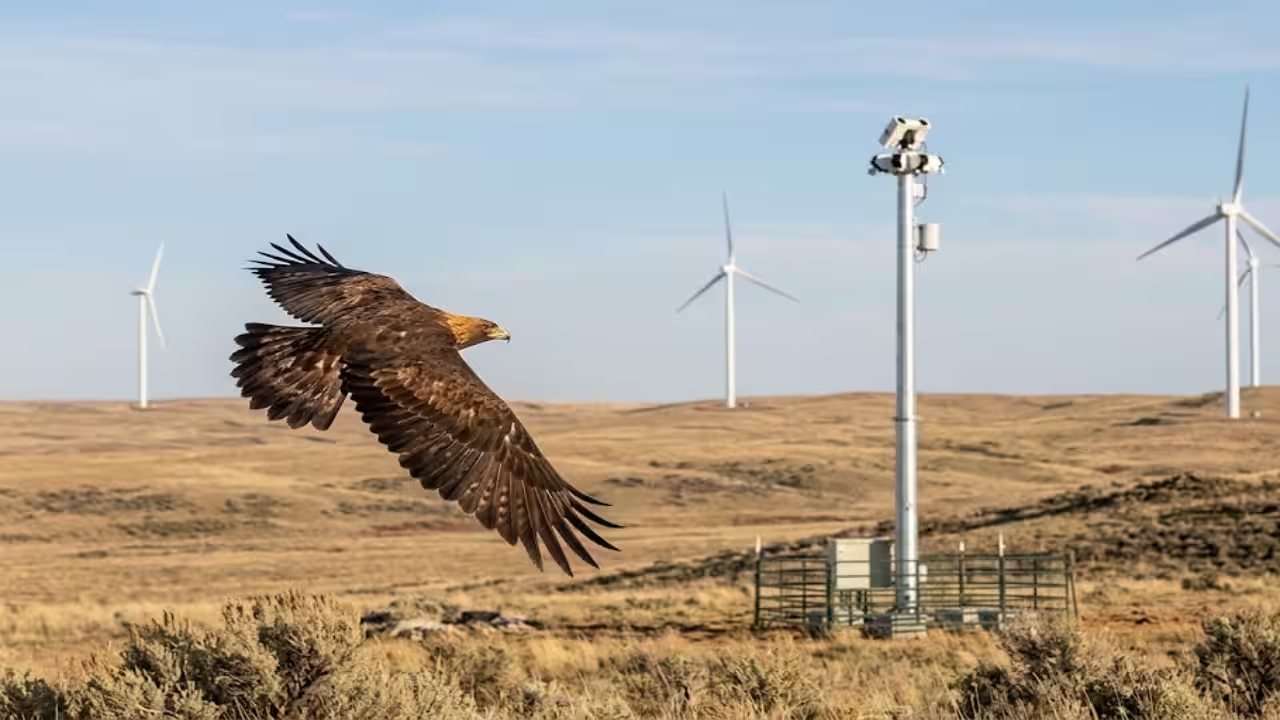
Wind turbines can kill eagles, and the usual remedy, curtailing turbines when an eagle is nearby, depends on someone spotting the bird in time. The conflict has long troubled both the wind industry and conservationists, because big raptors such as golden eagles fly along the same windy hills that make good turbine sites. Turning off turbines whenever an eagle might be in the area sounds simple until the question arises of who can see the bird in time.At Wyoming’s Top of the World wind farm, cameras and software now do that job. A device called IdentiFlight scans the skies, detects eagles and automatically curtails nearby turbines just before a possible collision. In January 2021, The Peregrine Fund, Western EcoSystems Technology and the US Geological Survey announced a study that found an eagle fatality rate 82% lower than at a reference wind farm.Why Top of the World needed a fixTop of the World and its neighbour Campbell Hill are wind projects in Converse County, Wyo. Their operator, Duke Energy Renewables, found 14 golden eagles and 149 other protected birds dead at the two facilities between 2009 and 2013, the US Justice Department said. In November 2013, the company pleaded guilty to violating the Migratory Bird Treaty Act, in what the Justice Department described as the first criminal enforcement of the law for unpermitted bird deaths at wind projects. It was sentenced to pay $1 million in fines, restitution and community service, placed on probation for five years and required to carry out a compliance plan aimed at preventing further bird deaths. An Associated Press investigation earlier that year had identified Top of the World as the deadliest of Duke’s 15 wind facilities for eagles.How the cameras work and what the study foundIdentiFlight is an automatic curtailment system: cameras and software that detect flying objects, classify them and slow or stop turbines when an eagle is at risk of a collision. Using the speed and trajectory of a bird that looks like an eagle, it calculates the time until collision, so a turbine only needs to be slowed down when it has to. The automated curtailment started at Top of the World in August 2018.The researchers used a before-after-control-impact design, comparing a treated site with a control site before and after the device was installed. The treated site was Top of the World. The control site was Campbell Hill, 15 km away, with 66 turbines and no such system. After correcting for carcass detection and scavenger removal rates, the scientists found that fatalities at Top of the World declined 63% between the two periods, while fatalities at Campbell Hill rose 113%. That is where the 82% figure comes from. It is not a single drop. It is the result of setting a fall at one site against a rise at the other. The researchers themselves were cautious. Todd Katzner of the US Geological Survey said the device greatly reduced but did not eliminate eagle collisions, and that it might be combined with other measures, such as avoiding building in high-risk locations.The number in questionIn August 2023, two scientists, Manuela Huso and Dan Dalthorp, published a reanalysis in the Journal of Applied Ecology. They made the point that the initial finding had appeared impressive for its size and its precision and then claimed that it was based on four key mistakes. For instance, in one case, the average number of eagle fatalities for the four years before the system was turned on was compared with the number in one single year afterwards, without accounting for the fact that the number of deaths fluctuates from year to year.After their revisions, they estimated a 50% reduction in the fatality rate, but the confidence interval was wide, ranging from a 159% increase to an 89% reduction. In plain English, the revised data were consistent with anything from a large benefit to no benefit to a rise in eagle deaths. Christopher McClure, the original lead author, responded in the same journal that the reanalysis ignored relevant data and included inappropriate observations. The original authors’ 2022 follow-up, which used data through 2021, put the reduction at 85%, with an uncertainty interval from 12% to 100%.The reanalysis does not say the cameras failed. It argues that a single monitored site over a few years cannot pin down how large the benefit is. The original authors disagree, and the dispute has not been settled. What isn't at issue is the problem itself and the notion behind the answer. Wyoming operators were convicted for killing eagles in wind farms, and a camera system that slows a single turbine just when a bird is near is a viable alternative to shutting down whole complexes. The honest bottom line is that it probably helps; nobody is sure how much, and it works best as one tool among several rather than as a total cure.You use AI every day. Now get your AI Quotient. Take the AIQ test.
Topics in this story
Gathered from external sources. Rights to this text belong to whoever originally published it.