The skies have changed, so has IAF's mission: 94 years of India's air power
The Indian Air Force was raised on October 8, 1932, on the recommendation of the Skeen Committee, which had been set up to look into demands for the
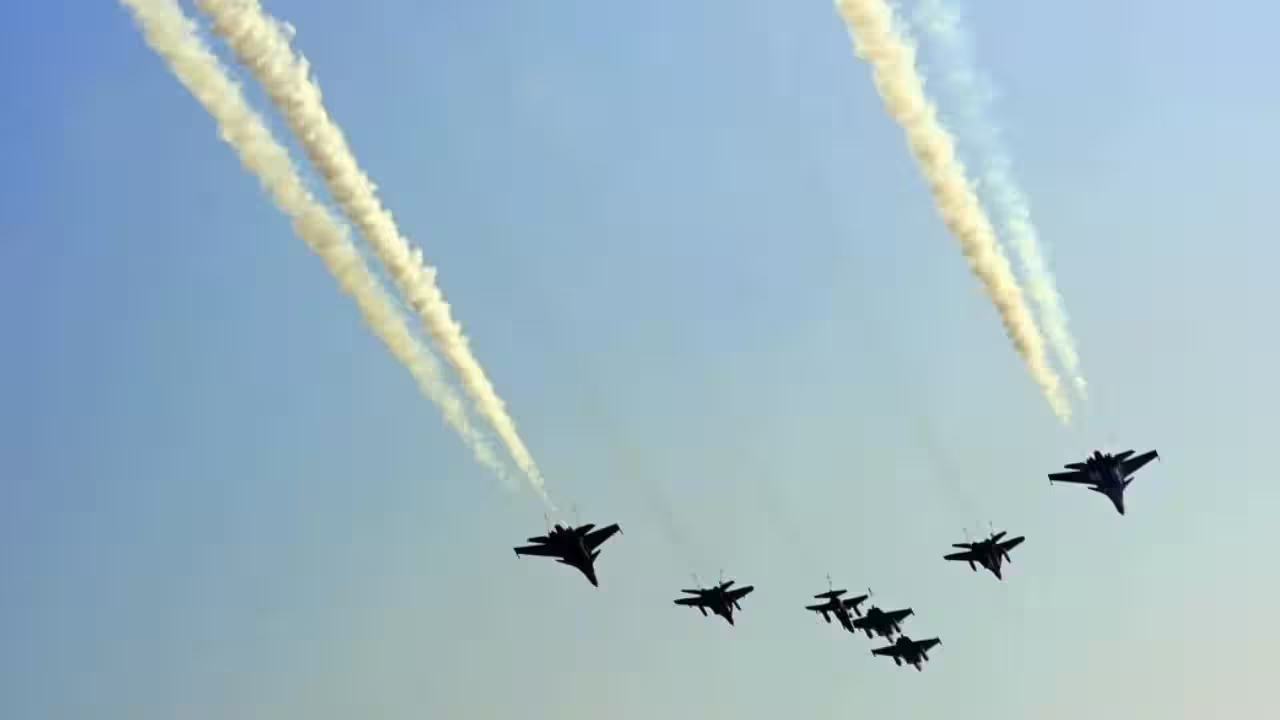
The Indian Air Force was raised on October 8, 1932, on the recommendation of the Skeen Committee, which had been set up to look into demands for the Indianisation of the Army. Its first squadron, the Tigers, came a few months later on April 1, 1933, at Drigh Road in Karachi, with four Westland Wapiti biplanes and five Indian pilots, a sixth having been moved to a logistics role. One of those five, Subroto Mukherjee, went on to become the first Indian chief of the air force. Born on October 8, the IAF is also the eighth oldest air arm in the world, behind those of the UK (1918), Italy and New Zealand (both 1923), Romania and Afghanistan (both 1924), Finland (1928) and Chile (1930).The air force todayIn the 94 years since, the IAF has grown into the world's fourth-largest air force by overall strength and a key component of national defence. It operates a diverse fleet of fighters, transport aircraft, helicopters, trainers and surveillance platforms. The fighter fleet includes the Su-30MKI, Rafale, Tejas, Mirage 2000 and MiG-29, while the C-17 Globemaster III, C-130J Super Hercules and C-295 handle transport and support. The force also flies Apache attack helicopters, Chinook heavy-lift helicopters and indigenous Dhruv helicopters.The big challenge for the force is numbers. The IAF currently has around 29 fighter squadrons against an all time high of 42, with each squadron typically comprising 16 to 18 aircraft. To bridge the gap, it is inducting Tejas Mk1A fighters, upgrading existing aircraft and adding advanced air-to-air missiles, unmanned systems and better air-defence networks. The government has also cleared the proposed acquisition of 114 Rafale fighters, subject to the procurement process. The priority is to strengthen squadron numbers, improve operational readiness and enhance indigenous aerospace capabilities, while the force continues to play a vital role in air defence, strategic deterrence, humanitarian assistance and disaster relief.A history in combatThe IAF has been in action almost since its inception. Its first operations came in the North-West Frontier Province from 1936 to 1947, followed by service alongside allied forces in the Second World War, notably in the Burma theatre. After independence, it flew into action in the First Kashmir War of 1947-48, airlifting troops and supplies into the Valley as well as air-to-ground operations. In 1962 it was in the background during the India-China war lifting men and material to the frontlines. The IAF played a much more active role in the 1965 and 1971 wars with Pakistan.Since 1984, Operation Meghdoot established India's presence on the Siachen Glacier, where IAF helicopters and transport aircraft remain the lifeline of troops at extreme altitude. The force supported the Indian Peace Keeping Force (IPKF) in Sri Lanka between 1987 and 1990, and in 1999 carried out Operation Safed Sagar during the Kargil War. The 2019 Balakot air strikes and the aerial engagement that followed marked the first use of air power across the border for the IAF since the 1971 war. The IAF demonstrated its combat capability during Operation Sindoor, during which the force grounded the Pakistani Air Force with precision strikes and a solid air defence, ensuring that Islamabad sues for peace.As the Indian Air Force marks its 94th raising day, the country's air arm is working to ensure that both the capacity and effectiveness multiplies. The IAF is striving to remain in sync with the changing technologies to remain at the cutting edge as the nature of warfare changes. The air force is always ready to execute any task in war and peace that the nation entrusts upon us.IAF: A networked forceToday, the IAF is changing from a force built around individual platforms into a networked aerospace power. At the centre of that change is the Integrated Air Command and Control System (IACCS) the digital backbone of India's air defence. Developed largely with Bharat Electronics Limited, it pulls data from ground-based radars, mobile surveillance systems, AWACS and AEW&C aircraft, surface-to-air missile networks and air traffic control into a single real-time picture. Commanders no longer work with scattered sensor feeds but with one recognised air picture that allows quick detection, identification, tracking and engagement of threats.The practical and operational gain here is of speed, IACCS shortens the time between a sensor picking up a threat and a shooter acting on it, which matters against cruise missiles, drones and precision-guided munitions, where reaction time is measured in seconds. It is backed by the Air Force Network (AFNET) a secure communications grid linking air bases, command centres and radar stations. Together, the two allow integration with the layered air defence systems of the other services.Unmanned systems extending the reachUnmanned systems are the second pillar of this transformation. Drones are no longer confined to surveillance and now handle intelligence gathering, precision strikes, electronic warfare, communications relay and battle damage assessment. The IAF's unmanned journey began with Israeli-origin Searcher and Heron UAVs and extended to Harop loitering munitions, with MQ-9B remotely piloted aircraft planned. Its roadmap covers propulsion, sensors, artificial intelligence, electronic warfare and autonomous mission execution, with the aim of building an indigenous ecosystem rather than simply buying drones. Importantly, they are not treated as a separate arm of warfare but integrated with fighters, surveillance assets and missile networks, acting as sensors, shooters and information nodes within the larger network.Bridges of friendshipThe force's strategic reach is best seen in its overseas engagements. Long-range airlifters such as the C-17 and C-130J, along with aerial refuelling, now let the IAF deploy across continents. It has taken part in Red Flag in the United States, Cope India with the US Air Force, Garuda with France and Indradhanush with the Royal Air Force. The most significant recent addition is Exercise Tarang Shakti, India's largest multinational air exercise, being held at Jodhpur with nearly 40 air forces.Beyond its military value, Tarang Shakti is an exercise in air diplomacy, showing that India can host and coordinate large-scale multinational air operations. Integrating several foreign contingents, planning complex missions and sustaining intensive flying require organisational capacity that few air forces possess. Exercises have become tools of strategic signalling and partnership-building as much as training.First responder: A friend in need is a friend indeedThe IAF has long been India's first responder at home, from the Gujarat earthquake and the 2004 tsunami to the Uttarakhand and Kerala floods, where helicopters and transport aircraft delivered supplies, evacuated civilians and restored connectivity. Over time, that mission has become part of foreign policy. After the 2015 earthquake in Nepal, Operation Maitri saw the IAF airlift rescue teams, engineers, medical staff and relief supplies. Operation Dost followed the 2023 earthquakes in Türkiye, with C-17s carrying NDRF teams, field hospitals and supplies, and Operation Brahma followed the March 2025 earthquake in Myanmar.The most striking recent example came in June with Operation Amistad, after twin earthquakes struck northern Venezuela. Two C-17s flew from Delhi to Caracas, covering more than 14,000 km in about 23 hours with 66 tonnes of aid, including an Army field hospital, over 35 tonnes of relief supplies and medical equipment, and two BHISHM Cubes, along with a 41-member team. The field hospital later began round-the-clock free medical services in Caracas. The mission took India's disaster response into Latin America and showed what the heavy-lift fleet can do. The IAF has also supported evacuations of Indian citizens from Yemen, Libya, Afghanistan and South Sudan.The measure of air powerAir power is now measured not only by the ability to fight and win wars, but by how well a force connects sensors to shooters, works with partners and responds when a crisis strikes. On all counts, the IAF is becoming one of India's most important instruments of national power, even as it works to rebuild its squadron strength.
Topics in this story
Gathered from external sources. Rights to this text belong to whoever originally published it.