Cloud seeding drones generate 19 million gallons of water in Alaska in just three hours, raising hopes for drought-hit regions
US News: A Southern California climate-tech start-up says it has produced an estimated 19 million gallons of additional precipitation over Alaskaâs Kenai Penin.
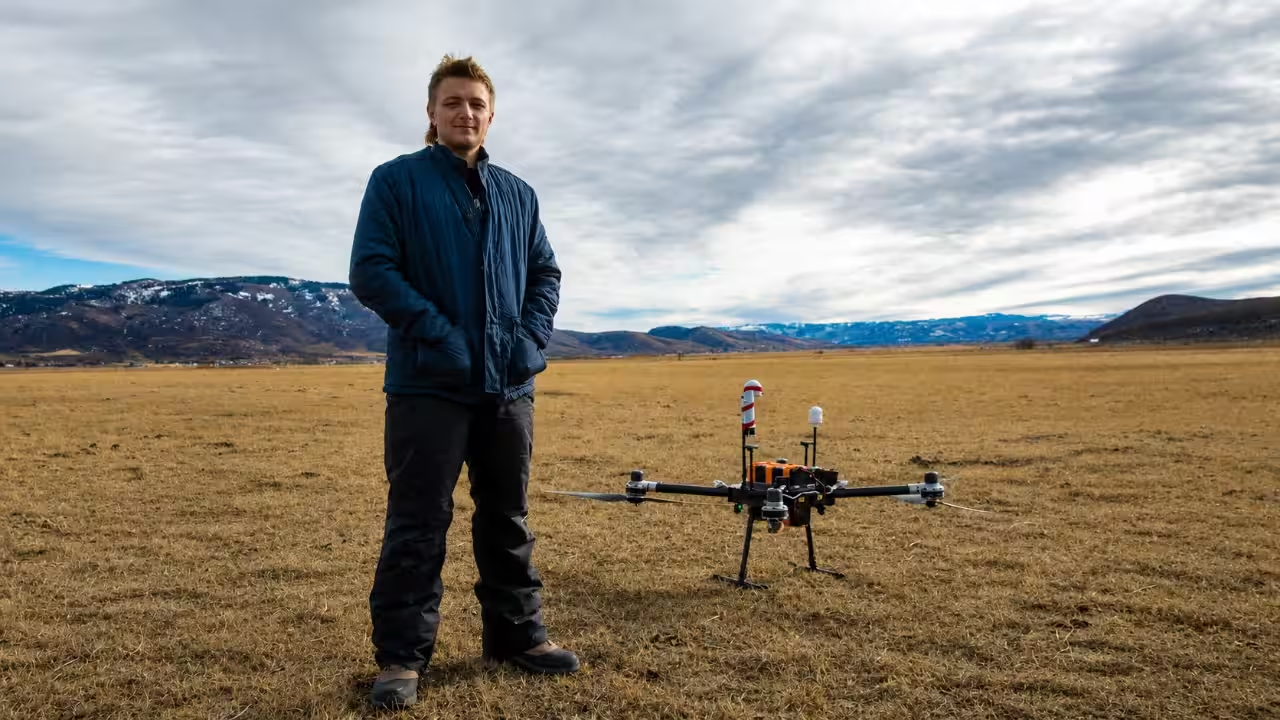
A Southern California climate-tech start-up says it has produced an estimated 19 million gallons of additional precipitation over Alaskaâs Kenai Peninsula in just three hours, using drones to seed clouds with silver iodide. The striking claim comes from a research operation conducted by an Alaska based company on 23rd August 2026. The company says its drone-based system could eventually help increase water supplies in drought-stricken parts of the American West, including the Colorado River Basin and the Great Salt Lake. Rather than creating clouds from nothing, the technology targets existing clouds containing supercooled liquid water and encourages the formation of ice crystals that can grow into precipitation. Rainmaker says the Alaska experiment represents an important step towards making cloud seeding more measurable and scalable, although the reported water volume remains a company estimate rather than an independently verified measurement.How Rainmakerâs drone-based cloud seeding system worksRainmaker conducted the operation across seven drone missions, deploying two Elijah autonomous aircraft equipped with silver iodide flares. The drones released 19 flares containing approximately 374 grams of the seeding material into clouds judged to contain suitable atmospheric conditions. Radar observations subsequently identified precipitation signatures associated with the seeded clouds. Rainmakerâs analysis estimated a mean additional precipitation volume of 57.6 acre-feet, equivalent to approximately 19 million gallons of water. The companyâs report placed the estimated range between 45 and 65 acre-feet. Silver iodide served as the ice-nucleating agent, with the experiment targeting supercooled liquid water within the clouds. The findings are significant primarily because the operation attempted to quantify the precipitation response rather than relying solely on observations of rainfall following a seeding flight. Rainmaker has described the Alaska campaign in their validation report as a validation exercise for its drone-based system.Why the Alaska cloud seeding test could matter for drought-hit regionsRainmakerâs Alaska validation report places the experiment within a wider effort to test whether cloud seeding can produce measurable increases in precipitation under naturally occurring conditions. The company identified seven distinct radar signatures during the three-hour operation and estimated that they represented 57.6 acre-feet, or about 71,072 cubic metres, of net new precipitation. Rainmaker notes that glaciogenic cloud seeding is already used across the Colorado River Basin and elsewhere in the American West, with potential applications extending to agricultural, municipal, industrial and environmental water needs, including efforts to restore the Great Salt Lake. The Alaska operation was conducted in an atmosphere that contained ongoing natural precipitation, with soundings showing conditions considered favourable for silver iodide activation. The report describes the results as a proof of concept and says the company plans to refine the platform during the upcoming winter season.Independent evidence will determine whether the results can be replicatedThe reported 19-million-gallon figure remains a modelled estimate rather than a directly measured volume of newly created water. Rainmaker derived its calculation from radar-based quantitative precipitation analysis and compared observed precipitation patterns with estimates of what would otherwise have occurred. That distinction is important because cloud systems are naturally variable, making the contribution of seeding difficult to isolate from background precipitation. The Alaska experiment therefore provides evidence for further investigation rather than establishing a guaranteed method of producing water on demand. Repeated trials across different cloud systems and independent analysis will be needed to determine how consistently the reported effect can be reproduced. For drought-prone regions, the central question is ultimately whether cloud seeding can deliver predictable additional precipitation at a scale large enough to influence water supplies. The Alaska campaign represents one attempt to answer that question with increasingly precise atmospheric monitoring.Catch the latest World News and Live updates. Download the TOI app.
Topics in this story
Gathered from external sources. Rights to this text belong to whoever originally published it.