A Wisconsin priest began a 1920 memorial for three local World War I casualties; over the next decade, Dickeyville’s parish grounds grew into a garden of shrines and grottoes
Explore the captivating history of the Dickeyville Grotto in Wisconsin, a remarkable outdoor folk art site created by Father Matthias Wernerus to honor three local men lost in World War I, blending religious devotion and patriotic tribute.
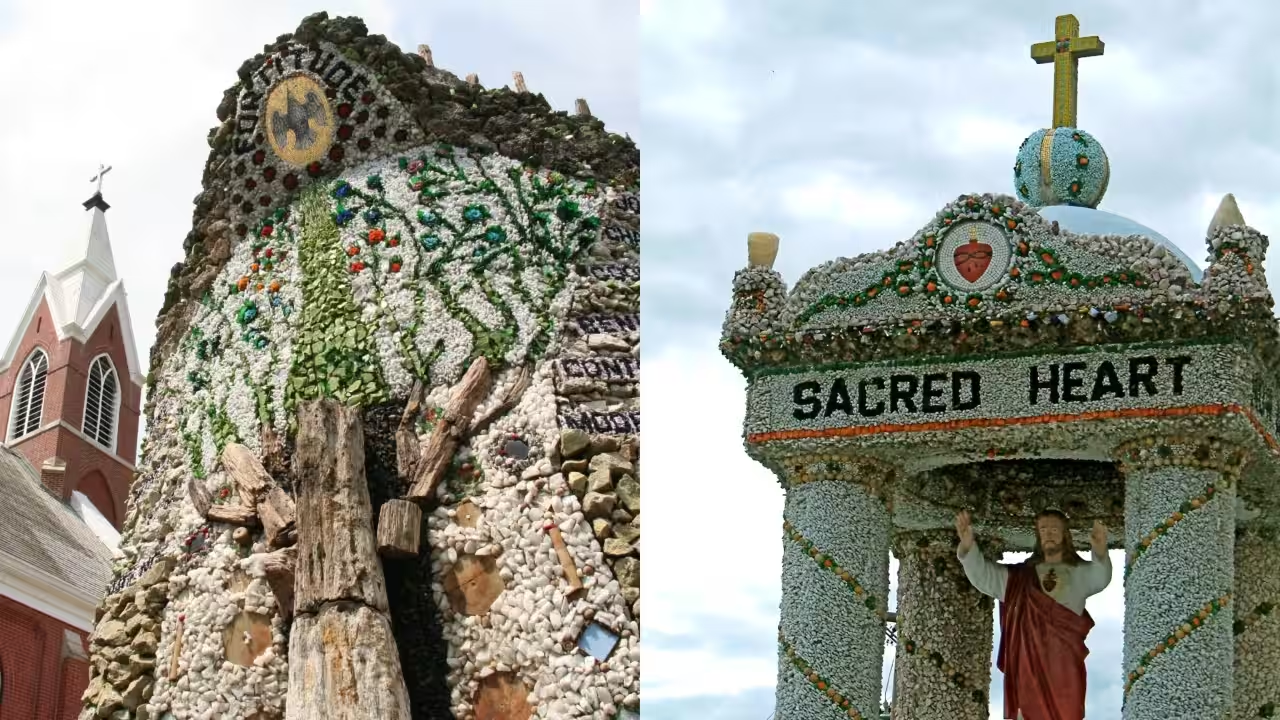
Towns all around America erected memorials to the young men who never returned home following World War I, and the majority of these were straightforward bronze or stone structures. A German-born parish priest in the southwest Wisconsin community of Dickeyville began in a similar manner and continued. In the years that followed, the churchyard of Holy Ghost Parish developed into a garden of concrete shrines and grottos covered in glass, shells, and stones after Father Matthias Wernerus constructed a traditional memorial for three local men who had lost their lives in the conflict. It is still one of the most well-known examples of outdoor folk art in the Midwest and is now called the Dickeyville Grotto.The Wisconsin Historical Society describes it as the state’s most famous and perhaps most striking example of outdoor folk art, tracing its origins to 1919. Wernerus served as parish pastor from 1918 until his death in 1931. State cemetery records show that the statues of the memorial’s Crucifixion Group were purchased in 1920 and that the cemetery layout was changed that year to accommodate them.From monument to grottoWernerus was born in Germany in 1873 and came to Wisconsin in 1904 to study at St. Francis Seminary. A few years later, he was ordained. His initial experiments were small. He decorated flower pots with coloured glass near the memorial. He also urged parishioners to help beautify the parish grounds. In 1924, he began work on the Grotto of the Holy Eucharist. The parish says most of the major work was done between 1925 and 1930.The parish describes the theme as the unity of two ideals, love of God and love of country, which is why the garden mixes religious shrines with a patriotic one. Wernerus himself wrote that many reasons urged him to put up “Religion in Stone and Patriotism in Stone”, and he added that the main reason was one he could not reveal. The patriotic shrine features Columbus, Washington and Lincoln in a colourful setting of stonework. Building something on this scale without blueprints took more than one pair of hands.Concrete, glass and found objectsSAH Archipedia, the online guide to American structures from the Society of Architectural Historians, says Wernerus worked with his cousin, Mary Wernerus, and a worker named George Splinter. At times they poured concrete into wooden forms on stone foundations, erecting pedestals, archways and shrines with about 6,000 bags of cement and six or seven carloads of stone. Then Wernerus decorated the surfaces with fossils, shells, rose quartz, petrified sequoia and cedar, tufa, stalagmites and stalactites. He achieved some of his most unusual effects with glass.The parish’s own brochure mentions plenty more, from coral, amber glass, agate and onyx to petrified wood and the circular knobs once used on the gearsticks of early automobiles. Visitors pass through a Roman arch, into which three rosaries are worked, and enter the main grotto.Wernerus’s work also reflected a wider Catholic trend towards shrine-building, inspired by the visions at Lourdes and Pope Leo XIII’s replica of the Lourdes grotto in the Vatican Gardens. Some have suggested that the Grotto of the Redemption in Iowa also influenced him, but no recorded account confirms that connection.What happened after WernerusSPACES, an archive documenting art environments, records that Wernerus died of pneumonia in February 1931, after which work on the grotto ceased. The site altered little, but in 1964 a succeeding parish priest, Father Lambert Marx, built concrete and sandstone Stations of the Cross.Wernerus had been anxious about the grotto’s future. Susan Niles, who analysed his letters to his bishop, concluded that he expected the grotto to become a major pilgrimage site, and feared that it would become a location of commercial attractions. The parish has largely prevented that outcome, and the grounds at 305 West Main Street remain open for self-guided walking tours.What began as a memorial for three men from one small parish became a landmark attracting visitors from far beyond Grant County. Its evolution into a garden of shrines and grottoes shows how one act of remembrance, carried forward by a priest, his cousin, a helper and a congregation willing to contribute their possessions, developed into an enduring example of outdoor folk art.You use AI every day. Now get your AI Quotient. Take the AIQ test.
Topics in this story
Gathered from external sources. Rights to this text belong to whoever originally published it.