Meet Kent Hups, the Colorado teacher who spotted three strange toes in North Dakota and helped uncover the first adult T. rex trackway
US News: Kent Hups, a Colorado high school teacher and amateur fossil hunter, was looking for an easier route out of a narrow, rocky valley in North Dakota's b.
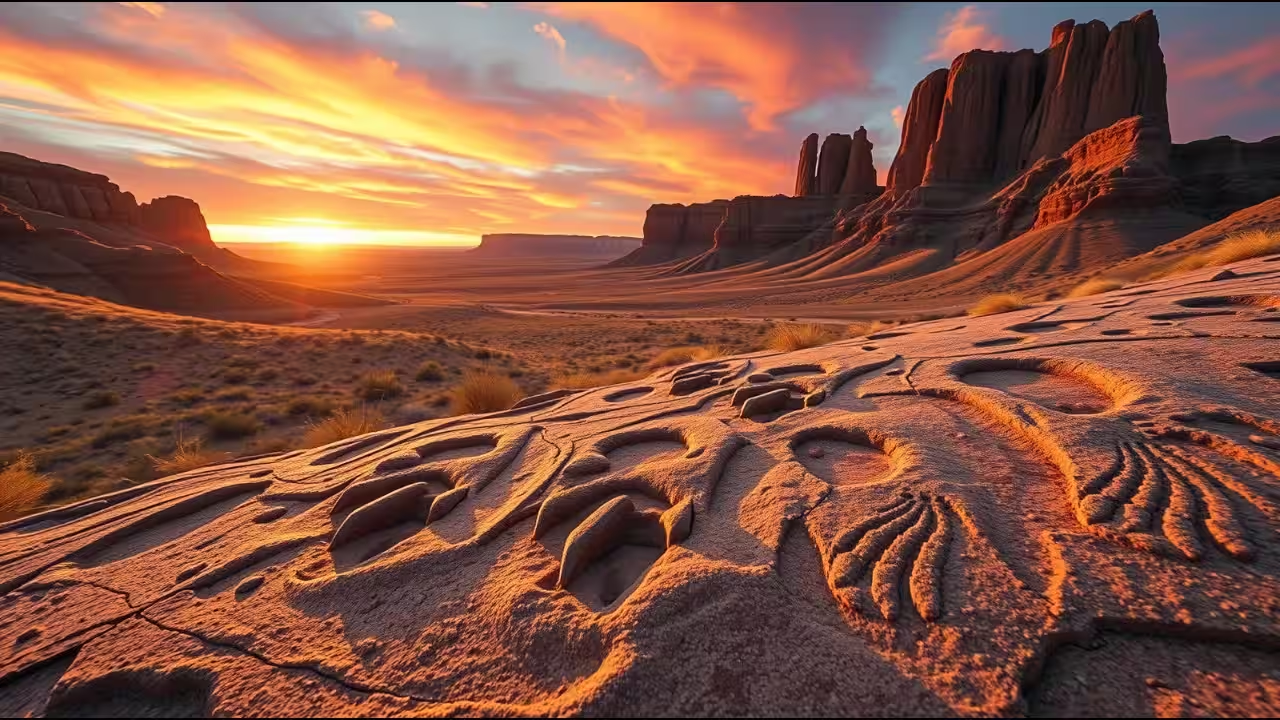
Kent Hups, a Colorado high school teacher and amateur fossil hunter, was looking for an easier route out of a narrow, rocky valley in North Dakota's badlands in 2025 when he noticed something unusual protruding from the ground. To Hups, who had spent about 30 years searching for ancient footprints as a hobby, the lumpy, wedge-shaped rock looked like three giant toes. He was volunteering with a fossil-digging team led by palaeontologist Tyler Lyson when he contacted him about the discovery. Lyson was sceptical and wanted more than a single unusual shape before accepting it as a dinosaur track. Further excavation revealed a sequence of four three-toed footprints stretching about 23 feet across the hillside. Researchers have identified an adult Tyrannosaurus rex as the most likely trackmaker, making it the first described trackway likely left by an adult T. rex. The approximately 66.5-million-year-old trail provides evidence of the dinosaur in motion, something that fossilised bones cannot show on their own.Lyson wanted a pattern, not just one footprintHups found the first footprint while prospecting for fossils in the Hell Creek Formation. He measured and photographed the unusual structure before contacting Lyson, a senior curator of vertebrate palaeontology at the Denver Museum of Nature & Science. At the time, scientists had identified only two adult T. rex footprints anywhere in the world, one in New Mexico and one in Montana, making the possibility of a third particularly significant.When Hups returned to the site the following day with companions, they identified another possible track. Lyson remained unconvinced and said he wanted to see a pattern. According to National Geographic's account of the discovery, Lyson marked a location where a third footprint should appear if the structures formed a genuine trackway. Excavation there revealed another footprint, followed by a fourth. The resulting sequence records two left and two right footprints. The published study titled A large tridactyl trackway from the Upper Cretaceous Hell Creek Formation of North Dakota, likely attributable to an adult Tyrannosaurus rex, describes the trackway as approximately 7 metres long, with the footprints each measuring roughly 1 metre in length. The distinction between an isolated footprint and a trackway is important. A single print can provide information about foot size and shape, but a sequence shows how an animal moved. In this case, the spacing between the prints gives researchers a stride of about 13 feet and allows them to estimate the dinosaur's walking speed.The Hell Creek Formation rarely preserves dinosaur footprintsThe discovery was made in the Hell Creek Formation of southwestern North Dakota, near Marmarth, on federal land administered by the U.S. Forest Service. The rocks formed about 66.5 million years ago in an environment that included forested floodplains, streams and swampy areas. The formation is particularly famous for dinosaur bones, including T. rex and Triceratops, but footprints are far rarer. The watery environment may help explain why. Sediment and flowing water could disturb or erase footprints before they became preserved. In this case, Lyson and his colleagues hypothesise that the three-toed depressions filled with warm, sandy water containing bacteria soon after the animal walked through. Sediments and minerals then accumulated in the hollows, eventually producing a dense mixture of calcium carbonate and sandstone around the footprints. Erosion later removed softer surrounding material and exposed the hardened structures.The resulting fossils are unusual because they are not simply shallow impressions in a layer of rock. National Geographic reported that the tracks are preserved in three-dimensional sandstone concretions, allowing the shape of the animal's foot to remain visible even after tens of millions of years. Researchers have found only one other trackway of any kind in the Hell Creek Formation, and it was not attributed to either T. rex or Triceratops.Nearby T. rex fossils helped identify the trackmakerScientists cannot normally determine a dinosaur's exact species from a footprint alone. Different animals can produce similar three-toed tracks, so researchers considered several lines of evidence when identifying the North Dakota trackmaker. The footprints are exceptionally large, roughly 3 feet long, and have a narrow three-toed shape. The surrounding area also contains abundant T. rex fossils. The researchers therefore identified T. rex as the most likely trackmaker rather than claiming that the footprints alone prove the species. The scientific description says the identification is supported by the tracks' size and morphology together with the abundance of T. rex fossils in the surrounding area.Other fossils found nearby add context. Lyson's team previously recovered a juvenile T. rex nicknamed Teen Rex, located a little more than 10 miles from the trackway. The team also excavated a largely intact Triceratops specimen nicknamed Triceratops Dreams less than half a mile away. A fragment of a tyrannosaur tooth was found on the lower jaw of that Triceratops, although researchers could not determine which tyrannosaur species the tooth came from.The tracks could reveal how T. rex movedThe four footprints provide a rare behavioural record. The trackway contains two left and two right prints, with an estimated stride of about 13 feet. Researchers estimate that the animal was moving at roughly 3.5 to 4.5 miles per hour, comparable to a brisk human walking pace. Because the tracks are heavily weathered, the speed estimate remains approximate. High-resolution 3D surface scanning has preserved detailed digital models of the entire trackway, allowing researchers to examine the footprints remotely and create physical reproductions. Three of the fossilised tracks are scheduled to be recovered by helicopter and transported to the Denver Museum of Nature & Science for preparation and further research. Scientists hope the specimens could provide additional information about T. rex foot anatomy, biomechanics and potentially even skin impressions. For Hups, the discovery began with a strange shape in a landscape where he had spent years searching for fossils. What emerged from the rock was not a T. rex skeleton, but a much rarer record of the animal actually walking across the ancient landscape. As Hups put it, a track shows the size of the living foot itself, including the dimensions that bones alone cannot fully convey.Catch the latest World News and Live updates. Download the TOI app.
Topics in this story
Gathered from external sources. Rights to this text belong to whoever originally published it.