A 1972 space rock skimmed Earth’s atmosphere over Utah at about 58 km and exited over Alberta; its predicted 1997 return was never confirmed
Discover the intriguing story of a mysterious space rock that entered Earth's atmosphere in 1972, its unique trajectory, and the unanswered question of its predicted return in 1997.
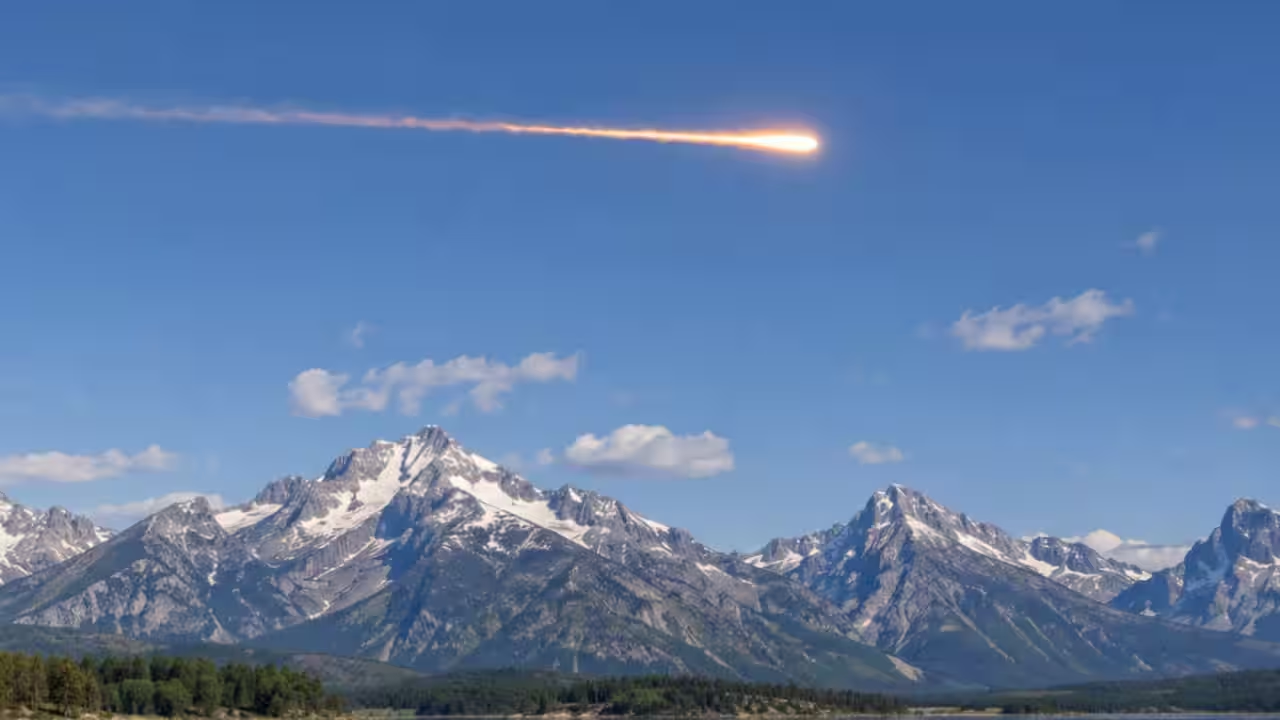
Some of the best space stories often start on an ordinary afternoon. On 10 August 1972, people in the western United States and Canada looked up to see a bright streak crossing the daytime sky. It was a rock from space that brushed the top of the atmosphere and then left. Astronomer Zdeněk Ceplecha studied the event in detail and published a paper in 1994 in Astronomy and Astrophysics. He found that the object's trajectory was nearly horizontal to the Earth’s surface, and its lowest point was at about 58 kilometres.A stone skipping across the skyWhat was unique about this fireball was its angle. A rock that enters the Earth's atmosphere at a steep angle usually gets burned up. But in this case, the rock entered at a shallow angle, almost like a flat stone skipping over still water. According to NASA's Astronomy Picture of the Day, the bright meteor was seen bouncing off the atmosphere and was even visible from Utah to Alberta. NASA also provided a picture of the fireball soaring above the Teton Mountains behind Jackson Lake in Wyoming. The rock entered the atmosphere over Utah, dropped to around 57 kilometres above the Earth's surface, and then left the atmosphere over Alberta. Ceplecha placed the closest approach at 58 kilometres, so the published figures differ by only a kilometre. Either way, that's way above where passenger planes normally fly, but low enough to leave a glowing trail that people could see.How big was the rock?Initial reports made the object sound huge, but later work set the record straight. Ceplecha said his original 1979 paper and a 1974 paper by Jacchia contained several mistakes and misprints. He wrote that the huge mass often quoted from Jacchia's paper was not correct. Using new models of how meteoroids burn away and break apart, he found that about five meters was the most likely size at its lowest point. The paper also concluded that the body could be no bigger than 10 meters in its orbit today, with a dark crust on its surface. According to a report by Rawcliffe and colleagues in 1974, infrared instruments of the time tracked its journey. The rock lost only part of its mass, so it was free to continue its journey through space in a changed orbit. A steeper path might have had a very different outcome.The comeback that never cameSince the rock was in orbit, the next logical question was whether it would reappear. Ceplecha estimated that it would pass close to the Earth again sometime between 30 July and 16 August 1997. He observed that Earth would be at the same point on its path on 11 August 1997. He was careful to label this as a rough estimate based on the orbit size and its uncertainty. He also noted that a proper calculation would be needed, taking into account gravitational pull from other bodies.No confirmed sighting of that return has been recorded till now, leaving the whereabouts of the rock after 1972 unknown. The story is also a reminder of how much of the sky goes unwatched. Instruments can track a small dark rock, but it can still disappear. It also shows how science corrects itself. Ceplecha went back to older numbers, corrected what was wrong, and gave a clearer picture of the object. The 1972 fireball might still be circling the Sun, but nobody can say so for sure.You use AI every day. Now get your AI Quotient. Take the AIQ test.
Topics in this story
Gathered from external sources. Rights to this text belong to whoever originally published it.