Ancient Greek elites wore jewellery made from metal that fell from space; scientists identified meteorite iron in 3,000-year-old rings
Europe News: Long before iron smelting became widespread in Greece, some Bronze Age elites were already wearing jewellery made from iron that may have come from me.
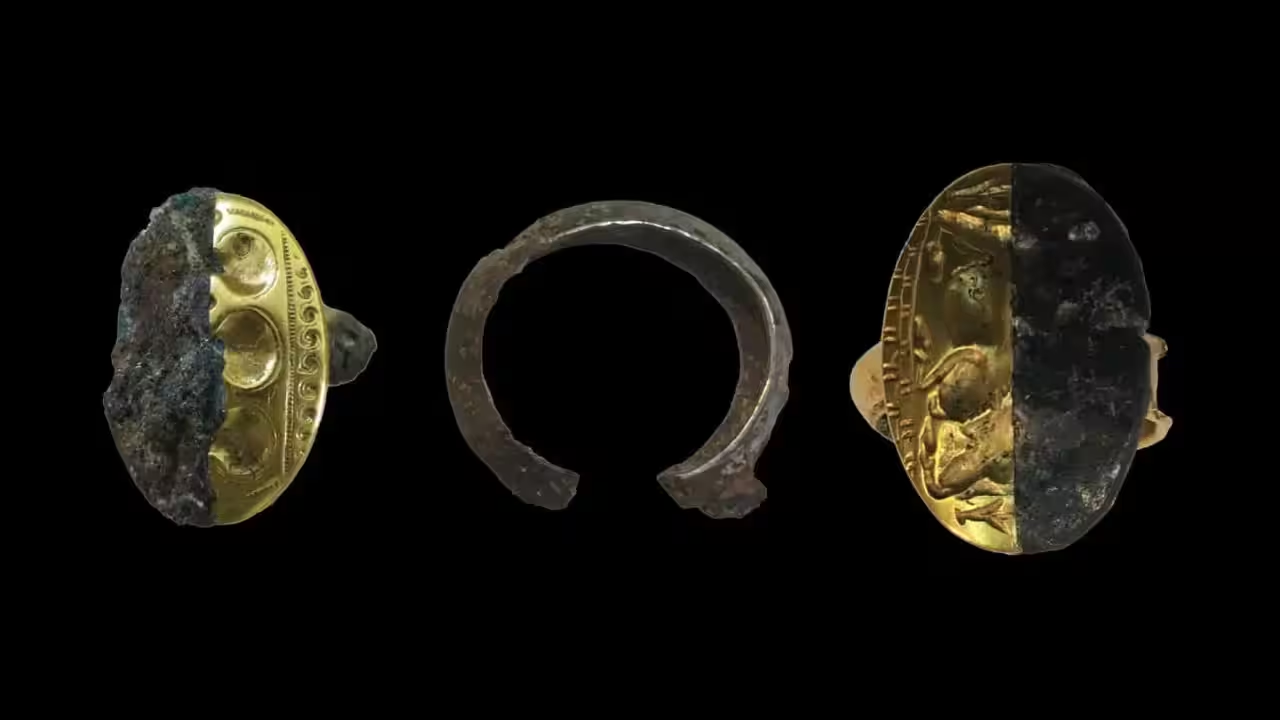
Long before iron smelting became widespread in Greece, some Bronze Age elites were already wearing jewellery made from iron that may have come from meteorites. A five-year study by Matthieu Gounelle of France's National Museum of Natural History and Eleni Mantzourani of the National and Kapodistrian University of Athens examined 105 Bronze Age and Early Iron Age artefacts from 33 archaeological sites held in 19 museums. Of the 105 objects, 91 were iron and were examined in detail using portable X-ray fluorescence. Thirteen iron objects, all rings or fragments of rings, contained significant amounts of nickel, a strong indicator of meteoritic iron. The researchers concluded that 9 of the rings were very likely made from meteoritic iron, another was quite likely to have been, while 3 require further investigation. The findings suggest that iron from meteorites was not simply a strange material encountered by chance, but a rare and valuable substance used for jewellery associated with powerful members of Minoan and Mycenaean society more than 3,000 years ago.How scientists identified meteorite iron in 13 ancient ringsThe study, titled Iron in Greece in the second millennium B.C.E., was published in the Journal of Archaeological Science. The researchers used portable X-ray fluorescence, or p-XRF, to examine the chemical composition of the objects without damaging them. This was particularly useful for fragile archaeological artefacts that could be difficult to remove from museum collections or transport to laboratories. Of the 91 iron objects analysed in detail, 78, or about 86%, contained no detectable nickel. These objects are consistent with iron produced through early smelting. The remaining 13 contained significant amounts of nickel. Because iron meteorites are naturally rich in nickel, the element provides an important chemical clue when researchers are trying to distinguish meteoritic iron from iron produced from terrestrial ores. The nickel concentrations in the rings varied considerably, ranging from about 1% to 50%, suggesting that the objects may not all have originated from the same meteorite. The researchers also note that nickel can be lost from archaeological iron during long-term burial and corrosion, meaning even relatively low concentrations can still provide evidence of an extraterrestrial origin.Why the meteoritic iron was used for ringsThe most striking pattern in the study was not simply the presence of nickel, but the type of objects in which it appeared. All 13 nickel-bearing objects were finger rings or fragments of rings. The wider collection included weapons, tools, jewellery and other iron objects, yet the evidence for meteoritic iron was concentrated entirely in the rings. Many of the rings were elaborate pieces featuring large, flat engraved surfaces and combinations of iron with other valuable metals such as gold, silver or bronze. Several came from richly furnished elite tombs in the Peloponnese, including sites such as Mycenae, Vapheio, Kakovatos, Aidonia and Dendra. The researchers argue that this pattern points to meteoritic iron having a special status. Rather than being used primarily as a practical material, it appears to have been selected for objects associated with wealth, prestige and social power. Eleni Mantzourani described the meteoritic iron as a very precious material used for objects of special value among high-status groups in Minoan and Mycenaean society.What the rings may reveal about Bronze Age tradeMeteorites containing large amounts of iron are relatively uncommon, and the researchers point out that meteorites are particularly scarce in Greece and Crete compared with some other regions of the eastern Mediterranean. That raises the possibility that meteoritic iron reached the Aegean through long-distance exchange networks. The researchers suggest Egypt as one possible source, given the established contacts between the Aegean and Egypt during the Bronze Age and the documented use of meteoritic iron in ancient Egypt. One of the best-known examples is the iron dagger found in the tomb of Tutankhamun, whose metal has been shown to have a meteoritic origin.The study does not, however, establish a specific trade route or prove that the Greek rings were made from Egyptian meteorites. The proposed connection remains a possibility that further research will need to test. Before this study, seven sites in the eastern Mediterranean had confirmed evidence of meteoritic iron. The researchers' work adds seven sites in Greece to that record, including Phaistos, Anemospilia, Mycenae, Vapheio, Kakovatos, Aidonia and Dendra.Why the meteorite-ring fashion disappeared around the 12th century BCEThe meteoritic iron rings appear to disappear from the archaeological record after the 12th century BCE, roughly coinciding with the upheavals associated with the Late Bronze Age collapse. That period saw the destruction or abandonment of Mycenaean palatial centres in southern Greece and major changes across the wider eastern Mediterranean. The researchers do not claim that the collapse directly caused the end of meteoritic iron jewellery. Instead, the timing suggests that changes to elite society and long-distance exchange networks may have played a role. The rings may simply have gone out of fashion, but the disappearance also occurred just as iron produced through terrestrial smelting was becoming increasingly important. That makes the rings particularly revealing. They capture a brief period when iron was still an unusual and prestigious material in the Aegean, long before it became the everyday metal that would define the coming Iron Age. For the people who wore these rings, the attraction may have been more than the metal's rarity. It was a material that had arrived from somewhere beyond the ordinary world a substance that had literally fallen from the sky and been transformed into jewellery for the most powerful people of Bronze Age Greece.Catch the latest World News and Live updates. Download the TOI app.
Topics in this story
Gathered from external sources. Rights to this text belong to whoever originally published it.