Dame Judi Dench: I can't do a play, do a film, or read any more
The actress tells BBC Radio 4's Today programme about how her eye condition has affected her life.
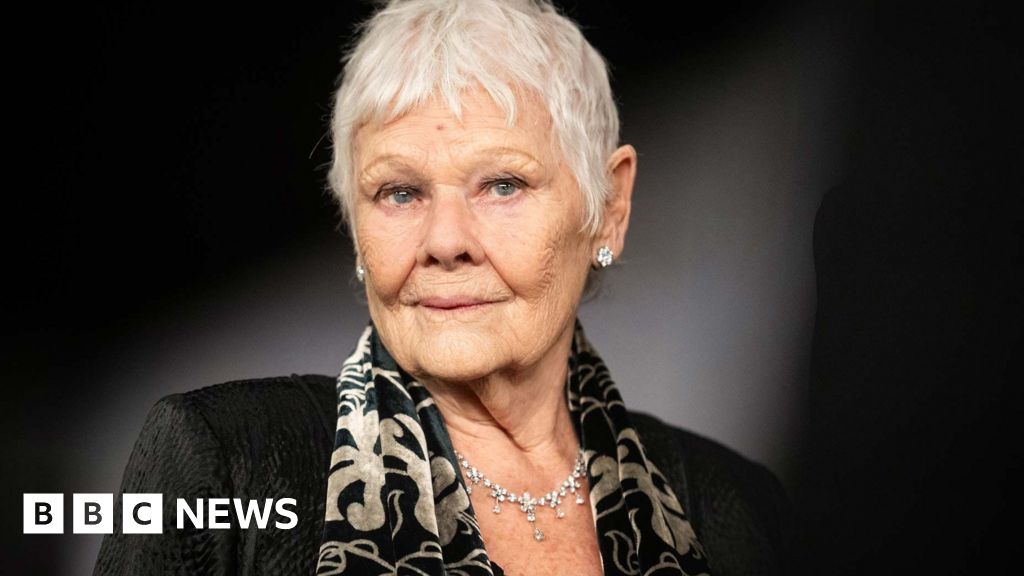
Oscar-winning actress Dame Judi Dench says her eye condition has left her unable to perform on stage or read, more than a decade after she was diagnosed.
Dame Judi was diagnosed with age-related macular degeneration (AMD) in 2012, a condition that affects her vision and has made it incredibly difficult to even recognise faces.
Speaking to Emma Barnett on BBC Radio 4's Today programme, she said: "I can't be on stage. I can't do a play any more. I can't do a film any more. I can't read any more."
She also revealed how her condition can lead to awkward encounters, saying she sometimes approaches the wrong people "and give them an almost hug" before realising her mistake.
When asked about ageing, Dame Judi, who's 91, replied: "There's nothing to say for it at all. [I] don't think about it too much."
She has enjoyed a career spanning more than seven decades and is one of Britain's most celebrated actors, with a body of work across theatre, television and film.
Dame Judi won an Academy Award for best supporting actress for playing Queen Elizabeth I in Shakespeare in Love in 1999, and became internationally recognised for her portrayal of "M", James Bond's boss. She made her debut as the character in GoldenEye in 1995, becoming the first woman to play the role.
But her sight loss has increasingly affected her ability to work, with the actress previously speaking about struggling to see on film sets and having difficulty learning scripts.
Despite her condition, she has continued to make public appearances and speak openly about adapting to life with deteriorating vision, stating that "the radio has always been important to me".
She was speaking to the BBC ahead of the release of her memoir, called Is It Too Late to Make a Run for It?, which was written alongside theatre director Brendan O'Hea.
During the interview, Dame Judi recalled being invited to lunch by former MI6 chief Sir David Spedding, describing the experience as "very exciting". When she asked where her driver should drop her off, she was told: "No, no, we'll send a car to you, we'll come and pick you up."
However, she arrived about 20 minutes late after the driver struggled to find her house. "I said, 'I'm sorry for being so late because your driver couldn't find my house.' I loved it."
Asked if she had any views on who should play the next Bond, she simply replied: "No."
Dame Judi also discussed meeting US actor Sidney Poitier, who became the first black man to win the Academy Award for best actor in 1964.
She was appearing in Amy's View in New York when Poitier came backstage after a performance. She recalled that director Richard Eyre was in her dressing room, giving her notes, when there was a knock at the door.
She said she felt as if she were in a wind tunnel when Poitier walked in, adding: "It was thrilling."
Asked what she had said to him, Dame Judi replied: "Not much, a bit of an open mouth. So charming. Very tall."
The conversation then turned to her love of Shakespeare. She recalled watching her brother play King Duncan in Macbeth when she was nine.
"He walked on and he said, 'What bloody man is that?' I thought, 'Oh my God, this is for me'. He said 'bloody', did you hear that?"
She also admitted to being "besotted" by Shakespeare's sonnets: "I just love them."
"It's the rhythm of it. It's the rhythm of your heart," she added. "It's the way he's summed up so simply the way that any of us feel about, well, anything."
West End theatre to be named after Dame Judi Dench
Judi Dench made patron of eyesight loss fund
Topics in this story
Gathered from external sources. Rights to this text belong to whoever originally published it.