New Zealand faces political uncertainty as special votes could reshape election result
New Zealand faces weeks of political uncertainty after a closely fought general election left prime minister Christopher Luxon’s centre-right National-led
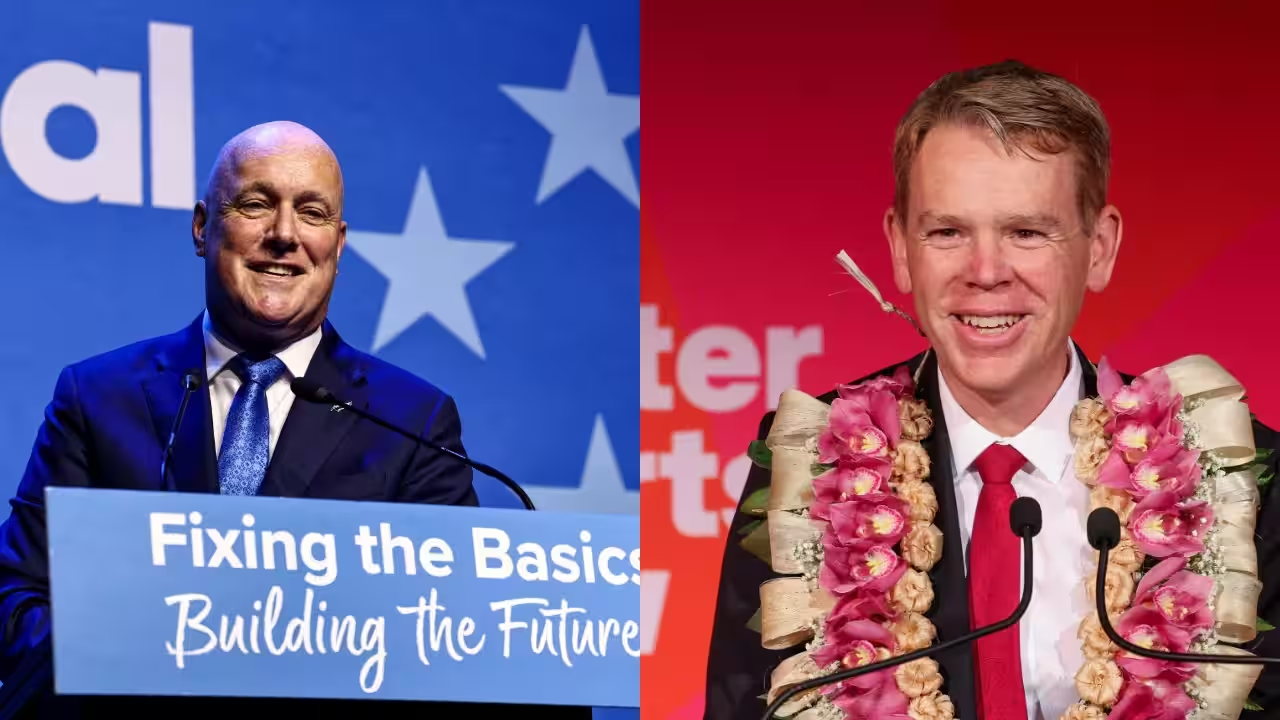
New Zealand faces weeks of political uncertainty after a closely fought general election left prime minister Christopher Luxon’s centre-right National-led coalition with only a wafer-thin majority in preliminary results, while nearly 400,000 special votes remain to be counted.The National Party, along with its coalition partners ACT and New Zealand First, is projected to win 67 seats in a 131-member Parliament, just one more than the 66 required for a majority. However, the final outcome could change when special votes, including ballots cast overseas and outside voters’ electorates, are counted.The Electoral Commission is expected to announce the official results on November 27. Until then, Luxon’s government will continue in a caretaker capacity, with coalition negotiations likely to follow the final count.Neither Luxon nor opposition leader Chris Hipkins claimed victory after Saturday’s election. Luxon said the contest was “too close to call”, but maintained that National had a “pathway” to forming the next government.“National is once again the largest party in Parliament, and we have a pathway to forming the next government,” he told supporters in Auckland, adding that negotiations and compromises would be necessary.Hipkins, whose Labour Party is projected to win 36 seats, also stopped short of conceding. “New Zealand has spoken. It may take us a little bit longer to figure out exactly what it is that you’ve said,” he told supporters, insisting that every vote must be counted.National has secured 42 seats, while Labour is followed by the Greens with 16, ACT with 13, New Zealand First with 12, the centrist Opportunity Party with seven and Te Pāti Māori with five, according to preliminary projections.The close contest has made the smaller parties crucial to government formation. Opportunity, led by Qiulae Wong, has crossed the 5% threshold required to enter Parliament, marking the first time a new party without roots in established political groups has cleared the threshold since New Zealand adopted its mixed-member proportional (MMP) system in 1996.Wong has said her party is open to working with either side, but would first negotiate with the party that wins the most seats. Luxon, who had previously ruled out working with Opportunity, struck a more conciliatory tone after the results, saying he wanted to build a relationship with Wong and find common ground.The party could become a kingmaker if the National-led bloc loses its narrow majority after the special votes are counted. The opposition grouping of Labour, the Greens and Te Pāti Māori is projected to have 57 seats, and would also need Opportunity’s support to form a government.Special votes could prove decisive. They have historically tended to favour the left: in the 2023 election, they helped Te Pāti Māori and the Greens gain three seats between them. The final count could therefore alter the balance of power, particularly given the narrow margins in several electorates.New Zealand’s MMP system gives voters two choices, one for their local electorate representative and another for a political party. The party vote determines each party’s proportional share of seats, while parties that win more electorate seats than their share of the party vote allows can retain the additional seats, creating what is known as an “overhang”.The election campaign was dominated by the cost of living, unemployment and concerns over the sluggish economy. High grocery and fuel prices, along with healthcare, were among the issues that shaped voter choices.The results also point to declining support for the two parties that have traditionally dominated New Zealand politics. National and Labour have each secured around 29% of the popular vote, with smaller parties gaining ground across the political spectrum.The Treaty of Waitangi, New Zealand’s founding document, was another major campaign issue, particularly among Māori voters. The Treaty Principles Bill, which sought to define the Treaty’s principles in law, was defeated in 2025. Te Pāti Māori co-leader Debbie Ngarewa-Packer has indicated that her party could work with Labour, the Greens and Opportunity to remove the incumbent government.With the special votes still to be counted, the country could face weeks of negotiations before a new government takes shape. Political observers have also warned that the process may extend beyond the final results, potentially leaving New Zealand without a confirmed government.You use AI every day. Now get your AI Quotient. Take the AIQ test.
Topics in this story
Gathered from external sources. Rights to this text belong to whoever originally published it.