After his family drilled their Ohio farm and leased it to a wildcatter, Barber Riggs saw a well gush 600 barrels in a day; its first check was $50,154
Discover how Barber Riggs' Ohio farm struck oil, generating a remarkable $50,154 initial payment and revolutionizing the family's income with the Barber Riggs No. 2 well in 1980.
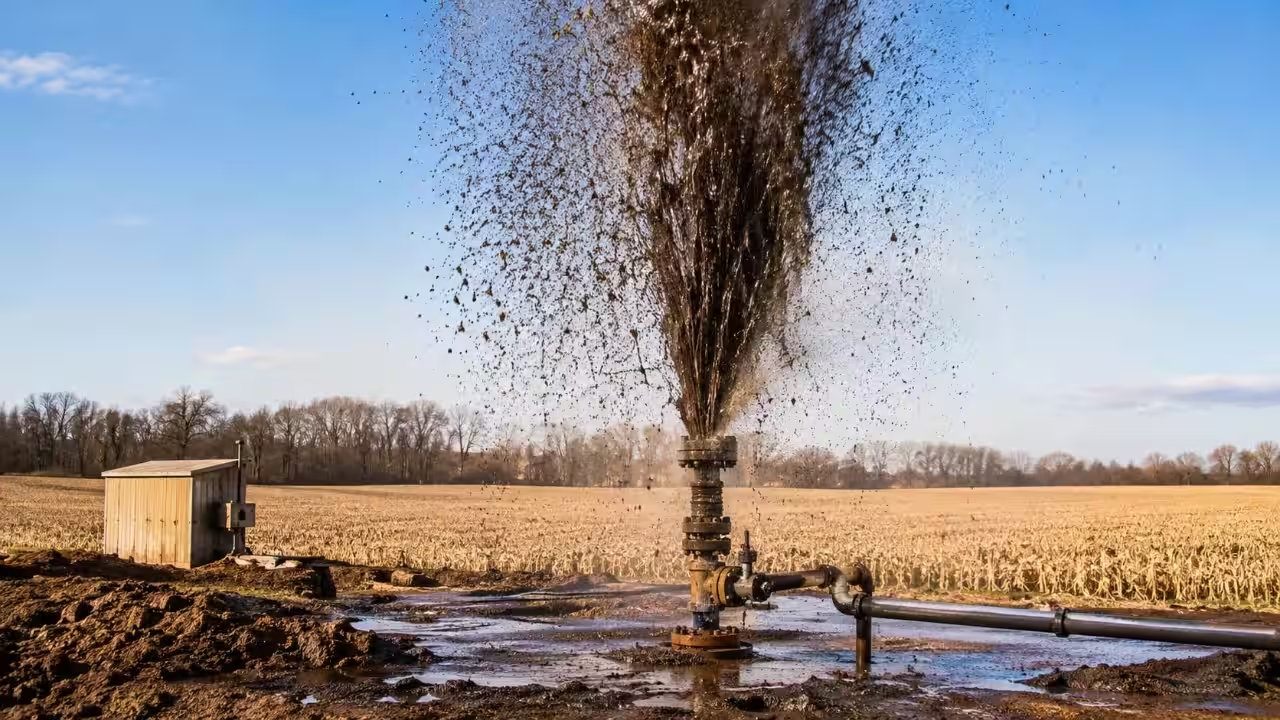
A productive oil well on the Riggs family’s farm in Washington County, Ohio, began bringing in royalty and override income in 1980, according to a Washington Post report from March 17, 1981. Addie Fields, Barber Riggs’s daughter, told The Washington Post that the well, named Barber Riggs No. 2, produced 600 barrels of oil on its first day, May 26, 1980. Fields said the first oil payment, for $50,154, arrived in August. The details come from Phil McCombs’s March 17, 1981 article in The Washington Post, “Little Oil Wells Yield Ohio Big Money,” which described the oil boom in southeastern Ohio. When the oil was discovered, Barber Riggs was already 94 years old. The daughter of Barber Riggs, Addie Fields, assisted her father in managing the oil business and provided some information to the reporter regarding the well’s productivity and payments. The discovery happened due to the rise in oil prices and as a result of the active drilling of wildcatters in areas in Ohio where oil had not been discovered for low prices before.Barber Riggs No. 2 produced 600 barrels on its first dayFields remembered being informed over the telephone on May 26, 1980 that the well had been gushing oil. She stated that the first day it came in at 600 barrels and then produced 500 barrels per day for two weeks. It maintained production levels of 400 barrels per day for a while before falling off in September. Fields further referred to Barber Riggs No. 2 as the best-producing well drilled in Washington County within the year before. This statement was credited to her and the report was published by the newspaper. For instance, the newspaper noted that a well producing 15 barrels per day was good in the locality. Thus, the initial production was outstanding within the local oil industry. The output, however, did not sustain this initial high level of production.The family received its first payment in AugustEven though the well came in May, the family did not receive their first check until August. According to Fields, the amount paid was $50,154. According to her, it had been frustrating for the family and she believed that the oil company had intentionally delayed making the check to earn interest on the amount. This was a personal opinion and not necessarily an answer to why there had been the delay. Apart from the royalties, the family made some money through another agreement with the operator.Riggs and his relatives had done the original drilling on the land, then leased the drilling rights to a wildcatter. In exchange for giving up those rights, they were paid an override fee. The newspaper analysed check stubs from two wells on the family’s land. From these check stubs, it is revealed that Riggs and relatives got $1430.83 for their one-eighth portion of 350.64 barrels of oil after a windfall profits tax deduction. They also got $423.36 as an override fee and $423.78 from their share of gas sales in the month.Rising oil prices renewed interest in southeastern OhioThe region in southeastern Ohio had been an area where the extraction of oil was prevalent. However, these wells were small-scale and could not yield much. According to The Washington Post’s 1981 report, these small-scale wells had stayed virtually untapped while oil prices were low. Ohio’s wider oil history stretches much further back. The Ohio History Connection says the first oil-producing well in North America was drilled in Noble County, Ohio, where Silas Thorla and Robert McKee discovered oil while drilling for salt brine in 1814. The well, known as the Thorla-McKee well, was located near Caldwell. The Ohio Department of Natural Resources also records that commercial oil and gas production in the state began in 1860. The 1981 report, Little Oil Wells Yield Ohio Big Money, documented how the renewed activity brought additional income to local landowners. For the Riggs family, the May 1980 discovery produced an unusually strong start, followed by a first payment that arrived several months later.You use AI every day. Now get your AI Quotient. Take the AIQ test.
Topics in this story
Gathered from external sources. Rights to this text belong to whoever originally published it.