Meet Wesley Goodridge, the Grade 7 Canadian student who built a device to test milk freshness before throwing it away; he won a $10,000 scholarship
Rest of World News: Wesley Goodridge, a Grade 7 student at Aberfoyle Public School in Morriston, Ontario, won gold in the junior category at the 2026 Canada-Wide Science .
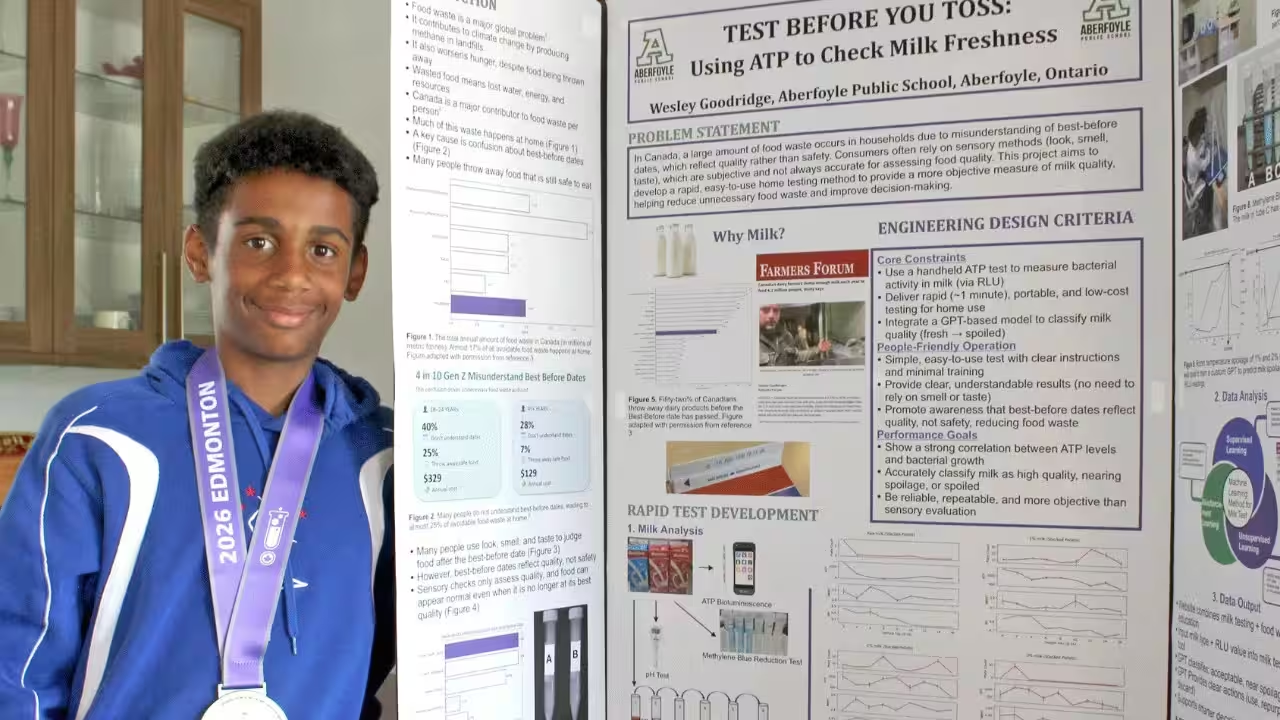
Wesley Goodridge, a Grade 7 student at Aberfoyle Public School in Morriston, Ontario, won gold in the junior category at the 2026 Canada-Wide Science Fair for a project tackling an everyday source of food waste: milk that gets thrown away before consumers know whether it has actually spoiled. His project, Test Before You Toss, explores whether a scientific measurement could give people a more reliable way to assess milk freshness than simply relying on a best-before date or their own senses. Goodridge also received the Agriculture, Fisheries and Food Challenge Award and a $10,000 university scholarship. His project grew out of an interest in food waste that began during a trip to Rome with his father, University of Guelph food professor Lawrence Goodridge. At the national science fair in Edmonton, held from May 23 to 30, 2026, the young researcher presented his approach alongside students from across Canada.How a trip to Rome sparked Wesley Goodridge's science-fair ideaAccording to the Wellington Advertiser, Goodridge's interest in food waste began during a trip to Rome with his father, Lawrence Goodridge, who was working with the United Nations' Food and Agriculture Organisation. A large display about food waste in a cafeteria caught the student's attention and led him to think about how much food gets discarded simply because people cannot easily determine whether it is still usable. Goodridge has said that science has always been part of his life because of his father, a food professor and Canada Research Chair in food-borne pathogen dynamics at the University of Guelph. His project turned that interest into an experiment focused on one of the most common foods found in household refrigerators.Why Goodridge focused on ATP to investigate milk freshnessInstead of trying to identify individual bacteria, Goodridge's project uses adenosine triphosphate, or ATP, as an indicator of biological activity. ATP is present in living cells, including microorganisms, making it possible to use ATP measurements as an indicator of microbial activity in a sample. For Test Before You Toss, Goodridge investigated whether measuring ATP could provide useful information about the freshness of milk. The approach is designed around giving consumers additional information when deciding whether milk should still be used, rather than relying only on the date printed on the container or traditional sensory checks. The project earned Goodridge the Agriculture, Fisheries and Food Challenge Award at the Canada-Wide Science Fair, recognising its focus on a practical food-related problem.How Test Before You Toss could help reduce food wasteThe basic idea behind Goodridge's project is to give consumers another tool for deciding what to do with milk that may be approaching the end of its usable life. A best-before date does not automatically mean that a food has become unsafe, but uncertainty about freshness can lead people to throw products away rather than risk consuming them. A test capable of providing additional information about a food's condition could therefore help reduce unnecessary waste. Goodridge's project combines that food-waste problem with a scientific measurement, turning a question that normally comes down to a smell test or a printed date into something that can instead be investigated experimentally.What Goodridge has already tested and where the project could go nextGoodridge's experiments have already included milk with three different fat percentages, allowing him to examine how the composition of the milk affects the results. That work forms part of the project's current research rather than being a future experiment he has yet to undertake. The project could eventually be developed into a more accessible system for consumers. Goodridge has also explored the possibility of using a photo-based app, which could make the technology easier for people to use outside a laboratory setting. His work at the national science fair was supported by the Canadian Black Scientists Network following his success at regional science fairs. He now hopes to continue developing the project and investigate whether the approach can eventually be applied more broadly. For a Grade 7 student, Goodridge's project starts with a remarkably ordinary question: before throwing food away, can science provide a better answer about whether it is still good?Catch the latest World News and Live updates. Download the TOI app.
Topics in this story
Gathered from external sources. Rights to this text belong to whoever originally published it.