Will the long shadow of Oct 7 scuttle Bibi’s re-election bid?
As he faces his ninth successive Knesset bid on Oct 27, Israeli PM Benjamin Netanyahu is increasingly under scrutiny for his ‘failure’ to prevent the Oct
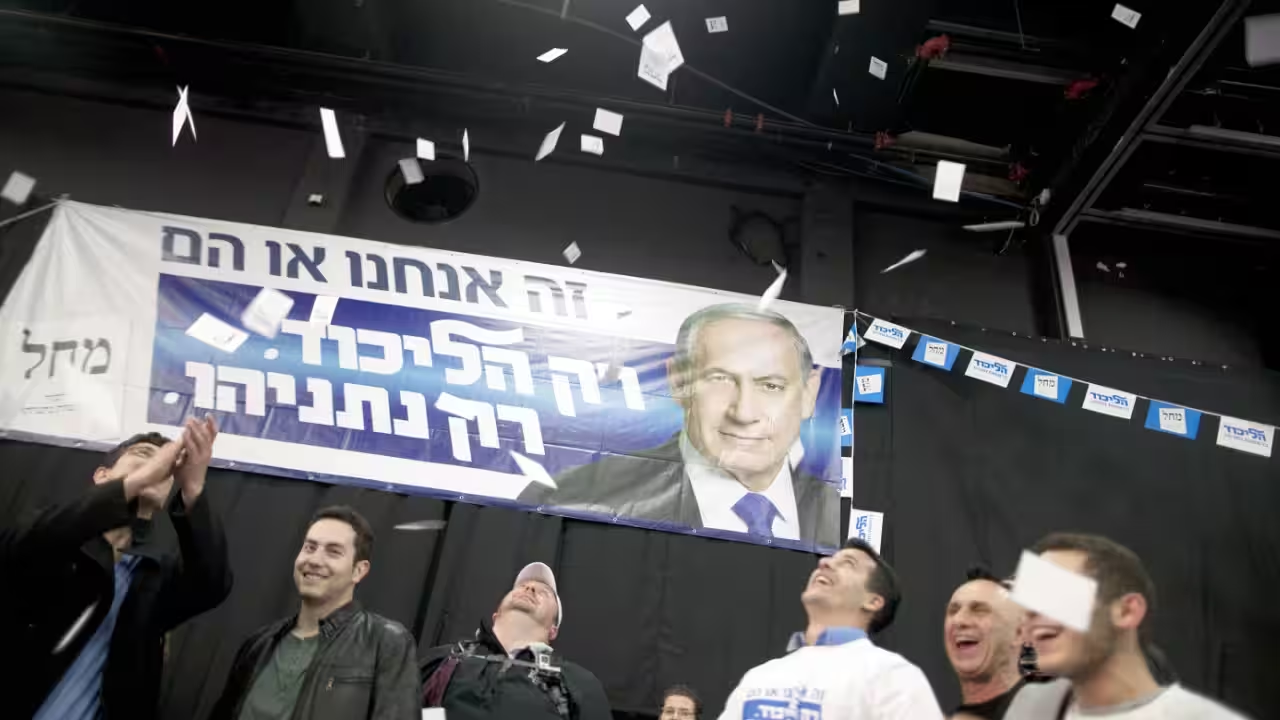
As he faces his ninth successive Knesset bid on Oct 27, Israeli PM Benjamin Netanyahu is increasingly under scrutiny for his ‘failure’ to prevent the Oct 7 massacre. In recent weeks, there has been a broad consensus inside and outside Israel that the Israeli govt, especially its intelligence establishment, failed to act on prior warnings from multiple sources, including Egypt, the UAE, and Palestinians. Arguments about the absence of ‘actionable intelligence’ do not hold water, especially with the families who lost their loved ones to incompetence and negligence.While Israel is known for last-minute electoral surprises, the picture is not rosy for Bibi. With more than 19 years in office, Bibi is already Israel’s longest-serving PM and has no intention of hanging up his boots anytime soon. Controversies and scandals are nothing new to him, and they date back to his first prime ministerial bid in May 1996. Unlike other elections in Israel and elsewhere, the forthcoming battle for the ballot does not center on the economy. Despite the war, the economy has recovered from the initial shock, thanks to high-tech resilience. With last week’s flydubai attempted hijack, the focus is on the proverbial security.There is a political-military divide in Israel over Oct 7. Several senior military and security officials took personal responsibility and left their posts prematurely. This has not been true of the political class. As the ultimate political authority, Netanyahu never took responsibility for the attack and avoided accountability. Initially, he delayed a formal inquiry, citing ‘ongoing war’, and then he hoped his ‘victory’ would weaken the demand for a judicial postmortem. His high-profile confrontation over controversial judicial reforms also contributed to his refusal.Under Israeli law and norms, a national inquiry commission into major crises is headed by the sitting president of the Israeli Supreme Court, equivalent to the Chief Justice of India. A similar inquiry into the October War of 1973 led to the resignation of PM Golda Meir, and she never returned to active politics. Naturally, Bibi has been averse to such judicial scrutiny.Unfortunately for him, as the Gaza and Iran conflicts dimmed, if not ended, demands for a national inquiry only grew. Indeed, all the major parties and leaders running in the election later this month are pledging a judicial inquiry into the failure. The field is also crowded with several former generals and intelligence figures who strongly disapprove of Bibi’s handling of Oct 7 and its aftermath. Hence, as much as he tries to avoid it, the massacre looms large over the electorate.Mainly due to the proportional system of elections, Israel has not had a single-party govt since 1948. Bibi is unlikely to secure even half of the majority mark. With his popularity falling, the latest opinion polls give Likud party only 18-21 seats, far fewer than the 32 seats it secured in the 2022 election.While he has established complete control over the ruling Likud, Bibi faces severe challenges from the right wing, which opposes even his minimalist accommodation of President Donald Trump’s Gaza Peace Plan. Otzma Yehudit (led by Itamar Ben-Gvir) and the Religious Zionist Party (headed by Bezalel Smotrich) oppose Bibi on the Gaza Strip and are projected to take a significant share of Likud’s voters.There are other significant contenders. Yashar, led by former general Gadi Eisenkot, is projected to be the largest party, expected to secure 21-25 seats. The rechristened ‘Together,’ the former Naftali Bennett-Yair Lapid coalition, could be another major player among centrist voters. Above all, the Democrats (the erstwhile Labour-Left coalition) are showing signs of revival and could garner some votes.For a long time, opposition disunity, the shrinking of the Left, and a strong alliance with the religious bloc have marked Bibi’s remarkable staying power. This time, the opposition is near-unanimous in rejecting Netanyahu’s refusal to be held accountable for Oct 7. If current projections hold and Likud loses more seats, Bibi’s post-election coalition-formation manoeuvring will be considerably weakened. Should the religious parties gain more seats, his dependence on the right-religious fringe will only increase.An election forecast is a dangerous gamble in Israel, and the signs are not very favourable for Bibi. Likud is unlikely to be the largest party in the next Knesset, but it could hold on to office with sufficient political concessions to the far right and economic incentives for the religious parties.As Israelis head to the polls just days after the third anniversary of the largest single act of terrorism in Israel’s history, Bibi might even do a political somersault and offer some form of judicial review of his role in the Oct 7 attack. Bibi, the proverbial comeback kid, could still spring a surprise and remain in office beyond Oct 27.Disclaimer: Views expressed above are the author's own.
Topics in this story
Gathered from external sources. Rights to this text belong to whoever originally published it.