Israel elections: Netanyahu faces crucial test; reports of fraud attempts, missing ballots - top developments
Israelis are voting in a crucial parliamentary election on Tuesday, with Prime Minister Benjamin Netanyahu facing a major test of his leadership amid
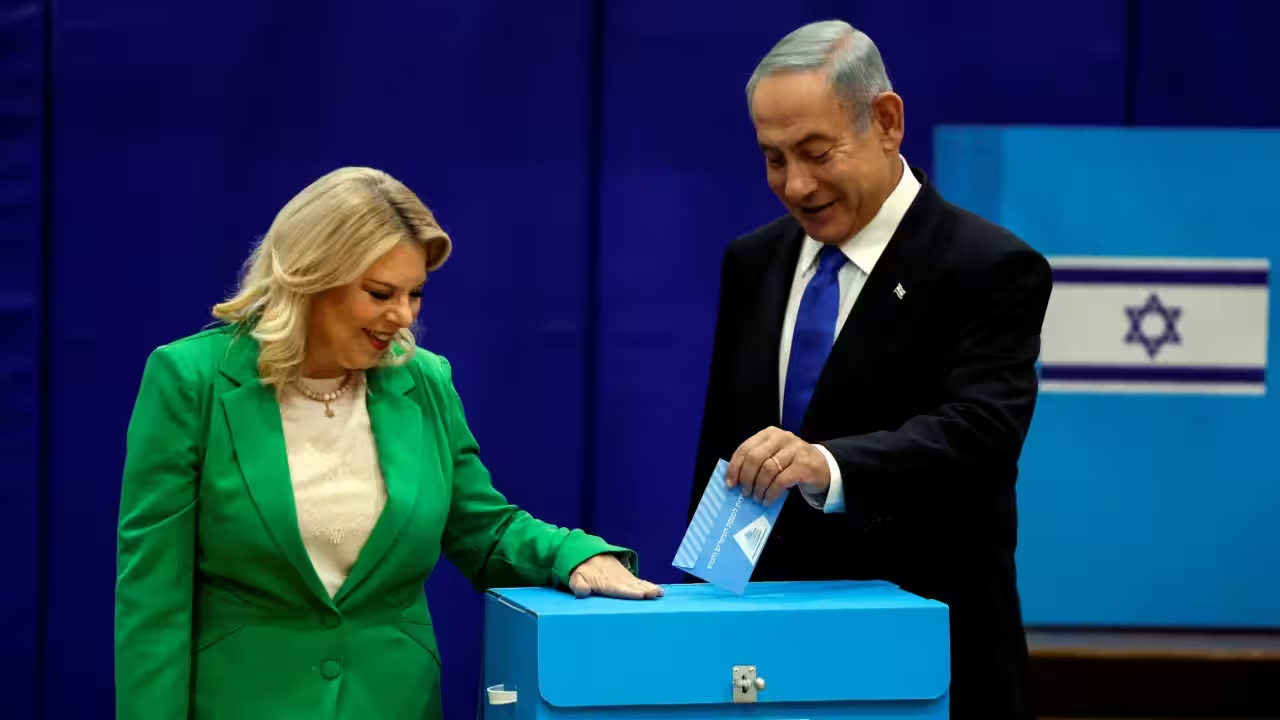
Israelis are voting in a crucial parliamentary election on Tuesday, with Prime Minister Benjamin Netanyahu facing a major test of his leadership amid unresolved conflicts, divisions over the country's future and growing international criticism of its conduct in Gaza.Netanyahu, Israel's longest-serving prime minister, is seeking to retain power against a group of parties hoping to unseat him, led by former military chief Gadi Eisenkot.The election is the country's first national vote since the Hamas-led October 7, 2023, attack that triggered the war in Gaza and related regional conflicts.However, reports of missing, damaged and defaced ballot slips have raised concerns about election integrity, with Eisenkot's Yashar party filing a complaint with the Central Elections Committee.1. Netanyahu faces a crucial testThe election is a test not only of Netanyahu's leadership but also of the direction Israel should take, with voters divided over security, military conscription, judicial independence and the country's international standing.Netanyahu's supporters view him as an experienced leader who has guided Israel through multiple wars and defended its Jewish identity.His critics accuse him of prolonging the war in Gaza and the hostage crisis for political reasons, undermining judicial independence and allowing ultra-Orthodox religious men to avoid compulsory military service.“The present government is driving the country into the ground,” voter Angela Bengur said in Jerusalem, the Associated Press reported.Eisenkot's supporters see him as a leader with strong security credentials who could improve Israel's international standing and strengthen democratic institutions. His personal losses during the Gaza war have also shaped his public image: his son and two nephews were killed while fighting in Gaza.2. Voter turnout hits highest midday level since 1973Voter turnout in Israel’s parliamentary election reached 31.5% by noon local time, the highest recorded at that hour since 1973, according to The Times of Israel, citing the Central Elections Committee.The strong participation reflects intense voter engagement as Israelis cast their ballots at more than 12,000 polling stations across the country.Turnout had already reached 16.68% by 10 am, with more than one million people having voted, the Central Elections Committee said. The figure was higher than the 15.9% recorded at the same time during the 2022 election.The Times of Israel reported that the morning turnout was the highest at that hour since at least 1996, when Benjamin Netanyahu first became prime minister. Other reports described it as the highest since 1981.Around 330,000 young Israelis are eligible to vote for the first time. Many are approaching compulsory military service as the country continues to grapple with the consequences of the October 7, 2023, Hamas-led attack and the wars that followed.Turnout among Israel Defense Forces (IDF) personnel was also higher than in the previous election. The IDF said 30% of service members had voted by 10 am, compared with 25.7% at the same point in 2022.3. Netanyahu warns of Arab-backed govt as Arab-led parties eye key roleArab-led parties could emerge as kingmakers in Israel’s parliamentary election if rival political blocs fail to secure a majority, potentially playing a decisive role in government formation, according to AP reports.Netanyahu urged Likud supporters to turn out in large numbers, warning that the country’s future was at stake.“This is an emergency call to Likud voters! Today no one stays home. No sea, no barbecue. Making sure that the family, friends, and neighbors also get to the polling station,” he wrote on X, sharing a video.“The future of our Jewish state is on the line: a strong right-wing government or a left-wing government supported by the Arab parties. Going out to vote with all our might!” he added.In another post, Netanyahu said buses were heading to polling stations and long queues were being reported in Arab communities, while right-wing strongholds had yet to see a comparable turnout.“If we don't go out to vote now, we'll find ourselves with a government of the Arab parties. We must not stay home. Every vote counts! Going out now to vote - Machal, Likud,” he wrote.Arab citizens make up around 20% of Israel’s population, giving Arab-led parties the potential to influence government formation if the main political blocs fall short of a majority.“Our vote will change the government,” Mansour Abbas, head of the Islamist Ra’am party, said after casting his vote. He added that he hoped turnout in Arab communities would exceed 70%.However, cooperation with Arab-led parties remains a contentious issue among right-wing politicians.Israel’s far-right national security minister Itamar Ben-Gvir, who has faced criticism for his treatment of Palestinian detainees and remarks about Palestinians in Gaza, warned that “it will be Mansour Abbas’ government” if Netanyahu and his allies fail to secure a victory.4. Yashar party alleges ballot tampering, files complaintEisenkot's Yashar party has filed a complaint with the Central Elections Committee over reports that ballot slips bearing its designated voting symbol, “Derech”, were missing, damaged or defaced at polling stations.The party said it had received reports from several locations across the country about ballot slips being removed, marked with pens or turned over inside voting booths, potentially resulting in votes being disqualified.“After Likud's fake news campaign, we received numerous complaints about our ballot slips being defaced or removed,” party chairman Yoaz Hendel said, The Jerusalem Post reported.The party described the alleged incidents as a possible systematic attempt to disrupt its vote and undermine election integrity.“Anyone who tries to steal ballot slips is trying to steal the election. This is a serious violation of election integrity and the fundamental right of Israeli citizens to vote,” the party said.The allegations had not been independently established in the information available at the time of reporting.5. Eisenkot visits October 7-hit community before votingEisenkot began election day by visiting Kibbutz Nir Oz, one of the communities hardest hit by the Hamas-led October 7, 2023, attack.He walked alongside former hostage Gadi Mozes towards his polling booth before leaving to cast his own vote elsewhere.“I am proud and moved to begin this day with Gadi Mozes, a symbol of the Israeli spirit and strength, of Israelis’ commitment to one another and their commitment to the state. I pledge to do everything I can to ensure that we are worthy of the price you paid, the price the kibbutz paid and the price we all paid, and to bring healing and repair to all citizens of Israel,” Eisenkot told reporters.Mozes endured 482 days in Hamas captivity and campaigned for Eisenkot, according to The Times of Israel.Eisenkot also criticised the government for not beginning election day in communities attacked on October 7. “If someone in the government had a shred of responsibility, they would start the morning here in the Gaza envelope,” he said.Netanyahu had not appeared in public in the first three hours after polling stations opened, according to the initial reports. In Tel Aviv, families of people killed during the October 7 attack and former hostages observed a moment of silence.6. President Herzog calls election a 'holiday of democracy'President Isaac Herzog visited the Central Elections Committee headquarters and urged Israelis to participate in the democratic process.“It is a real holiday of democracy, and no one can be allowed to ruin it — quite the opposite, this is our opportunity, all of us, to influence our fate, the fate of our children, and the fate of our grandchildren. It is something that is deeply embedded inside of our spirit, as a very democratic nation,” The Times of Israel reported him as saying.“We are putting different slips in the ballot, and we are expressing different opinions, in the end we have a common fate. A common fate in this land, a common fate in our beloved country, and this election process is another way to express our love for our country,” Herzog added.7. Israel deploys 100,000 personnel for election dayIsrael has mounted a large logistical operation for the parliamentary election, with around 100,000 personnel, including election officials and workers, deployed across the country.Acting director general of the Central Elections Committee Dean Livne said around 50,000 election workers had received training at approximately 2,140 venues.The committee has prepared 12,018 polling stations, 18,000 ballot boxes, 12 million voting envelopes and 250 tonnes of paper for ballot materials. It has also established 6,209 accessible polling stations.Special voting arrangements have been made for more than 600,000 people who may be unable to vote at their designated polling stations, including soldiers, diplomats and hospitalised voters. These voters can use an outer-envelope system, with checks designed to prevent duplicate voting.Authorities have also arranged free travel on 660 intercity public transport routes, including all Israel Railways services, to help voters reach polling stations. Around 690 million shekels, or approximately $223 million, has been allocated for the election.The Central Elections Committee has deployed around 15,000 cameras for electoral integrity inspectors to monitor polling stations and document voting and counting. The system is intended to protect ballot secrecy and allow inspectors to identify attempts to pressure or influence voters.8. How Israel's electoral system worksIsrael is a parliamentary democracy in which voters elect lawmakers rather than directly choosing the prime minister. The government must retain the confidence of the Knesset to remain in power.The country uses a proportional representation system. Voters choose a party list, and the 120 seats in the Knesset are distributed broadly in proportion to the votes received by parties that cross the electoral threshold.Unlike many other parliamentary democracies, Israel treats the entire country as a single constituency rather than dividing it into geographic electoral districts. This allows smaller parties representing religious, political and ethnic communities to win parliamentary representation.Parties must receive at least 3.25% of valid votes to enter the Knesset. The system often produces fragmented parliaments in which no single party wins an outright majority, making coalition negotiations central to government formation.9. What happens after the votes are counted?After the results are finalised, President Herzog will consult the leaders of the elected parties before assigning a lawmaker the task of forming a government.The person chosen does not necessarily have to lead the largest party; the key consideration is who appears most likely to assemble a coalition with sufficient parliamentary support.The designated lawmaker will have 28 days to form a government, with a possible 14-day extension. If the attempt fails, another party leader may be given 28 days to try.If that effort also fails, at least 61 lawmakers can request that the president assign the task to a particular member of the Knesset within a further 21-day period.A new government must win a confidence vote in parliament. A minority government may also take office if it receives more votes in favour than against, even without the backing of 61 lawmakers.The process could take weeks, leaving the identity of Israel's next prime minister uncertain even after election results emerge. If all attempts to form a government fail, the country could face another election, with Netanyahu remaining caretaker prime minister until a new government takes office.10. Iran tensions remain in the backgroundThe election is also taking place amid continuing tensions with Iran. Netanyahu intensified his warnings to Tehran ahead of the vote, saying it would face “a devastating blow” if it attacked Israel.Israel's conduct in Gaza and the occupied West Bank has also drawn growing international criticism. Public support for Israel in the US has fallen, while some European and other partners have imposed sanctions.You use AI every day. Now get your AI Quotient. Take the AIQ test.
Topics in this story
Gathered from external sources. Rights to this text belong to whoever originally published it.