France in flames: How student protests spiralled into nationwide unrest
What began as student protests over deteriorating school conditions has escalated into a nationwide crisis in France, with more than 2,000 arrests,
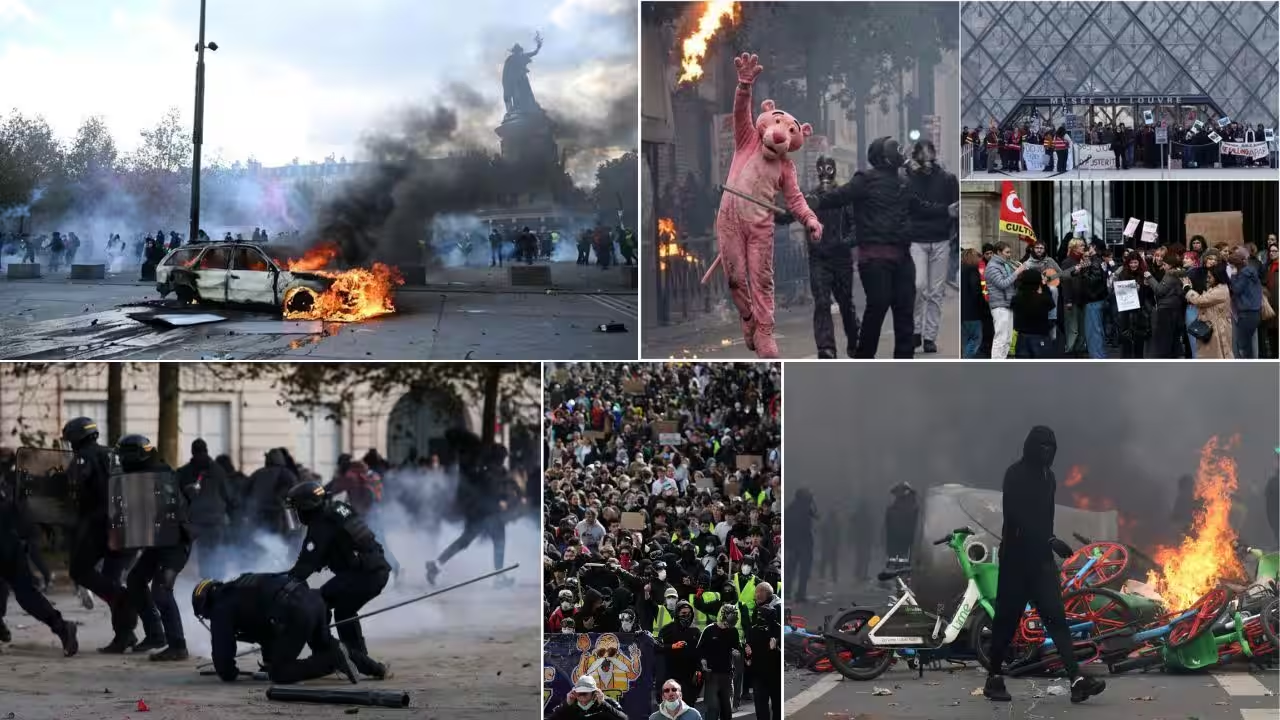
What began as student protests over deteriorating school conditions has escalated into a nationwide crisis in France, with more than 2,000 arrests, thousands of businesses damaged or looted and public buildings set on fire. More than half a million people took part in demonstrations across the country on October 17, according to the interior ministry, as anger over underfunded public services and rising living costs brought students, workers, farmers and other groups onto the streets.The violence has raised three central questions: How did the protests spread so rapidly? Did authorities fail to anticipate the scale of the unrest? Did far-left groups exploit the demonstrations to fuel disorder? While the government has blamed far-left agitators and looters, opposition leaders have pointed to years of discontent over public services and economic pressures. President Emmanuel Macron has acknowledged failures in planning and intelligence, rejected the interior minister’s resignation and ordered a review of policing methods.How did student protests turn into nationwide unrest?The demonstrations began in September, when high school students blockaded schools to protest overcrowded classrooms, teacher shortages, deteriorating infrastructure and what they described as inadequate funding. Some also demanded changes to the state-run system used to determine university admissions, which they consider unfairly selective.The movement expanded in early October as teachers, parents, trade union members, farmers and other groups joined the demonstrations. Their demands extended beyond education to include rising living costs, fuel prices and declining public services, including healthcare, housing and welfare.Also read - France student protests: Why are thousands of students blocking schools and taking to the streets?The mobilisation culminated in nationwide marches on October 17. The interior ministry estimated that around 550,000 people participated, while the CGT trade union put the figure at more than 800,000.Although most demonstrations were peaceful, groups of rioters targeted shops, supermarkets, public buildings and police vehicles. Authorities said thousands of businesses were affected, while several municipal and government buildings suffered fires or other damage.In Limoges, a fire badly damaged the historic town hall, causing its roof to collapse. In Lyon, a tourist office was set ablaze, while authorities in Bordeaux reported an attack on the prefect's residence. Shops and businesses in Paris, Marseille and Lille were also targeted.The spread of violence across multiple cities transformed a protest movement rooted in public grievances into a nationwide law-and-order crisis. The scale of the destruction also intensified scrutiny of the authorities' ability to protect public property and prevent peaceful demonstrations from turning violent.How did intelligence failures and police deployment contribute?One of the central questions is why security forces were unable to prevent violence from spreading across several cities despite weeks of demonstrations.Interior minister Laurent Nuñez acknowledged that authorities had failed to anticipate the scale of the mobilisation and admitted that police had "lost control" in some major cities. He also said policing numbers had fallen short in certain areas.On Monday, Macron acknowledged “failures in anticipation and intelligence” but rejected Nuñez's resignation, which the interior minister had submitted on Sunday. The Élysée Palace said the president wanted the interior ministry to ensure transparency over the failures in planning and intelligence gathering that contributed to the violence. Macron also called for new operational methods for security forces.The movement of violent groups away from the main demonstrations appears to have complicated the police response. Fabien Jobard, a researcher at the French National Centre for Scientific Research, told TIME that rioters dispersed beyond the main protest areas, apparently catching police off guard.This movement left authorities with less time to deploy sufficient forces at different locations. With violence spreading across city centres, commercial districts and public buildings, police also faced the challenge of protecting multiple potential targets simultaneously.The unrest has revived questions about France's approach to crowd control. The country has experienced prolonged clashes during previous protest movements, including the Yellow Vest movement that began in 2018 over fuel taxes and broader economic grievances, and demonstrations against pension reforms in 2023.However, the available information does not establish that a single intelligence failure or policing decision caused the nationwide violence. The government's own admission points to shortcomings in anticipating the mobilisation, while the dispersal of rioters presented an additional operational challenge.How did ultra-left groups become part of the controversy?The government has accused far-left activists and organised groups of exploiting the demonstrations to provoke confrontation and undermine public order.Prime Minister Sébastien Lecornu said the authorities were dealing with a "shadowy network" of instigators and argued that some groups wanted to create widespread disorder ahead of next year's presidential election.Nuñez also blamed what he described as "hordes of troublemakers and looters" and "far-left activists", saying police tactics needed to adapt to highly mobile groups.The government's position is that the violence was not simply an extension of the student movement, but also involved people who used demonstrations as an opportunity to attack public property and loot businesses.The accusations have been contested by the political opposition. Jean-Luc Mélenchon, leader of the left-wing France Unbowed party, argued that the unrest reflected deeper problems with the government's handling of public services.Mélenchon described the protest movement as “the result of ten disastrous years in which President Macron has disorganized the state and public services.”The competing explanations point to two issues that need to be distinguished: why people joined the protests and who was responsible for the violence. Anger over schools, living costs and public spending helps explain the scale of the demonstrations, but it does not establish who organised or carried out individual attacks.The available evidence also does not establish that far-left groups orchestrated the entire unrest. The government's allegations remain central to the political dispute, while the extent of any organised role would need to be assessed through police investigations and evidence about specific incidents.How did economic anger fuel the protests?The unrest has unfolded against growing frustration over the cost of living and the condition of public services in France.Students have complained about overcrowded classrooms, teacher shortages and inadequate school infrastructure. Other groups have joined the movement over rising fuel prices, pressure on household budgets and concerns about access to healthcare, housing and welfare.Fuel costs have become another source of anger amid disruption to energy supplies linked to the war involving Iran. Farmers have also raised concerns about agricultural expenses.The demonstrations have consequently drawn support from groups with different demands, making the mobilisation broader than a conventional student protest. Organisers have described the movement as a convergence of education-related grievances and wider economic discontent.The government's fiscal position has added to the political pressure. France's high public debt and debate over spending have intensified scrutiny of its ability to fund public services while controlling government expenditure.Macron has acknowledged that young people's concerns need to be heard and said the government was working with fuel distributors to deliver a tangible impact on prices. However, the political dispute over public spending and the government's response has continued alongside the security crisis.Economic grievances help explain why the demonstrations attracted such a wide range of participants. They do not, on their own, explain why some gatherings turned violent, making it necessary to examine the conduct of rioters and the authorities' response separately.How are curfews helping the government restore order?Authorities have introduced local restrictions to prevent further violence and protect businesses following the weekend's destruction.Paris police imposed an overnight curfew covering Place de la République, where clashes took place, and the Les Halles shopping district. The restrictions were scheduled to run from 11pm on Monday until 6am on Tuesday, with gatherings and demonstrations also prohibited from 8pm.Other local authorities introduced restrictions, including overnight curfews for minors in parts of Lille and Nice. Bordeaux also announced a week-long night curfew for unaccompanied minors following violence and looting in the city centre.Also read - France unrest: PM orders curfews, hints at declaring emergency; over 2,400 arrestedLecornu said the government preferred limited, localised curfews rather than a nationwide measure and indicated that restrictions could be extended where necessary."The targeted curfews have contributed to the calm of last night," the prime minister said on X on Tuesday, adding that the measures could be extended "where the situation requires it".France's cities were reported to have remained calm overnight under the new restrictions, giving the government a temporary reprieve. But protest groups have announced further demonstrations, including calls for renewed student mobilisation and actions associated with the Yellow Vest movement over fuel costs.The government is therefore facing two parallel challenges: restoring public order and addressing the grievances that brought hundreds of thousands of people onto the streets. Curfews may help limit opportunities for further disorder, but they do not resolve the underlying disputes over education, living costs and public services.How has the unrest intensified political pressure on Macron?The unrest has triggered a wider political confrontation as France approaches its next presidential election, scheduled for 2027.Far-right National Rally leader Jordan Bardella accused the government of failing to protect the public, while Marine Le Pen called for calm and condemned the destruction.“Violence is not an opinion. Destruction is not a form of expression. And chaos cannot serve as a project for France,” Le Pen said in a video address.Macron has vowed that those responsible for looting and attacks on public buildings will be held accountable. Economy Minister Roland Lescure has also pledged support for businesses affected by the destruction.The government has faced criticism from both the right and the left, with opponents disputing its handling of the security situation and its broader economic and public-service policies.The coming days will test whether local curfews and revised police tactics can prevent another wave of violence. Further demonstrations could also reveal whether the movement remains focused on student grievances and living costs or becomes more closely associated with wider opposition to Macron's government.How did the protests spiral out of control?France's unrest cannot be explained by a single factor on the available evidence. Public anger over education, living costs and public services helped bring hundreds of thousands of people onto the streets. The alleged involvement of far-left activists and looters added another dimension, while the government's admission of failures in anticipation and intelligence raised questions about police preparedness.The key distinction is between the grievances that fuelled the mobilisation and the actions that turned parts of it violent. The available information does not establish that ultra-left groups orchestrated the nationwide unrest, nor does it show that soft policing alone caused the escalation.The crisis has exposed the challenge of responding to widespread public discontent while preventing violent groups from exploiting demonstrations. Whether the government can restore order will depend not only on policing and intelligence reforms, but also on how it addresses the wider grievances driving the protests.You use AI every day. Now get your AI Quotient. Take the AIQ test.
Topics in this story
Gathered from external sources. Rights to this text belong to whoever originally published it.