A 50,000-square-foot Gilded Age mansion was bought for $26 million by a convicted fraudster; now the estate is being sold to help settle a $1 billion bankruptcy
US News: A 50,000-square-foot Gilded Age mansion in Mahwah, New Jersey, has become one of the most striking assets caught up in the billion-dollar bankruptcy o.
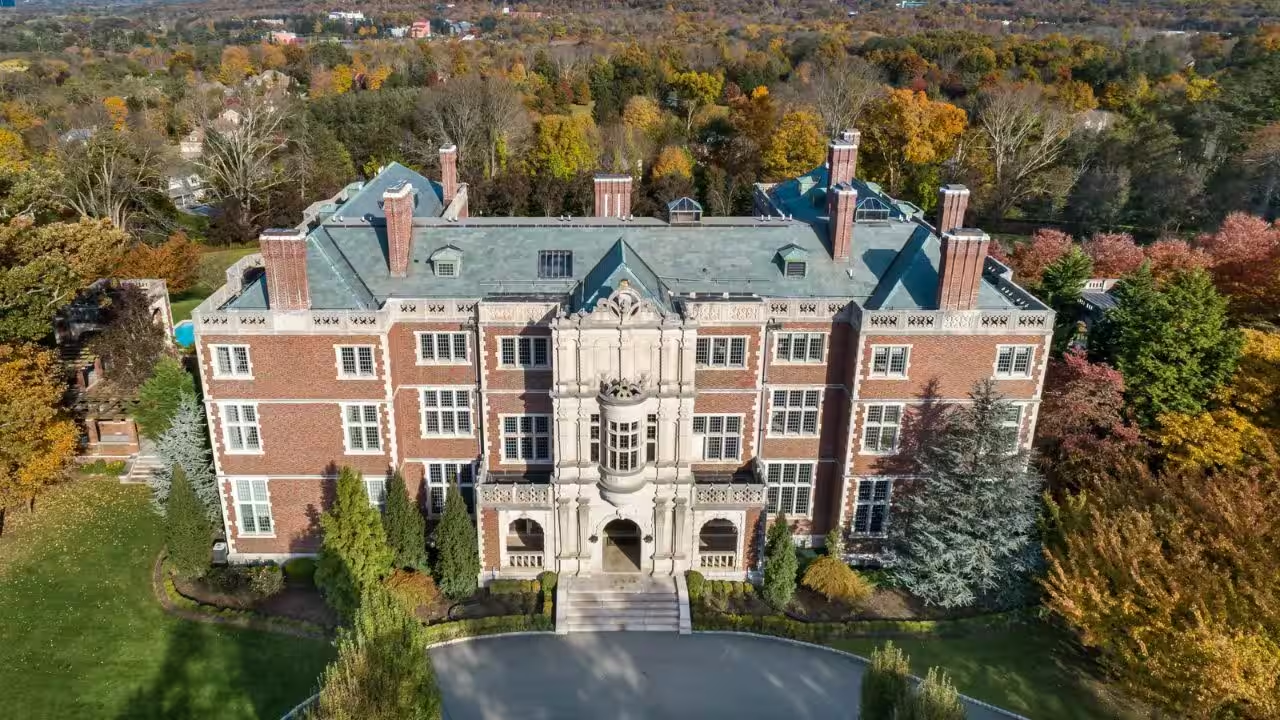
A 50,000-square-foot Gilded Age mansion in Mahwah, New Jersey, has become one of the most striking assets caught up in the billion-dollar bankruptcy of convicted fraudster Miles Guo. The historic ‘Crocker-McMillin mansion,’ built in 1907 for railroad heir ‘George Crocker,’ was purchased by Guo for $26 million in 2021, only months before his financial troubles and criminal case would place his collection of luxury assets under intense scrutiny. Now, the 75-room estate is on the market for $19 million, with the proceeds expected to address the enormous debts linked to Guo’s bankruptcy. According to Business Insider, the mansion’s story stretches from Gilded Age wealth and lavish parties to its seizure in a modern financial scandal. According to Realtor, repeated price cuts have brought the asking price well below both its original listing price and what Guo paid for the property.The 50,000-square-foot Gilded Age mansion at the centre of a billion-dollar bankruptcyThe Crocker-McMillin mansion sits about 25 miles from New York City and overlooks New Jersey's Ramapo Mountains. According to Business Insider, the vast property contains 75 rooms and around 50,000 square feet of living space, making it a remarkable survivor from America's Gilded Age. The mansion was built for George Crocker, the son of Central Pacific Railroad co-founder Charles Crocker. Construction began in 1902 and took five years to complete, costing around $2 million at the time. Architect James Brite designed the house after ‘Bramshill,’ a historic English country estate dating back to the early 1600s. The result was an enormous home built with red brick, carved limestone, steel beams and concrete floors. Its interiors were filled with elaborate wood and marble carvings, while the two-storey Great Hall became the centrepiece of the property. As reported by Business Insider, the hall features a huge fireplace, coffered ceilings and Tiffany silver chandeliers. Perhaps its most unusual feature is a 30-foot Aeolian player pipe organ that still stands in the Great Hall. The instrument could play music automatically using perforated paper rolls, allowing guests to enjoy performances even if nobody in the room knew how to play the organ.Miles Guo brought the mansion into a modern financial scandalThe mansion's latest chapter began when Miles Guo, also known as ‘Ho Wan Kwok’ and ‘Guo Wengui,’ bought the property for $26 million in 2021. According to Business Insider, the home was later seized in connection with his bankruptcy after he was convicted of federal fraud and racketeering conspiracy charges. Realtor reported that prosecutors said Guo spent around $18 million on renovations after buying the mansion. Among the expensive plans were a separate wing for his wife and luxury furnishings that included a $62,000 television, a $53,000 fireplace accessory and Chinese and Persian rugs valued at nearly $1 million. The estate's eight-car garage was also used to store a custom-built Bugatti that cost around $4.4 million. The mansion became one of several high-value assets connected to Guo's bankruptcy and fraud case. Realtor reported that his assets were being sold to help recover money connected to the wider financial collapse, which involved debts and claims worth billions of dollars.A home built for extraordinary wealth and entertainmentWhen the mansion was first completed, it stood on a far larger estate of roughly 1,100 acres. Today, the property has been reduced to 12 acres, but it still retains many of the features associated with its past. Business Insider reported that the original estate included woodlands, a lily pond, Japanese cherry trees and a lake stocked with thousands of trout. Crocker also kept horses on the property, where they could train and race along a private track. Inside, the mansion was designed to accommodate both its owner and his guests. It had 21 bedrooms, a grand dining room, a richly decorated library and a billiards hall. There were also 15 rooms for servants on the third floor. The house was technologically advanced for its time. It had electric-powered heating, laundry machines, a central vacuum system, lifts, a telephone switchboard and even ice cream freezers. Yet George Crocker had little time to enjoy the enormous home. He moved into the mansion in 1907 but died of stomach cancer in 1909, at the age of 54.How did the mansion pass through different handsThe estate changed owners several times over the following decades. In 1912, banker and philanthropist ‘Emerson McMillin’ purchased the property for $1 million. He and his family hosted parties and community gatherings there until his death in 1922. The mansion later came close to becoming a golf and country club before eventually being purchased by the ‘Archdiocese of Newark.’ According to Business Insider, it became home to the ‘Immaculate Conception Seminary,’ with its first group of seminarians moving in during 1927. The Great Hall was converted into a chapel, demonstrating how dramatically the purpose of the mansion had changed from its original days as a private retreat. Over time, however, the property fell into disrepair. It was later restored, helping preserve many of its historic architectural details and transforming it once again into a grand private residence.The mansion is now back on the marketThe Crocker-McMillin mansion was initially listed for $33 million in January 2025. However, Realtor reported that a series of price reductions eventually brought the asking price down to $19 million in December of that year. That figure is $7 million less than the $26 million Guo paid for the estate in 2021. The difference becomes even more striking when the renovation spending is considered. Despite its troubled recent history, the property itself remains an extraordinary piece of American architecture. Its historic interiors still include hand-carved details, murals, marble work and the towering Aeolian organ. Modern features include spaces for entertainment and relaxation while preserving much of the mansion's original grandeur. The house that once symbolised the immense fortunes of the Gilded Age has now become part of a very different story. Its sale is tied not to the expansion of another fortune, but to the effort to settle the financial consequences of a billion-dollar bankruptcy.Catch the latest World News and Live updates. Download the TOI app.
Topics in this story
Gathered from external sources. Rights to this text belong to whoever originally published it.