Harry and Meghan are back in Britain: Tracing their journey from royal fairytale to rupture
UK News: When Prince Harry and Meghan Markle married at St George’s Chapel in Windsor in May 2018, the moment seemed to carry more than the promise of a royal .
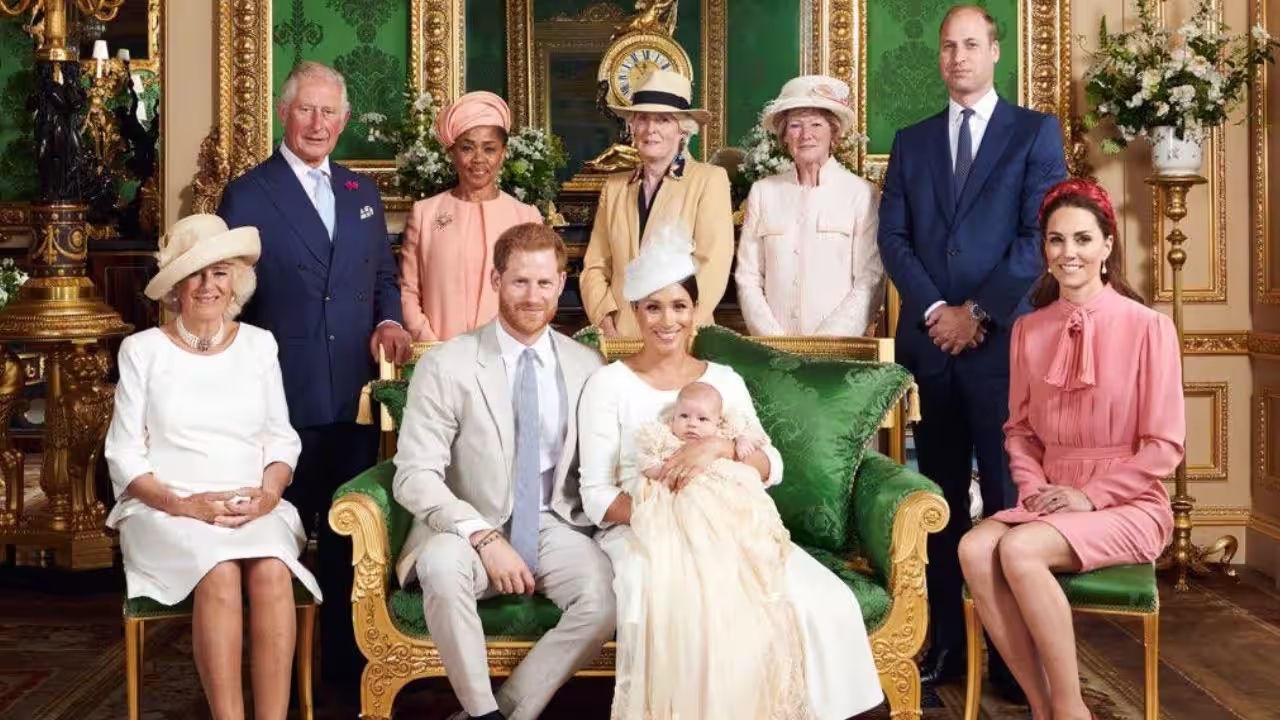
When Prince Harry and Meghan Markle married at St George’s Chapel in Windsor in May 2018, the moment seemed to carry more than the promise of a royal romance.It looked, in many ways, like the beginning of a new era.There was the prince who had grown up in the glare of the British monarchy, and the American actress who had entered an institution built on centuries of tradition. There was the spectacle of the wedding, the crowds outside Windsor and the global attention that followed.And there was something else.Harry was the younger son of the future king. Meghan was an outsider who had married into the world's most famous royal family. Together, they appeared to offer the monarchy a different kind of future.For a time, the picture was almost perfect.Harry and Meghan joined Prince William and Catherine, Princess of Wales, in what was widely seen as a younger royal generation capable of carrying the institution into the future. The four were often portrayed as the monarchy's modern "fab four".But the image did not last.Within less than two years, Harry and Meghan would announce that they were stepping back from their roles as senior working royals. They would leave Britain, first for Canada and then for California, and build a life outside the formal machinery of the monarchy.The years that followed would bring an explosive interview with Oprah Winfrey, a Netflix documentary, Harry's memoir and an increasingly public rupture between the Sussexes and other members of the Royal Family.The "fab four" became a symbol of what might have been.William and Catherine moved closer to the centre of the institution. Harry and Meghan moved further away. And yet, Britain never quite disappeared from their story.Harry has repeatedly returned to the country he once left. Family events, royal occasions and personal circumstances kept bringing him and Meghan back to Britain.Their latest return therefore raises a question that goes beyond where the Sussexes live.Can Harry and Meghan ever really leave Britain behind?Before Meghan, there was DianaHarry did not grow up with an ordinary understanding of what it meant to be royal.His childhood was lived inside one of the world's most scrutinised families. His parents' marriage was played out under extraordinary public attention. His mother became one of the most recognisable women on the planet.Diana's popularity was extraordinary, but so was the attention surrounding her.Her relationship with the monarchy, her marriage to then-Prince Charles, her separation and her life after the breakdown of the marriage all became subjects of intense media interest.For Harry, this was not merely history.It was his childhood.He was 12 when Diana died in a car crash in Paris on August 31, 1997. For Harry, her death defined the collision between the private lives of the Royal Family and the enormous appetite of the press and public for their stories.That history matters when looking at Harry's relationship with Meghan.Meghan was not Diana. Her experience was not Diana's, but there was an undeniable echo.Like Diana, Meghan became an extraordinarily prominent woman after marrying into the British Royal Family. Like Diana, she attracted intense media attention. And like Diana, her relationship with the institution became the subject of relentless public discussion.For Harry, however, the connection was even more personal.He had already spent his childhood watching his mother struggle with the pressures of royal life and media scrutiny. But with Meghan, Harry was no longer the boy being carried behind his mother's funeral procession.He was the husband. And his response to the press became increasingly forceful.Harry's hostility towards sections of the media is not a mere disagreement over headlines. It is also rooted in a childhood experience that shaped his understanding of what publicity can do to a royal family.In that sense, Meghan's arrival brought the concerns back into Harry’s adult life.2018: The couple who could have changed the monarchyThe wedding at Windsor seemed to suggest that the institution had found a way to embrace change without abandoning tradition.Meghan's background made her different from many previous royal brides. She had already established herself as a public figure before entering the Royal Family.Harry and Meghan quickly developed their own charitable and public identity. Their tours generated huge interest. They appeared energetic, modern and comfortable with the global media spotlight.The Sussexes seemed capable of becoming an important bridge between the traditional institution and a younger, more diverse audience.And they were not alone. William and Catherine were also developing their own public roles.The four represented a generational shift.William was preparing for an eventual role as King. Harry was the popular younger brother with a strong connection to younger audiences. Catherine had become one of the most recognisable members of the Royal Family. Meghan brought a distinctly international profile.The monarchy appeared to have a formidable younger team.The "fab four" were not a formal royal institution or constitutional arrangement. It was a media description of a family dynamic and public image.But the image mattered.It suggested unity, continuity, and the difficult experiences of the previous generation could perhaps be left behind.2019: When the fairytale began to frayThe Sussexes' first years as working royals were accompanied by intense media interest.The birth of their son Archie in May 2019 brought another moment of global attention. But by then, the couple's relationship with the British press had become increasingly difficult.Harry and Meghan's approach to privacy was also markedly different from the traditional expectations surrounding royal life.This was not simply a question of wanting to avoid cameras.Royal life operates on an unusual bargain. Members of the Royal Family receive enormous public attention and occupy privileged positions within a national institution, but they are also expected to undertake public duties and accept a degree of scrutiny.The Sussexes increasingly appeared uncomfortable with that bargain.\Their decision to establish a separate household and their increasingly independent public identity were signs of a relationship with the institution that was changing.2020: Megxit - the announcement that altered everythingIn January 2020, Harry and Meghan announced that they would step back as senior members of the Royal Family and work towards becoming financially independent.The phrase "Megxit" soon became a shorthand for the decision, although the reality was more than a couple moving house.Harry and Meghan were stepping away from the traditional role of senior working royals.The distinction is important.Being a member of the Royal Family is not necessarily the same as being a working member of it. The monarchy includes relatives who do not undertake official duties on behalf of the monarch. Working royals, by contrast, represent the King and carry out engagements and responsibilities connected to the institution.Harry and Meghan were choosing the second path.They wanted greater control over their lives and financial independence while retaining their family connection and royal identities, and the eventual destination was California.From royal duty to a life of their ownCalifornia changed the Sussexes' relationship with the public.In Britain, Harry and Meghan had been members of a constitutional institution.In America, they became a global couple building an independent public brand.They signed commercial deals. They developed media projects. They spoke publicly about their experiences.Their story was no longer being told primarily through royal announcements.They were increasingly telling it themselves, and that was where the next great rupture began.Oprah: when the palace walls became transparentIn March 2021, Harry and Meghan's interview with Oprah Winfrey became a global media event.The couple discussed their experiences within the Royal Family and made serious allegations about their treatment and the pressures surrounding Meghan's life as a royal.The significance went beyond any individual claim.For generations, the British monarchy had operated according to an unwritten principle of restraint. Private family disagreements were generally kept private.Harry and Meghan broke with that tradition.The Sussexes had their own account of what had happened.The institution did not respond with an equivalent public narrative.The result was a new kind of royal conflict: one side speaking openly, the other largely maintaining institutional silence.The family dispute had become a global media story.And the "fab four" image was becoming increasingly difficult to remember.The Queen's death and the return to BritainIn September 2022, Queen Elizabeth II died.For Harry, the event brought him back into a world from which he had deliberately created distance.The death of his grandmother placed family, monarchy and personal history in the same physical space.Harry returned to Britain at a moment when the institution itself was changing.Charles became King Charles III.William became heir to the throne.The Royal Family entered a new reign.The monarchy that Harry had left behind in 2020 had changed.But so had Harry. He was no longer simply the younger prince standing behind his brother. He was a husband and father living in California, a bestselling author and an internationally prominent figure who had publicly discussed his relationship with the Royal Family.Yet, in Britain, he was still Harry, Diana’s younger son and William's little brother.Spare and the collapse of the brothers' old imageIf Oprah had opened the door, Harry's memoir Spare pushed it much further.Published in 2023, the book offered Harry's most detailed account of his life inside the Royal Family and his relationship with William.The title itself was loaded with meaning.Harry had grown up knowing that William was the heir to the throne, and he was the "spare".The memoir made the distance between the brothers one of the defining narratives of the modern monarchy.The old image of William and Harry as inseparable brothers had been replaced by something far more complicated.The “fab four” split paths. William and Catherine remained inside, Harry and Meghan remained outside.The Diana parallel becomes harder to ignoreDiana's story had demonstrated that a royal could become bigger than the institution itself.Her popularity was extraordinary. Her public identity could not easily be contained within the formal boundaries of royal duty.Harry and Meghan's story is different, but it raises a related question.What happens when members of the Royal Family become global public figures with audiences and platforms independent of the institution?Diana eventually left the formal structure of the monarchy after her divorce from Charles, but remained one of the world's most famous women.Harry and Meghan made a different choice.They left royal duties while retaining their titles and global profile, and they established a life independent of the British monarchy.The parallel should not be overstated.Diana's circumstances were unique. Meghan's were different. Their marriages, departures and public lives unfolded in different eras. However, the picture also paints the difficulty of separating the individual from the institution once that individual has become globally famous.For Harry, the connection is even more profound.He has spent much of his adult life trying to protect his private life from the kind of media attention that surrounded his mother. And every time he returns to Britain, he returns not simply to a country, but to the landscape of his childhood.Why Britain keeps pulling Harry backHarry's life in California is now established. Yet Britain continues to draw him back.Some returns have been unavoidable consequences of family events. Others have been connected to personal matters and his continuing relationship with the country.That repeated movement across the Atlantic is revealing.Harry may have left the institution and royal duties. But he cannot leave his history behind.Britain is his childhood. It is where his mother became one of the most famous women in the world. It is also where he served in the British Army, married Meghan, and where his relationship with his family was formed long before the public became aware of the fractures within it.For Meghan, Britain carries a different meaning. Her relationship with Britain was created through Harry and the monarchy.For their children, the connection is still more complicated.Archie and Lilibet are growing up primarily in the United States. Their father's childhood in Britain is part of their family history rather than their everyday experience.The Sussex family's future therefore raises another question.Will Britain remain a place of family obligation and royal history, or can it become something more personal for the next generation?A monarchy that moved onThere is another reason the Sussexes' return feels different today.The monarchy moved on.Queen Elizabeth II died and King Charles III began a new reign. The Sussexes, meanwhile, have created a parallel life.That does not necessarily mean that every return to Britain represents reconciliation.Nor does it mean that Harry and Meghan are preparing to resume their old roles.The institutional distinction remains important: a return to Britain is not automatically a return to royal duty.A family visit is not the same as becoming a working royal again.The long road homeIn 2018, Harry and Meghan's wedding looked like a beginning. But it was also the beginning of a chain of events that would reshape the modern British monarchy.The couple who were expected to help refresh the institution eventually walked away from it.The "fab four" who appeared to embody a united younger generation became two very different couples pursuing very different lives.And Harry, the boy who lost his mother under the most intense glare of the world's media, became an adult determined to control the way his own family was exposed to that same glare.The Sussexes may have left royal life.But Harry cannot leave behind the country that shaped him, the family into which he was born or the memory of the mother whose own complicated relationship with the monarchy continues to cast a long shadow over his story.Eight years after the wedding, the Sussexes stand outside the royal future. But they are not entirely detached from it either.Perhaps that is the enduring paradox of Harry and Meghan's journey.Catch the latest World News and Live updates. Download the TOI app.
Topics in this story
Gathered from external sources. Rights to this text belong to whoever originally published it.