18 warships, wider global reach: Indian Navy eyes biggest-ever fleet expansion
2026 is shaping up to be a landmark year for the Indian Navy, with plans to induct or commission as many as 18 warships, the largest single-year addition
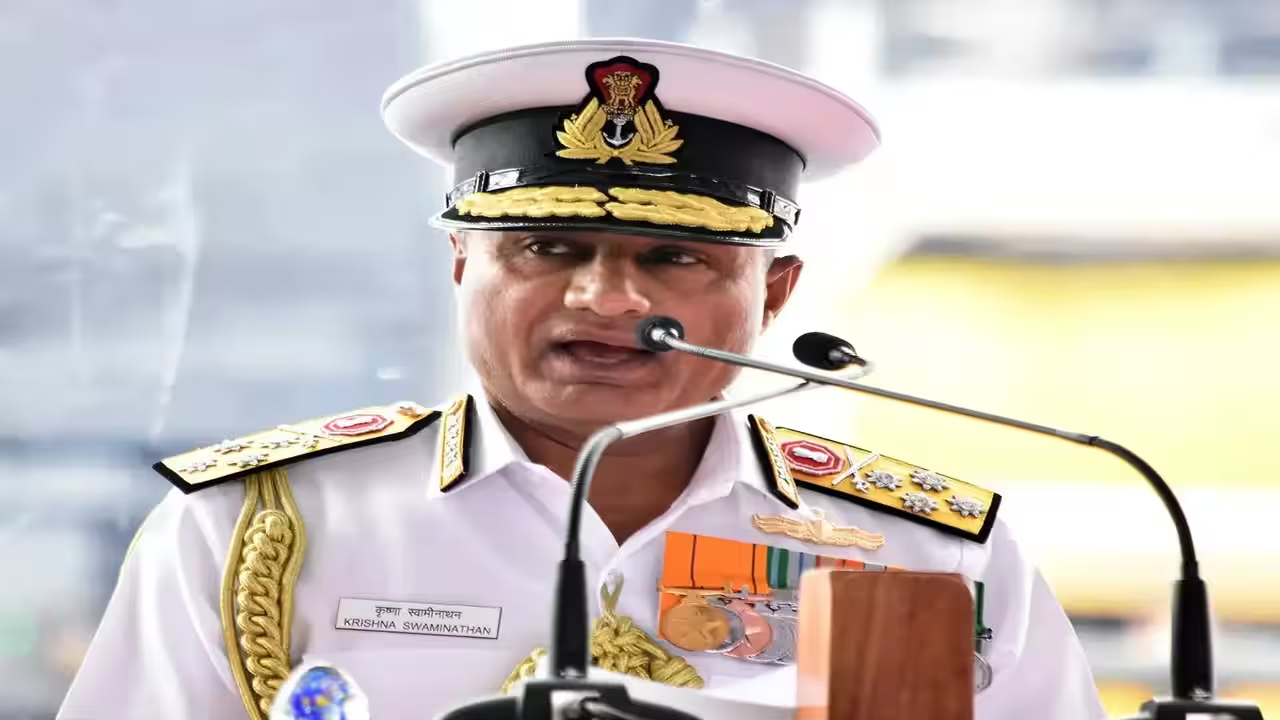
2026 is shaping up to be a landmark year for the Indian Navy, with plans to induct or commission as many as 18 warships, the largest single-year addition to the fleet in the Navy's history.The scale of the expansion was highlighted at the Navy's biannual Commanders' Conference, held at Nausena Bhawan in New Delhi. The developments were described as a reflection of the growing maturity of India's domestic naval shipbuilding ecosystem.At the conference, India's position in the Indian Ocean Region was also highlighted, with the country increasingly seen as a first responder and preferred security partner. Its strategic responsibilities are expanding amid a more complex maritime environment marked by congestion, deception and so-called grey-zone activities. The Navy emphasised the need to strengthen monitoring and response mechanisms, including a significant upgrade of India's maritime surveillance architecture to keep pace with the growing volume and complexity of maritime traffic.The Navy's expanding reach beyond its traditional area of operations was another key focus. Indian warships are currently deployed in the South China Sea, the Mediterranean and the Atlantic Ocean, underscoring the force's blue-water capability and growing role in providing strategic depth and power projection. This expanding maritime footprint was linked to the broader vision of Viksit Bharat 2047, with the Navy's role extending beyond protecting India's maritime boundaries to safeguarding economic interests and contributing to regional stability.Defence minister Rajnath Singh particularly praised the Navy's role during the recent crisis in West Asia, highlighting its efforts to ensure the safe passage of Indian-flagged merchant vessels, including LPG tankers, through the Strait of Hormuz under Operation Urja Suraksha.The security of these sea lanes has direct implications for India's economic and energy security. India imports roughly 85-90% of its crude oil and around half of its natural gas by sea, making the uninterrupted movement of energy supplies through key maritime chokepoints critical to the country's economy.Minister of State for Electronics and IT Jitin Prasada, who addressed the Naval Commanders, also lauded the Navy's role in safeguarding India's energy security. He highlighted the government's parallel push to strengthen India's sovereignty in semiconductor and chip production and build a more resilient technology ecosystem.Prasada was briefed on the Navy's efforts towards innovation, indigenisation and technology absorption. He also highlighted the growing importance of artificial intelligence, quantum technologies and other emerging technologies for both the wider technology ecosystem and the armed forces.Pointing to critical choke points in defence trade and their links with emerging technologies, Prasada reiterated the government's commitment to ensuring the rapid and effective absorption of new technologies as part of a tech-enabled and self-reliant defence ecosystem.The Navy's growing indigenous capability was another major theme at the conference. Recently commissioned warships were noted to carry more than 75% indigenous content, with India's naval shipbuilding ecosystem now being described as capable of meeting global benchmarks. The focus, however, is increasingly shifting from meeting domestic requirements to developing the capacity to export warships to friendly nations.The conference also reviewed the Navy's progress on women's empowerment under its 'all ranks, all roles' approach. Women officers are now serving on frontline warships and aircraft and participating in major expeditions, including the Navika Sagar Parikrama voyage.India's recent assumption of command of Combined Task Force-154 under the Combined Maritime Forces was also highlighted as an important contribution to regional cooperative security. The Navy's Operation Southern Readiness in Kochi brought together 276 personnel from 27 countries, while the deployment of INS Sudarshini for Lokayan-26 strengthened India's maritime diplomacy and engagement with the Indian diaspora across the US, Atlantic and Mediterranean regions.The three-day Commanders' Conference, held from September 29 to October 1, brought together the Navy's top leadership to review operational preparedness, maritime security and future capability development.
Topics in this story
Gathered from external sources. Rights to this text belong to whoever originally published it.