England found 238 constituencies where at least 20% of properties are more than a 15-minute walk from green or blue spaces
UK News: Access to nature remains uneven across England, with hundreds of communities lacking convenient routes to green or blue spaces. New analysis by The Wi.
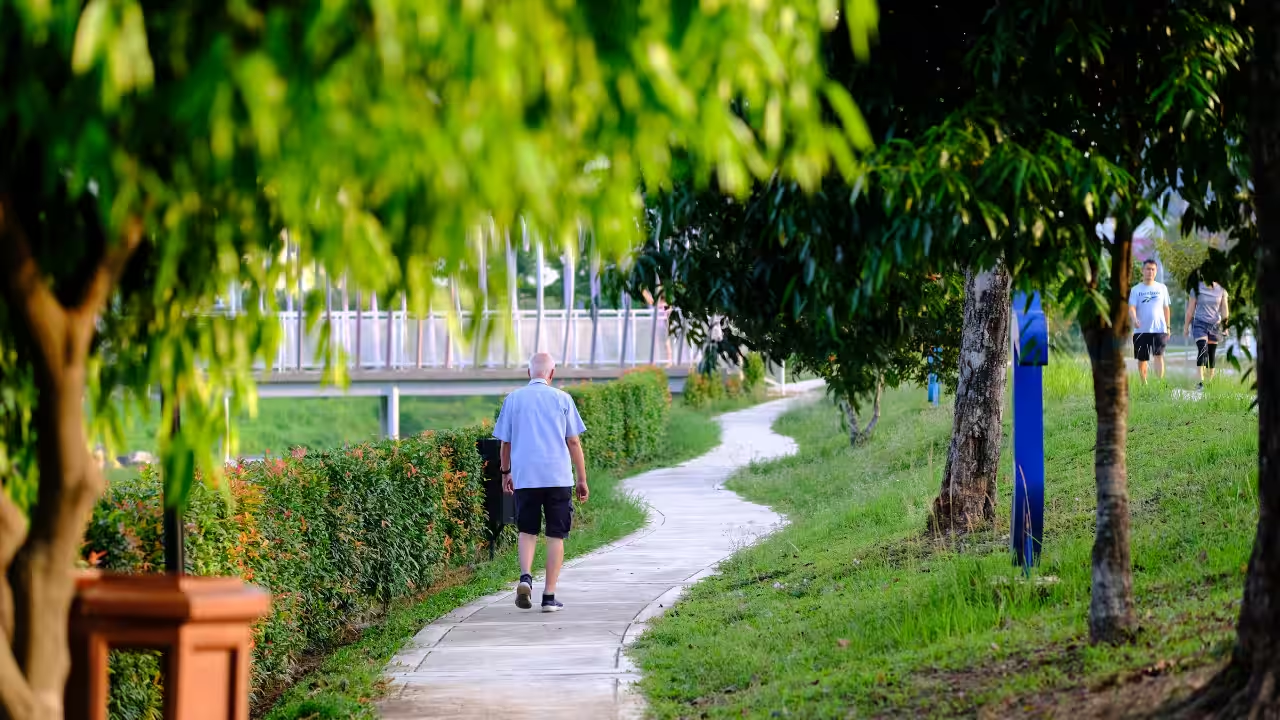
Access to nature remains uneven across England, with hundreds of communities lacking convenient routes to green or blue spaces. New analysis by The Wildlife Trusts and Liberal Democrats for Nature and Climate found that 238 parliamentary constituencies, 44% of those in England, have at least 20% of properties located more than a 15-minute walk from an accessible green or blue space. The findings come as the Wildlife Trusts calls for greater action to improve access to parks, rivers, gardens and other natural areas. These findings underscore the growing calls for policymakers to prioritise equitable green space access as a fundamental component of public health and environmental planning across England.238 English constituencies have limited access to natureThe analysis examined Defra data and applied it to Westminster constituency boundaries to assess how easily people can reach accessible green and blue spaces. The Wildlife Trusts defines low access as having at least 20% of properties more than a 15-minute walk from such a space. The results identified 238 constituencies meeting that threshold, equivalent to 44% of all English parliamentary constituencies. Some of the largest concentrations are in urban areas, with London accounting for 50 of the constituencies, followed by the South East with 42 and the North West with 28. Harrow West, Croydon West and Nottingham East were among the constituencies with the lowest levels of access according to the analysis.The figures do not mean that every resident in these constituencies lacks access to nature. Rather, they identify areas where a significant proportion of properties are beyond the 15-minute walking threshold used in the analysis.Nature access varies alongside economic deprivationThe Wildlife Trusts' analysis also found a relationship between economic deprivation and limited access to nature. Seven of England's 10 most economically deprived constituencies appeared on its list of places with low access to green or blue spaces. Bradford West, Bradford East and Birmingham Perry Barr were among the examples identified in the analysis. The organisation argues that communities facing economic deprivation can also have fewer opportunities to benefit from nearby parks, rivers and other natural areas.The issue is not restricted to large cities. The Wildlife Trusts points to constituencies such as South Norfolk and mid-Leicestershire, where some residents can live in predominantly rural areas while still having limited access to public parks, footpaths or other usable natural spaces. This illustrates the difference between living in a rural constituency and having convenient, publicly accessible nature nearby.Green and blue spaces can also provide relief during heatThe findings have emerged after a summer of extreme heat across England, when some urban areas recorded temperatures above 38C. The Wildlife Trusts says parks, trees, rivers and other nature-rich spaces can provide cooler environments during periods of high temperatures. The organisation has also gathered public experiences of accessing nature during heatwaves. Its consultation included people describing local woods and other natural spaces as places where they could find shade, cooler air and opportunities for walking.The Wildlife Trusts' head of health and education, Dom Higgins, told The Guardian access to nearby natural spaces is particularly relevant as extreme weather events become more significant for public health. The charity points to evidence linking nature-rich environments with physical and mental health benefits, while stressing that these opportunities are not distributed equally.Wildlife Trusts calls for changes to improve accessThe Wildlife Trusts has set out proposals for improving access to green and blue spaces. The organisation says the proposals are intended to support the government's existing commitment to ensuring people can reach nature within a 15-minute walk. Among its proposals are making it easier for local authorities to acquire land for parks and green spaces, helping community groups buy land, and providing longer-term funding for the maintenance of public parks and gardens. It also wants access to nature to be considered more closely in housing and development planning, including requirements for climate- and nature-friendly developments.The charity has additionally called for improved access to major rivers, particularly in urban areas, and for community-led walking and cycling routes to be easier to establish. Its earlier analysis argues that new housing should increase, rather than reduce, access to nearby green space. The research therefore highlights a geographical dimension to access to nature: proximity alone does not guarantee that people can easily reach or use natural spaces. The Wildlife Trusts is now urging policymakers to use the data alongside local knowledge and public experiences when considering how England's parks, waterways and other green spaces should be planned and maintained.Catch the latest World News and Live updates. Download the TOI app.
Topics in this story
Gathered from external sources. Rights to this text belong to whoever originally published it.