In 1982, Chile imported European bumblebees to pollinate crops; the invaders crossed into Argentina, spread through Patagonia, and pushed its only native bumblebee toward regional extinction
US News: In 1982, Chile introduced European bumblebees for crop pollination, leading to ecological disruption and the decline of the native bombus dahlbomii in Patagonia. This article explores the consequences of this invasion and the urgent need for conservation efforts.
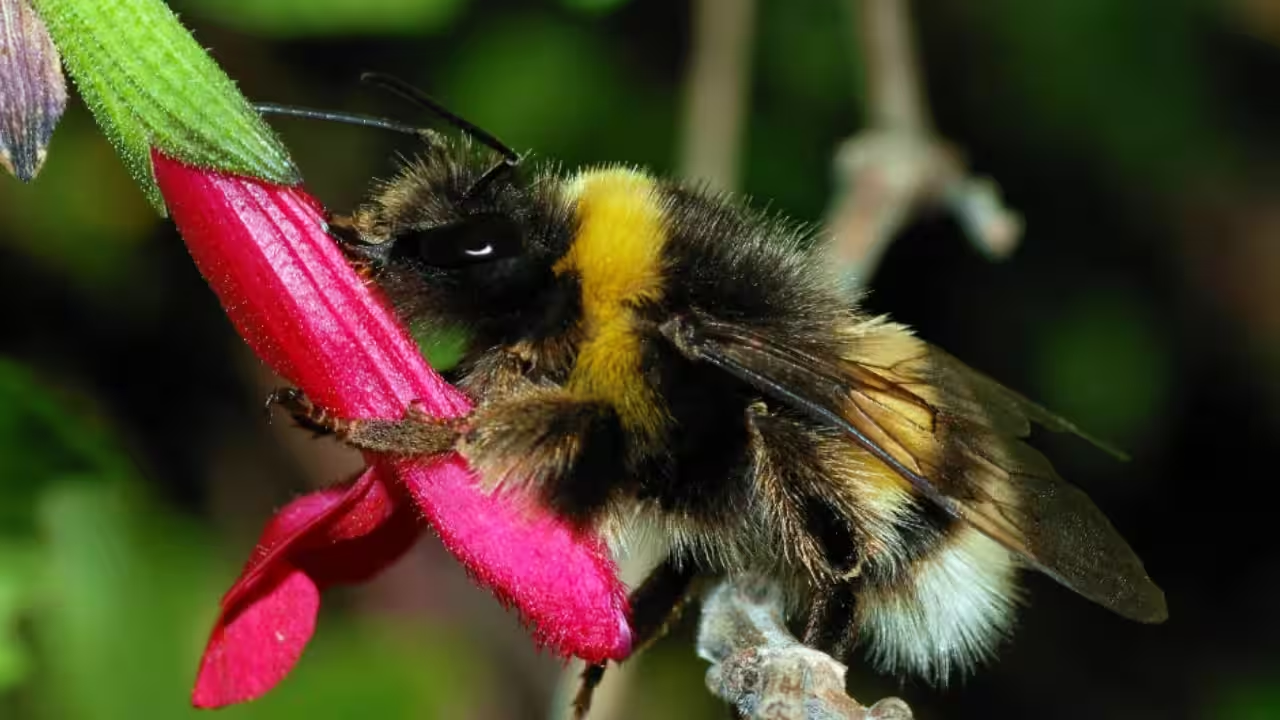
What began as a farming fix in central Chile has, over four decades, reshaped pollinator communities across southern South America. Approximately 300 queens of Bombus ruderatus were introduced into central Chile in 1982-1983 from the New Zealand population to increase the yield of red clover seeds. This farming choice led to ecological alterations that are now putting the Bombus dahlbomii at risk of regional extinction. Bombus dahlbomii is the sole bumblebee species native to the area and is one of the biggest bumblebees in the Americas.A second invader spread faster than expectedRed clover depends heavily on long-tongued pollinators, and honey bees have proved inefficient at the task. The species Bombus ruderatus was used because it had already proved successful in New Zealand's red clover fields. The scheme worked: freed from the natural enemies that had limited their numbers in Europe, the bees spread on their own and reached Patagonia, Argentina, by the early 1990s. It would take another fifteen years for Chile's greenhouse tomato industry to introduce a second European species, Bombus terrestris, which itself would take nearly another decade to disperse across the Andes and reach Patagonia.An alien parasite arrived with the invasive bees Carolina Morales, Marina Arbetman, Sydney Cameron and Marcelo Aizen documented the first records of Bombus terrestris in Patagonia, Argentina, in March 2006, after it dispersed over the Andes from Chilean greenhouses, in their 2013 article in Frontiers in Ecology and the Environment, "Rapid Ecological Replacement of a Native Bumblebee by Invasive Species." Their wide survey of Patagonia found that within less than five years of its introduction, B. terrestris had become the most widespread and abundant bumblebee species in the region.Some interesting statistics can be highlighted from this evidence. During the duration of the research, B. ruderatus extended its geographical distribution up to 434 kilometers, while B. terrestris extended up to 1,320 kilometers. This southern extension of its distribution was accompanied by a retreat of B. dahlbomii. In another 20-year study of pollinators visiting the native flower Alstroemeria aurea in northern Patagonia, Aizen and colleagues found that the two exotic species had replaced the native pollinator B. dahlbomii, which had pollinated the flower for generations.The native bumblebee has vanished from parts of its rangeRange expansion alone does not fully explain how quickly the native bee vanished from so many locations. A second line of research points to disease as a compounding factor. The study ‘Alien parasite hitchhikes to Patagonia on invasive bumblebee’ (Arbetman et al., 2013), published in Biological Invasions, tested bumblebees collected before and after the arrival of B. terrestris for the pathogenic protozoan Apicystis bombi.In the absence of the invasion, not a single specimen of B. ruderatus or B. dahlbomii was infected by the parasite. Following the establishment of B. terrestris in the area, the situation drastically altered. Nearly one in two B. terrestris specimens tested positive for the parasite, as did just over one in two B. ruderatus specimens and about one in nine B. dahlbomii specimens. The genetic analysis revealed that the parasite belonged to the European lineage, which means that the parasite had most probably been brought in alongside the commercial bees. As noted in the study discussed above, this was the first recorded instance of Apicystis bombi infecting B. ruderatus or B. dahlbomii in the whole world.Researchers are testing acoustic monitoring to track survivors This combination of factors that are competition, the accelerated colony turnover rate of the invader and spillover pathogens has been very costly. Species B. dahlbomii has gone extinct in certain areas it used to inhabit, such as some portions of the Challhuaco Valley that scientists had been monitoring for decades. According to the information provided by the IUCN species account, this bee has not been classified in terms of its inclusion in the IUCN Red List yet. This example demonstrates the necessity of implementing regulations concerning non-indigenous pollinators. The article by Morales et al. states quite directly what this particular case study implies for future actions in other places: given how rapidly an invasive bumble bee displaces its native congener, introducing non-indigenous pollinators in areas inhabited by endangered bee species should be done much more carefully than was done in Chile in 1982.Catch the latest World News and Live updates. Download the TOI app.
Topics in this story
Gathered from external sources. Rights to this text belong to whoever originally published it.